3 months ago
17
3 months ago
17
It’s a warm Thursday morning in inner Sydney. In the back of an Uber between meetings about reviving the short film festival Tropfest, founder John Polson is doing what he does best: telling an entertaining story.
The Australian actor turned director normally tells stories on screen for a living, having made four films, episodes of such American TV series as The Mentalist, Elementary and The Walking Dead and, earlier this year, the Australian streaming drama The Last Anniversary. But on the way to inspect a venue for two days of workshops for emerging filmmakers, Polson is talking about how he once had to reject a film made by his own brother, Tony, for Tropfest.
“When it comes to the selection, I’m pretty cut-throat,” he says. “I hesitate to say this but I’ll just say it: it may have been the worst film that has ever been made for Tropfest. I love my brother but it was just so profoundly wrong on so many levels.
“First of all, even if it was The Godfather, dude, you’re the brother of the festival director. There was no good outcome. But the fact is you made an iconically bad film to the point where all the copies ended up being destroyed.”
It’s a long and funny story that concludes with Tony, a talented guitarist and part-time sound engineer, turning up with a copy of his iconically bad film, which he is convinced is a masterpiece, as Tropfest is being set up in Sydney’s Domain and the crowd is arriving with picnic baskets and blankets.
“He goes, ‘Mate, mate’ – and he’s holding up this [VHS] – ‘Come on mate, just put it on,’ ” Polson says. “He’s brought, like, 21 friends with him and he said, ‘John will put this on.’ ”
Pause.
“It was a tough Tropfest for the Polsons,” he says.
Like thousands of budding filmmakers since the festival emerged from Polson screening a short film he’d made at the Tropicana Caffe in Sydney’s Darlinghurst in 1993, poor Tony felt the sting of rejection. But for many others, the self-described world’s largest short film festival played a major role in launching their film and TV careers as it expanded from the cafe to the street outside to live events attracting tens of thousands of fans in Rushcutters Bay Park, the Domain, Centennial Park and Parramatta Park.
It was a fun “thongs on the red carpet” night on the summer calendar with a relaxed, democratic charm – open to anyone to enter and free to watch. There were always celebrity judges – among them Keanu Reeves, Salma Hayek, Nicole Kidman, Russell Crowe and Cate Blanchett – and the winner was often made by an unknown for virtually nothing. “Budgets don’t matter,” Polson would say. “Idea is king.”
There were smaller satellite events at different times in New York (where Australia’s Jason van Genderen won with a masterful short that cost $57), London, Berlin, Abu Dhabi and elsewhere. A Trop Jr competition drew in young filmmakers.
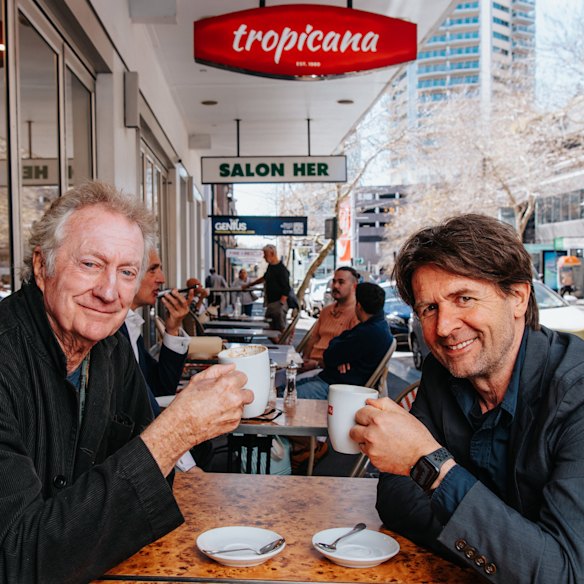
Bryan Brown and John Polson at the Tropicana Caffe in Darlinghurst. Credit: James Brickwood.
Tropfest came through two financial crises. The first – little-known at the time – was when the Sydney 2000 Olympics drained sponsorship to the point where Polson, who had just moved to New York, had to write letters to five people he knew to ask if they could help. The festival went ahead with financial support from Kidman and Tom Cruise, Crowe, and Lachlan and Sarah Murdoch.
In 2015, Tropfest fell over when Polson’s then friend and business partner Michael Laverty, whose company had been licensed to run it for six years, emailed, “I am afraid I messed up” – admitting to an accounting error that resulted in a loss of $180,000. A devastated Polson cancelled the festival and, returning from New York, discovered the loss was actually $500,000 for an event costing at least $1.1 million to stage. It was only when an angel sponsor emerged, CGU Insurance, that Tropfest returned two months later.
Polson has never heard from Laverty since. “I don’t have any ill will towards him,” he says. “But I think it’s not awesome what he did.”
When COVID-19 forced festivals of every kind to be shut down, it seemed like Tropfest had died for good this time. Another great live event killed by the pandemic. Six years later, Tropfest is returning with Polson, who turned 60 recently, teaming up with a heavy-hitting alliance from the business, sport and entertainment worlds – Sarah Murdoch, Peter V’landys, Richard Weinberg and Bryan Brown.
V’landys, the boss of Racing NSW and the Australian Rugby League Commission, calls Polson “the best can-do man I’ve ever seen”. That’s high praise from the sporting innovator/human bulldozer behind the $20 million The Everest horse race and many of the ideas that have the National Rugby League thriving. But “can-do man” seems fitting.
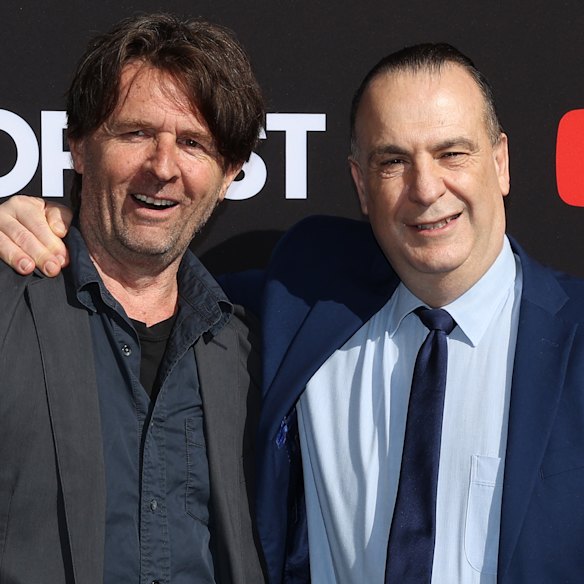
Polson with fellow board member Peter V’landys.Credit: WireImage
Leaving school at 15 after what he calls a “train-wreck” childhood, Polson forged a successful career without going to acting school, rejected by NIDA twice. He played Hamlet in the first production of the Bell Shakespeare Company in 1991 and shone in the miniseries Vietnam and Barlow and Chambers: A Long Way From Home, and the films The Sum of Us, The Boys, Mission: Impossible II and The Dry.
Despite also being rejected for film school, Polson has directed the films Siam Sunset, Swimfan, Hide and Seek and Tenderness, as well as scores of hours of American TV. Driving Tropfest through its ups and downs, he has become one of the best-connected figures in Australian entertainment while living in New York with his wife, former casting director and now yoga studio owner and teacher Amanda Harding, and daughters Harper, 16, and Marlowe, 14. He also has a home upstate and flies his own plane, a single-engine Cirrus SR22, to work around the US and Canada.
So how did Polson become such a “can-do man”? How has Tropfest returned from the dead – and, after a six-year-break, can it succeed again?
A single mother – a brilliant jazz pianist – with mental health, drug and alcohol problems who had four kids under the age of five when their father left their Sydney home. Then years living rent-free in a series of homes that were due to be demolished in Wellington, New Zealand, courtesy of her five brothers in the construction business.
After their mother took up with a heroin-addicted drummer and started using, too, she lost custody of the kids and went away for treatment. Polson was 12 when their dad – a jazz singer turned insurance salesman who had remarried – took them with his own two children rather than having them fostered.
“It’s quite a movie,” Polson says of his upbringing.
‘I was literally like, “What’s an audition?” I hadn’t even done a school play.’
John PolsonIn what he jokingly calls “the one working-class family” in Cammeray on Sydney’s lower north shore, Polson was smart enough to get into a selective school, learning the saxophone and piano but playing the class clown rather than paying attention. He was discouraged from staying at one school then expelled from another at 15 for being disruptive.
Polson knew he had to find a job before his dad, Ron, returned from an overseas work trip. Wanting to become a car mechanic, he approached a local petrol station.
“They said, ‘We’re not looking for anyone,’ ” he says. “I said, ‘Listen, you don’t have to pay me but I’ve been kicked out of school,’ so it was an early sign of entrepreneurship. They said, ‘OK,’ so I bought the Caltex uniform for 120 bucks – I don’t know where I got that money – and I enrolled in night school for the basic School Certificate.” Polson told his dad about the job and the studies but didn’t mention he wasn’t getting paid.
A phone call out of the blue when he was 17 changed his life. A family friend who had started a talent agency, Robyn Gardiner, had seen him doing a Billy Joel impression on piano at their house and said they needed a teenage boy for an audition. “I was literally like, ‘What’s an audition?’ ” he says. “I hadn’t even done a school play.”
After a pep talk, Polson won his first role – playing a 17-year-old boy whose mum had a drug problem, had been kicked out of school and wanted to be a car mechanic – in a play, Busted. “It was basically me,” he says. “It was for Sidetrack Theatre, which was ‘theatre in education’. The funniest part was we ended up going to schools that I’d been kicked out of and my classmates were still there.”
Polson fell in with the Carides sisters – well-known actors Zoe and Gia and non-acting Dani – whose mum had just left their dad (“I felt like I found my people,” he says), and started funnelling his restless energy into acting. When he won a small role in the 1986 film For Love Alone, Polson was inspired by the company of Sam Neill, Hugo Weaving and Hugh Keays-Byrne. “It was sort of a community,” he says. “I suddenly felt like all these people get me, and I get them.”
After “some physical abuse, not sexual, just beatings” growing up in his mother’s house, and with friends who ended up in jail or dead from drugs or motorcycle accidents, he reckons “the acting world saved me”.
During months when he had no work – “I got quite depressed or anxious, like, ‘What am I doing with my life?’ ” – Polson realised he didn’t like waiting around to be hired so he started making what he calls “pretty woeful” short films.
One was a Cops-style mockumentary about food delivery drivers, which he shot with a $2000 video camera bought with a sympathetic friend’s credit card from a shop with a seven-day return policy that was then taken back for a refund. To get it seen, Polson borrowed a TV and a U-matic video player, set it up in the Tropicana and was shocked when the screening that night was packed with cast, crew, friends and curious customers. That evolved into Tropfest.
Another break for Polson was bonding with Tom Cruise over their shared interest in flying while he played a knockabout helicopter pilot in Mission: Impossible II in Sydney. The Hollywood star loved Polson’s 1999 film Siam Sunset and, when the M:I II production moved to Los Angeles, he set up screenings that led to Polson getting an American agent then, while casting Swimfan, falling in love with Harding and moving to New York.
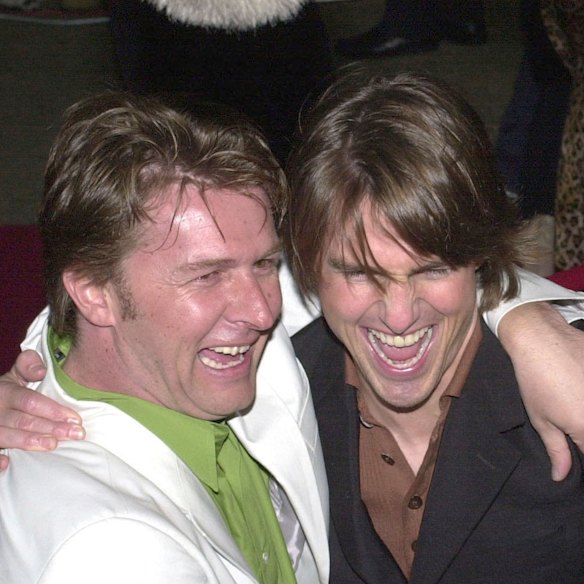
Polson and Tom Cruise at a premiere of Mission: Impossible II in 2000. They bonded over a shared interest in flying.Credit: Getty Images
Polson says there was a light-bulb moment watching a documentary randomly on a flight five years ago: he realised he had ADHD. “No one wants the stigma of any diagnosis but ADHD is a bit of a superpower,” he says. “It’s handicapped me in many ways, including school, but probably some of the great things that have happened to me might not have happened without it.”
He now meditates, keeps active with walking, cycling and yoga, and has therapy on and off, trying not to pass issues from his childhood on to his kids. Prolific producer Bruna Papandrea (Big Little Lies, The Last Anniversary), a friend since she was a 19-year-old barista in Melbourne and he was touring in Hamlet, thinks Polson’s drive comes from growing up with very little. “You’re not afraid of losing things, so you’re never afraid to take risks,” she says. “He’s a great entrepreneur and he f---ing works harder than anyone I’ve ever met.”
Kidman, who funded best actor and actress awards at the festival for many years, calls Polson “a leader of heart” and says she has loved seeing him emerge as a director, father and at Tropfest since they acted in Vietnam together in 1987. He will direct her for the first time next year in the second season of the Prime series Scarpetta, which she is producing as well as starring in as forensic investigator Kay Scarpetta.
While not everyone has been enamoured of Polson’s knockabout confidence and powerful friendships over the years, what he achieved with Tropfest before it vanished was remarkable. Gregor Jordan, who was unknown when he won with Swinger in 1995, was able to make the classic Australian film Two Hands four years later. Brothers Clayton and Shane Jacobson, who were just as unknown when Tickler won the Tropicana prize in 2001, had a hit with Kenny five years later. Sam Worthington and Rebel Wilson were both little known when they won acting prizes in 2001 and 2009 respectively.
“We were all at the beginning of our careers,” says Robert Connolly, who was second with Rust Bucket in 1997 and went on to a producing and directing career that has included The Boys, The Slap, Paper Planes and The Dry. “We were trying to work it out, we were collaborating, we were playful, we were adventurous and Tropfest was such a big part of that.”
But it wasn’t just about opening doors for many formative talents, including Nash and Joel Edgerton, Emma Freeman, Alethea Jones, Paul Fenech, Damon Herriman, Daina Reid, Patrick Hughes, Abe Forsythe and Patrick Brammall. Justin Kurzel was a theatre designer who had just been turned down for film school when he went to Tropfest in 1997, watching Nash Edgerton win with Deadline amid a party atmosphere in a packed Victoria Street. “It was quite inspiring just seeing how alive and energetic the festival was and how receptive people were to seeing shorts,” he says. “That night suddenly made me really think, ‘God, it would be great to do a film.’ ”
Before then, Kurzel says that making even a short felt impossibly far away. After placing second at Tropfest with Meeting Misty Rain two years later, he made shorts and music videos until he was able to launch a directing career that has included Snowtown, Nitram and The Narrow Road to the Deep North. “It gave me the confidence,” he says. “Eighty per cent of the battle when you’re a filmmaker is trying to believe in yourself and have the confidence to keep going.”
Sarah Murdoch sounds surprised that she is chairing the new non-profit Tropfest Foundation, which will run both the big event on February 22 next year and a year-round program for emerging filmmakers. Its board includes Polson as festival director, V’landys, Terrace Tower Group chief executive Richard Weinberg and actor-producer Bryan Brown.
“I have no film experience,” Murdoch, the former executive producer of Australia’s Next Top Model and wife of Fox Corporation-News Corp boss Lachlan Murdoch, says. “So I was saying to them, ‘I don’t have to be involved in any formal capacity. I’m happy to be here and support you and do whatever I can do to help’ … but Peter is one of those people who says, ‘You can do it. I want you to do it.’ So we’ve started relaunching Tropfest essentially from scratch.”
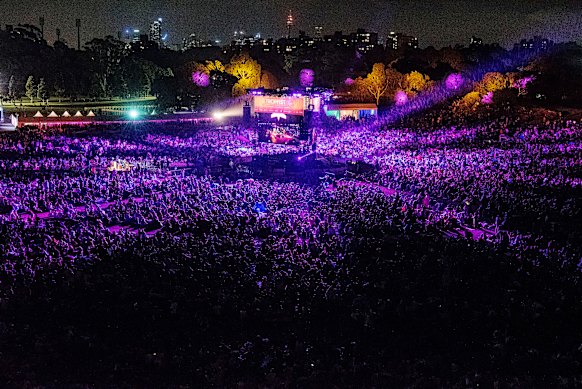
Tens of thousands at Tropfest at Centennial Park in 2016. Two months earlier, a financial crisis had scuppered the festival before it was bailed out.Credit: Courtesy of Tropfest
That relaunch has involved some of the country’s most influential identities – a mix of longtime friends and strangers – meshing their talents and connections for a good cause. V’landys became involved after learning from a young filmmaker that there was no real pathway into the industry after university. “We decided we were going to do our own short film festival – then we met John and realised you don’t need to go from the start,” he says. “Tropfest was the festival.”
Early on, V’landys sounded out Brown, a mate since the then head of the NSW Harness Racing Club hosted a Sydney City Mission fundraiser at Harold Park racecourse, about the new festival. The veteran actor has been going to Tropfest since the Tropicana days. “I said, ‘Listen, why don’t we see if Tropfest can’t start up again?’ ” Brown says. ” ‘Let me get on to Polson’ … John was like, ‘Yeah, let’s do it.’ His main thing was, ‘Who am I getting in bed with?’ He knew Sarah well but didn’t know anything about Peter.”
A Zoom call established that everyone wanted the same thing – what Polson describes as a free festival with the same DNA as the old Tropfest plus a year-round focus on “discovering and fast-tracking Australian screen talent”. Says V’landys: “The common cause is to give young Australian talent an opportunity.”
Loading
Murdoch, who knew V’landys from rugby league and Polson from her time living in New York, says planning moved quickly. “I said to the group, ‘Get a bunch of people together who are doers and it’ll get done,’ ”
she says. “We were in sponsorship meetings within a couple of weeks. I’ve never sat in meetings where there’s been [such a strong] response from everyone, usually because there was one person in the room that went to Tropfest. There’s just so much love for it and people really missed it.”
The sponsors they recruited include the Commonwealth Bank, YouTube, which will host a global live screening on the night, Qantas, Nine Entertainment (publisher of Good Weekend), the NSW Government and Greater Sydney Parklands. Entries opened on December 1, with this year’s signature item an “hourglass” (a mandatory inclusion in all entries to ensure films are made specifically for Tropfest). Margot Robbie will be the jury president and prizes include a handsome $50,000 for the winner, $30,000 for second and $20,000 for third.
Brown thinks that Tropfest will be even more important, given all the changes in film and TV in its absence: “I, for one, am thoroughly interested in what the young generation of filmmakers want to say to us in their films,” he says.
Bruna Papandrea believes there’s a huge appetite for the festival’s return, given how the potential career paths for aspiring filmmakers have transformed. Beyond the traditional dream of shifting from short to full-length feature, there are now creative options in episodic and long-form television, YouTube content, commercials and the new generation of “vertical video” dramas designed to be watched on phones.
Kidman, also noting “a massive uptick in short-form content”, believes the festival will be a wonderful opportunity for emerging talent again. “But it needs to be discovered, new voices need to be found, which is what Tropfest allows,” she says.
Kurzel thinks Tropfest will succeed. “People are desperate for live events,” he says. “I’m hoping they’ll get a lot of entries. Everyone loves being out at night and watching these stories that are made specifically for this festival.”
Polson, who is confident that at least 60,000 people will watch the films in Centennial Park, has been surprised by the enthusiasm for Tropfest’s return. “It’s that thing,” he says. “If you lose something, you realise how valuable it was.”
Get the best of Good Weekend delivered to your inbox every Saturday morning. Sign up for our newsletter.
To read more from Good Weekend magazine, visit our page at The Sydney Morning Herald,The Age and Brisbane Times.