 1 hour ago
2
1 hour ago
2
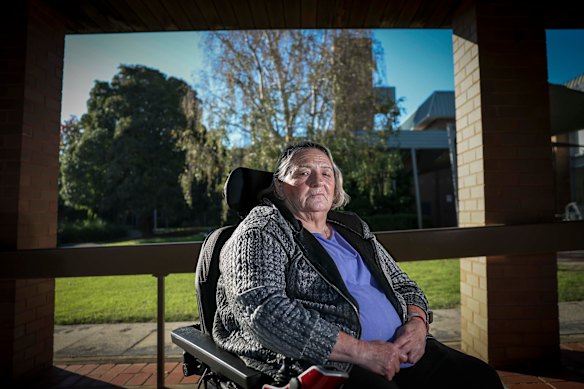
Vicki Kelly is supposed to be lazing on a cruise ship’s sunny top deck, drinking something pink with a little umbrella.
“I thought, this is my time,” says the 69-year-old. “I just wanted to do some things for me. Everything has always been about everybody else.”
Instead, the Victorian mother of three has spent 17 months in hospital, paralysed from the waist down after a tiny, expensive pump, implanted to treat back pain, led to a blood clot that blocked a spinal cord artery.
“[My doctor] told me it’s catastrophic. They have never heard of it before,” she says. “I can’t get up. I can’t walk, I can’t get myself out of bed. It’s a nightmare. No one is telling me exactly what happened, what caused it. They are saying it is one in a million, and I don’t believe that. Is this going to affect someone else? Is the pump going to play up again?”
Kelly’s experience is far from isolated: more than 150,000 incidents involving medical devices require hospitalisation every year, according to data from federal government agency the Australian Institute of Health and Welfare.
The Therapeutic Goods Administration, Australia’s medical devices watchdog, refuses to say how many reports it receives of injuries or deaths linked to devices each year.
To retrieve the data, an investigation by this masthead and 60 Minutes used digital scrapers to extract more than 81,000 government logs of medical device side effects, along with recalls and hazard alerts; interviewed more than 70 patients, doctors, researchers, TGA staff and industry consultants; reviewed court cases and coronial inquests; and obtained internal regulator documents.
The data analysis reveals a steady increase in deaths, injuries and adverse event reports.
The investigation also discovered major flaws in this database, with dozens of deaths before October 2019 unlogged. Following questions from this masthead, the TGA published a warning about a “technical issue” with the database.
The investigation also reveals a system in which the regulator thoroughly scrutinises only a tiny fraction of the thousands of new devices approved every year. The TGA conducted detailed conformity assessments on just 4.3 per cent of the 55,223 devices it had approved for use since 2016. In that decade, it rejected just 830.
In Australia, medical devices can be approved without any human testing. More than 85 per cent of Australian medical devices are approved based on European certification, awarded by dozens of for-profit notified bodies, not a regulator.
“It’s a race to the bottom,” a TGA source, not authorised to speak publicly, said of the use of notified bodies. “You can shop around for the one that will get you through.”
Historically, these companies have been much quicker to register products, and the devices are 2.9 times more likely to be recalled or have a safety alert, than those approved by the US regulator, a 2016 study in medical journal BMJ found.
And when devices start harming people, the TGA struggles to spot the problem because it relies on ageing technology and has, at times, been understaffed, documents released under freedom-of-information laws reveal.
“The regulatory regime has traditionally been a lot more sloppy than it has for drugs,” said Wendy Bonython, an associate professor at Bond University who has studied medical device regulation. “There is a long, long history of faulty medical devices tending to slip through the cracks.”
The situation has made TGA staff uneasy. Screenshots from an online staff briefing in November, obtained by this masthead, show employees raising concerns about industry influence, device non-compliance and the regulator’s role.
“We are biased by serving industry rather than the general public, our most important stakeholder,” one TGA employee wrote.
Another asked: “Are we functioning as regulators, or have we turned a blind eye to our responsibility in evaluating, assessing and monitoring therapeutic goods?”
The pump’s weakest link
Vicki Kelly’s Medtronic SynchroMed II pain pump was installed in 2007 to treat her chronic back pain.
She was unaware until recently that it had been the subject of seven Class I hazard alerts since 2013 – the TGA’s most serious alert, where there is a “reasonable possibility of serious injury or death” – for over- and under-infusion problems, electrical shorts and pump failures.
Nor was she aware Medtronic had signed a consent decree with US regulators banning it in 2015 from selling the pumps due to years of quality standard violations. (After design changes, the ban was lifted in 2017).
“They don’t work and are inherently dangerous,” said Dr Chris Hayes, director of the Hunter Integrated Pain Service in Newcastle and vice dean of Australia’s Faculty of Pain Medicine.
In a 2012 study of his practice’s experience with pain pumps, Hayes found seven of 25 patients suffered urgent complications including pump failures, the pump leaking into patients causing a “life-threatening overdose”. Three had severe infections requiring surgery to remove the pump, and spinal cord compression that put the patient in a wheelchair.
Kelly says she was told her injury was one in a million. But while other experts told this masthead her specific injury was extremely rare, spinal cord injuries are a known complication of the SynchroMed pump – a risk she says she was never warned of.
“No one said anything,” she said. “Just that the Medtronic pump would really help with the pain.”
Kelly’s doctor, who agreed to an interview under the condition he was not identified, noted her catheter appeared to have migrated from the rear to the front of her spine. “I don’t know how frequently this happens. I have never heard of it before,” he said.
Evidence suggests the catheter, which feeds opioids from the pump into the spinal cord, is the device’s weak point. Dislodgements, breaks and kinks are the most common complications.
Catheters dislodged for 3 per cent of patients in a Medtronic-sponsored study. About 10 per cent of patients who took part in that study experienced complications, and 20 per cent in others.
US device safety reports include three patients who suffered bleeding on their spinal cord: two reported nerve deficits or paralysis, and the third patient died.
Medtronic recalled the pumps in 2008 after it was discovered the catheters could cause inflammatory masses to develop on the spinal cord (Kelly’s doctor said this was not the cause of her injury).
“Another disaster that pain medicine needs to own,” said Professor Chris Maher, director of the Institute for Musculoskeletal Health at the University of Sydney. “Someone needs to hold those guys accountable for what they are doing here.”
In a statement, Medtronic said that “publicly available data demonstrates that the incidence of paralysis associated with the SynchroMed™ system is extremely rare, and we believe the benefits of this technology outweigh its risks.
“We understand that any report involving a negative patient experience can be deeply concerning, and our thoughts are with the individual and their family. Patient safety is our highest priority, and we take all adverse event reports seriously.”
A lack of evidence of efficacy – or safety
Australia is awash in medical devices: there are about 1.4 million registered with the TGA, versus about 40,000 drugs. That number is growing.
“There’s too many devices to deal with,” said a former TGA medical devices auditor, speaking anonymously for fear of retribution. “You basically say, ‘We cannot cope.’”
In Australia, the approval of a drug or vaccine typically requires a large, expensive clinical trial lasting several years to prove it works and is safe.
Pfizer had to show its COVID vaccine had beaten a placebo in a published study of 43,548 people before the vaccine was approved. Alzheimer’s drug lecanemab was initially rejected for registration because human trials did not show a strong signal for effectiveness.
The TGA says the same rules apply to medical devices: every approved device in Australia has clinical evidence showing it is safe and works.
But clinical evidence does not always mean a clinical trial – or even tests on humans.
In some cases, the regulator allows manufacturers to claim their devices are “substantially equivalent” to others already on the market – allowing the new devices to avoid a clinical trial altogether.
“They are basically grandfathered off the previous model,” said Bonython. “Previous situations where devices have gone horribly wrong would suggest it is not a good idea.”
This is the pathway pelvic mesh took to the Australian market. Its use became one of Australia’s biggest medical scandals when women started to come forward with experiences of devastating complications including chronic pain, organ perforations and persistent infections.
When the scandal became a $300 million class action, Federal Court judge Anna Katzmann registered her surprise at the major differences between drug approval and device approval.
“The regulatory process for taking a device to market does not ensure that the product is safe and efficacious for use in humans,” she wrote in her judgment.
With so many devices on the market, the TGA can only scrutinise a portion.
“It’s a scary number, the number of medical devices,” said Dr Jorge Enrique Garcia, former principal scientific adviser to the regulator’s medical devices branch. “It’s unrealistic to assess every product that comes in.
“A clinical trial of a medicine is easy. You give 500 people the medicine and the other 500 a sugar-coated pill. You can’t do that with a medical device.”
The TGA allows manufacturers to self-assess low-risk devices for safety and quality. Many applications have been assessed by computers, not humans. “The system more or less accepts applications for low-risk assessments automatically,” Garcia said.
During investigations, the regulator has sometimes found these self-assessments to be too thin.
In the early months of 2020, the TGA approved more than 2000 new face masks and respirators. After this masthead revealed quality problems, it reviewed them – and cancelled 88 per cent of the registrations.
In Europe, device testing and certification is handled by dozens of private for-profit companies, which receive fees from the manufacturers they certify.
“If you have the CE mark [European approval], it gives you an automatic way in without independent oversight,” said Associate Professor Marco Rizzi, an expert in therapeutic goods regulation at the University of Western Australia. “That was the main issue with pelvic mesh.”
Said Garcia: “Notified bodies are commercial bodies. They are not regulatory agencies. They provide certificates for money.” While notified bodies “by and large do a very thorough job”, he said, certain ones were known by the TGA to be less trustworthy. “We sometimes take a second look.”
Once a device wins approval, a new issue emerges. In some cases, companies are allowed to continually add similar new medical devices using the same initial approval – without additional TGA testing.
“If you’re in my role in the industry, and you’re clever, you submit your [registration] with a broad intended purpose,” said a medical device consultant, speaking anonymously to protect commercially sensitive relationships. “You can have a product right now, registered, and in a year or two’s time, you can have another product. And you can count that as included without doing much paperwork.”
A spokesman for the Medical Technology Association of Australia, which represents manufacturers, said it was inappropriate to compare recalls for medicines and for medical devices “because they operate in fundamentally different regulatory and clinical contexts”.
It was unethical to conduct placebo-controlled clinical trials for medical devices such as pacemakers, the spokesman said.
“It is not appropriate or necessary for patient safety for every device to require a full clinical trial.”
But scientists do conduct true placebo-controlled studies of medical devices. They have revealed pacemakers and spinal cord stimulators are far less effective than previously thought.
‘A complete mess’
Vicki Kelly’s SynchroMed II was approved in Australia on the basis of European approval in 2003.
According to the US regulator, the pump’s design has been updated hundreds of times since it was approved.
These updates can be improvements - but they can also change devices so thoroughly they can be quite different to what was originally approved. The more times an approved device is updated, the higher the risk of something going wrong, a study published in JAMA in 2023 found.
Because Australian approval for the pump was based on European certification, Medtronic had no obligation to inform the local regulator about these updates.
Once a device is approved, it creates an incentive for manufacturers to avoid clinical trials, as they could show the device does not work well, an internal TGA source said, speaking on condition of anonymity.
Toronto’s health quality agency tried to review the evidence for the SynchroMed as a treatment for chronic pain 13 years after the device was approved. It found just two clinical studies, and concluded there wasn’t enough evidence to know if the pumps worked any better than painkillers.
The rate of serious adverse events requiring surgery ranged from 10 to 33 per cent.
England’s health service stopped funding the pumps in 2015 due to a lack of evidence they worked.
As evidence for the pump’s effectiveness and safety, Medtronic pointed to a registry study of 4646 patients that found a serious adverse event rate of 8.9 per cent, and a study that found the pumps had led to a significant drop in opioid usage. Neither study compared the pump to alternatives, and Medtronic funded both.
Australia’s Faculty of Pain Medicine released a statement in 2023 advising members there was no reason to think the pain pumps were any better than oral painkillers.
“They are probably the riskiest pain management technique that is still in use,” said Associate Professor Michael Vagg, the faculty’s director of professional affairs.
In 2024, Medtronic introduced its new SynchroMed III, “redesigned for peace of mind” and “enhanced for reliability”.
There are no published clinical trials of the new device either. A Medtronic spokesman confirmed it was approved in Australia “based on SynchroMed II”.
Said Professor Maher from the University of Sydney: “I find it extraordinary that you can implant a device like this into someone’s body, on the back of zero credible evidence.
“It does seem a complete mess. I think the public would be horrified to learn of this.”
In response to questions, the TGA said that “all medical devices included in the Australian Register of Therapeutic Goods must meet regulatory requirements for safety and performance. This is demonstrated through appropriate evidence. Regardless of pathway, no device is approved for supply in Australia unless it meets these requirements.”
The Medical Technology Association of Australia said the country “has one of the most robust and respected medical technology regulatory systems in the world, overseen by a highly rigorous and internationally respected regulator in the TGA”.
The TGA pointed to data showing it had audited 1334 of the 5177 devices it approved in 2023-2024.
Audits typically only look at a device’s documentation. Conformity assessments can involve inspecting the device, and the Australian regulator conducted only 179 such assessments in 2024.
A regulator overwhelmed
In theory, the TGA’s post-market surveillance should catch problems its pre-market registration process misses.
But the government itself last year concluded the system “remains insufficient for identifying and mitigating longer-term device failures” such as vaginal mesh.
Hospitals and device sponsors are meant to report any adverse events to the regulator. A study published by TGA staff in 2019 estimated 99.5 per cent of events were unreported (the TGA says that number has now improved, with four times as many reports being submitted).
Vicki Kelly’s doctor never reported her paralysis to the TGA. “I never even thought about it, to be honest,” the doctor said. “No one had ever seen anything like this before.”
When sponsors get a report of a potential adverse event, they have wide latitude to decide whether it needs to be handed to the Australian regulator.
If they think the adverse event is unlikely to cause death or serious injury, it does not need to be reported; nor do side effects listed in the device’s documentation. In 2020, the TGA proposed scrapping those exemptions. Following industry opposition, that proposal remains unimplemented.
An investigation by Private Healthcare Australia into spinal cord stimulator manufacturers found some had submitted far fewer adverse event reports than others, despite their devices having similar complication rates.
When the TGA eventually requested full adverse event data from the manufacturers following the investigation, it revealed many sponsors had been “relying on or interpreting the medical device adverse event exemption rules to exclude many adverse events”.
Medtronic said it “complies with all relevant TGA requirements for adverse event reporting. Furthermore, we pride ourselves on our ethical operations and are confident in our rigorous post-market surveillance measures and reporting practices.”
The Neuromodulation Society of Australia and New Zealand in a statement said Kelly’s case could not be blamed on her pump implant and instead pointed to the possibility “spontaneous” paralysis. The society also strongly defended the TGA-overseen system for device regulation.
In her hospital room, Vicki Kelly has been left to deal with the consequences of the system. Each morning her pump alarm goes off, a reminder of the device that changed her life and is still inside her body.
“People need to know how these pumps can affect your life,” she said. “I don’t want anyone else to go through what I am going through.
“No one has offered me anything. I think, ‘Can I be fixed?’ I don’t know. And I don’t want to be here.”
For more, watch 60 Minutes on Channel Nine at 8.30pm on Sunday.
The Examine newsletter explains and analyses science with a rigorous focus on the evidence. Sign up to get it each week.