 1 hour ago
2
1 hour ago
2
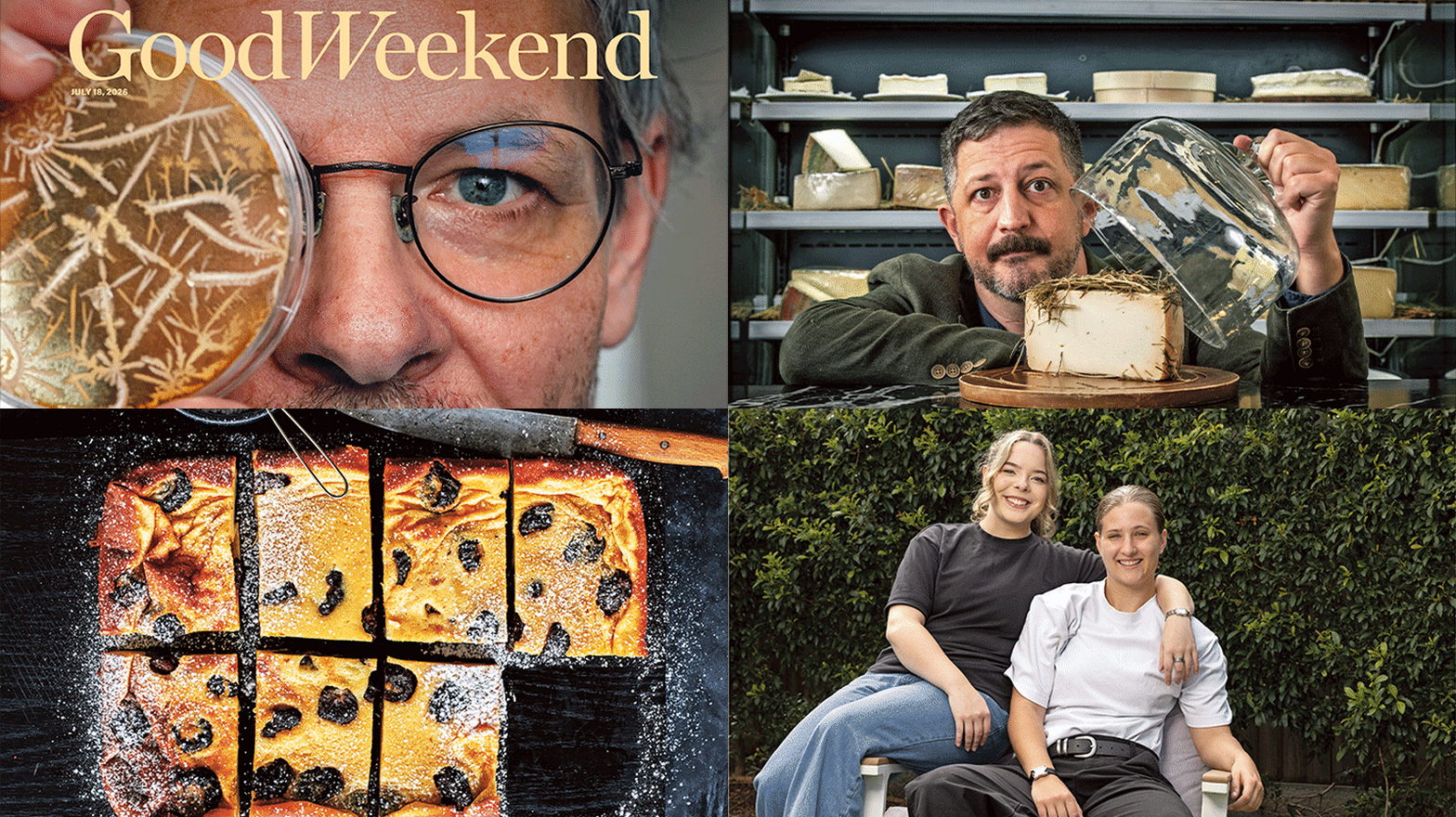
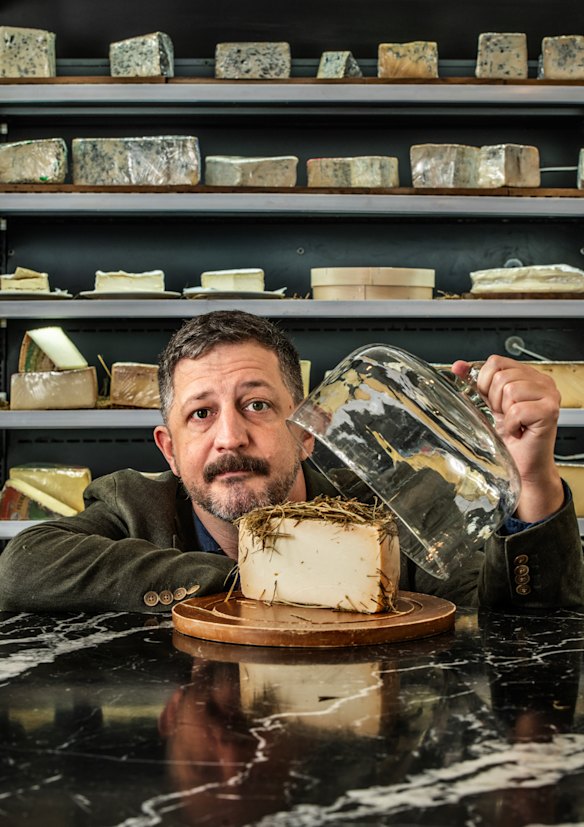
Dr Hugh Goold watches as Sogna Ocello cleaves open a wheel of firm goat’s cheese, wrapped in hay from the grassy slopes of northern Italy. Wielding a silver cheese plane, she spirits a cylindrical skein from its pale centre and offers it forth. It melds with the tongue, offering umami and sweetgrass.
I meet Goold, a synthetic biologist with the NSW Department of Primary Industries and Regional Development (DPIRD), at Formaggi Ocello in Sydney’s Surry Hills because it is a palace of devotion, of sorts, to microbial fungi: a kind of organism with which Goold has done something extraordinary. (Also, incidentally, he once moonlighted as a young researcher in London at a cheesemonger that served Buckingham Palace.) Stilton, he explains, is made by lancing cheese inoculated by Penicillium roqueforti spores with steel spikes to produce peppery streaks of blue funk. Another species of the fungus forms the bloomy rind of a triple cream brie he also insists we try, and which is so silky-buttery it makes your eyes roll back. He picks out a spicy buffalo milk number next, and then an oozing glob scooped from a craterous vat of gorgonzola.
The fungi that transmogrify milk, salt and rennet into these delights belong to the same category of organisms as humans: the eukaryotes. Unlike the primitive, single-celled prokaryotes – which are mostly bacteria – most eukaryotes are a riot of complexity, characterised by a nucleus of DNA encased in a membrane. This vast domain of eukaryotic organisms spans from gnats to iguanas, death adders to ducklings, jellyfish, ironbarks, leeches, liverworts, cats, gibbons and whale lice.
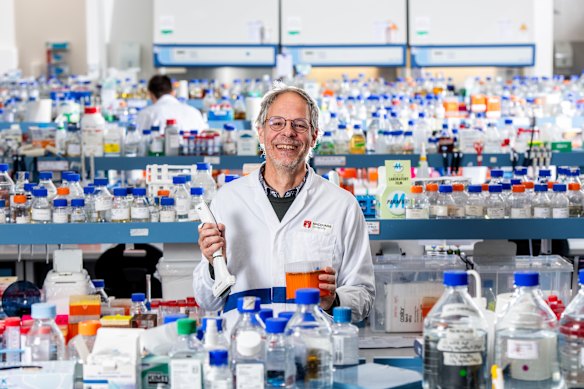
A fungal candidate, Saccharomyces cerevisiae, or brewer’s yeast, was selected from this broad menagerie by a daring global project bridging the gap between nature’s organisms and those made by human hand. The result will soon grow: yeast with an entirely synthetic genome. Collaborators from at least 10 international institutions have spent 20 years building each of the organism’s 16 chromosomes in a quest to gain unprecedented control, and knowledge, over its blueprint. Goold announced last year that he and his colleagues had completed the final one in a Sydney lab.
Already, using gene-edited microbes, synthetic biologists have formulated biological factories capable of crafting cancer drugs, spider silk, hallucinogenic psilocybin and “barramundi” meat. Fully synthetic yeast could deliver even greater acts of microbial alchemy and usher in a new era of biological knowledge.
First we learnt to read DNA. Then we edited it. Now we are learning to write.
Next, each of the artificial chromosomes, including Goold’s, will be united at the New York University lab of project leader Professor Jef Boeke. When that mote of yeast shudders into existence, it will be the first organism within our biological domain with genetics wholly crafted by humans, via computers and robots. The first synthetically designed eukaryote. An entity with digital ancestry.
Life, 2.0.
Ian Paulsen is a man who can’t stop moving. Zoom meetings with the Macquarie University microbiology professor are notorious for motion sickness: within seconds he grabs his laptop and begins violently pacing. On the meeting table in his office lies a rainbow slinky, silicon fidget toys and a miniature Japanese Zen garden gifted to him by colleagues. “I’m sort of hyperactive,” he explains. “I like to fiddle with things.”
The decision to build one of yeast’s chromosomes from scratch, made by Paulsen and Macquarie’s research chief Professor Sakkie Pretorius about 13 years ago, lay somewhere between ambitious and absurd. The only published paper at the time on building chromosomes was as helpful as hieroglyphics. But their efforts quickly built hype. NSW’s first chief scientist, Mary O’Kane, came on board alongside the state government, interested in the project’s potential to revolutionise agriculture by unlocking better methods of improving crop and livestock genetics.
The DPI hired Goold and his decade of gruelling lab work began. Surfing the momentum, Paulsen launched the Centre of Excellence in Synthetic Biology, funded by the Australian Research Council, in 2020. The centre, headquartered at Macquarie, now hosts almost 300 people working across nine Australian universities and has spun-out a dozen start-ups, all sprouting around the project dubbed Yeast 2.0.
Paulsen was once a synthetic genome naysayer. In the early 2000s, he worked at the then Institute for Genomic Research in Maryland alongside the pioneering scientists gunning to handcraft the chromosome of Mycoplasma mycoides, a bacterial parasite of cows. “I was like, ‘That’s crazy. That’s never going to work.’”
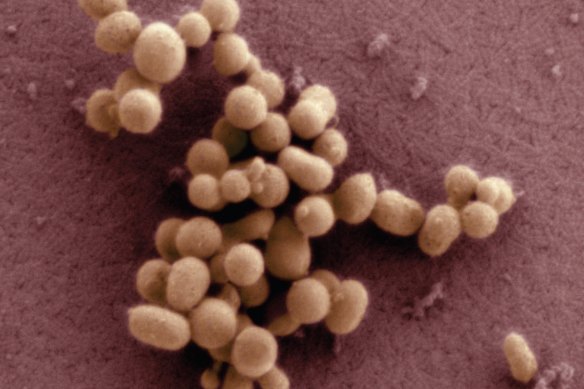
In 2010, the late genomic visionary J. Craig Venter announced it was done. Venter and his team had coaxed their DNA into a cell and it divided into the first synthetic lifeform, albeit a simple, unicellular prokaryote with only one chromosome. They called it Synthia. The groundwork was laid for Yeast 2.0, an undertaking at least 10 times larger in terms of raw genetic material and vastly more complex.
Paulsen tells me this while striding into the Australian Genome Foundry, a synthetic biology lab that partly grew out of the yeast project. It’s an echo of Paulsen’s childhood in Melbourne’s working-class Clayton, where the sci-fi mad schoolkid spent holidays shovelling sand and lugging metal moulds around the foundry his father worked in.
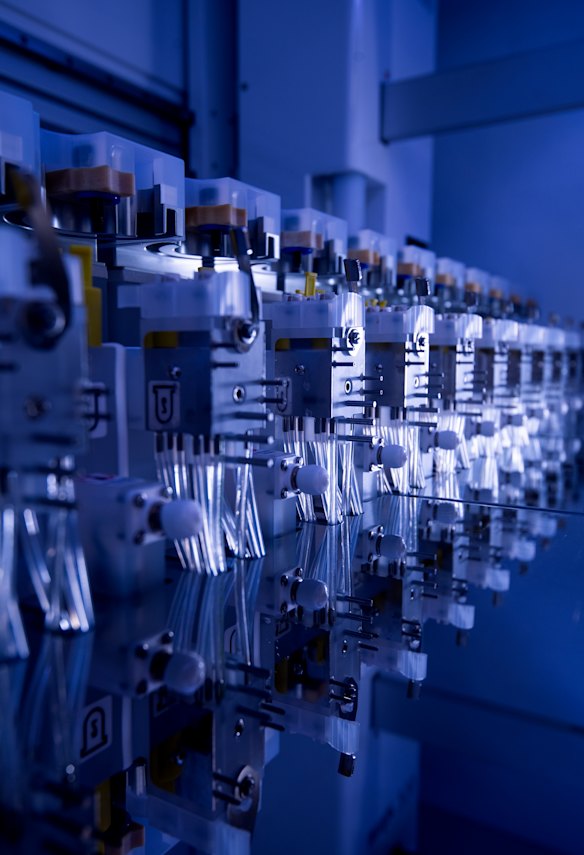
Paulsen’s foundry deals not in molten metal but in liquid life. Robots resembling giant hi-tech microwaves hum on benches: they can clone, culture and edit DNA and cells at a superhuman rate. Blue-gloved young scientists hunch over microscopes and murmur in pairs. The banner-like flame of a bunsen burner ripples while a towering blender nearby mixes a liquid that’s possibly alive and as bright orange as carrot juice.
“Molecular biology researchers in labs spend most of their time doing boring, repetitive stuff, sitting and transferring small volumes of liquid from one tube to the other,” Paulsen says. “They’re like skilled artisans in the 15th century, doing careful work but not high-throughput. This foundry is the industrial revolution.”
The pace of computer science is governed by Moore’s Law, which is derived from an observation that the number of transistors on a microchip doubles every two years. The acceleration of synthetic biology eats Moore’s Law for breakfast. When Paulsen was a PhD student in the 1990s, it took him 18 months to sequence one gene. Now Ancestry.com labs can scan 700,000 genetic markers in a vial of spit in a matter of days. (In this way I recently discovered I’m 7 per cent Norwegian. Hallo!) Price has also plunged: it cost $36 million to sequence a human genome in 2006. Now companies do it for $115. The utopian promises of biological engineering have often stalled as manipulating life proved harder than expected. But with robots, and now AI, scientific capability is catching up to the hype. It’s within this foundry Goold and his colleagues finished synXVI: the 16th yeast chromosome.
To build the yeast chromosome – a long, compact coil of DNA, which itself is a double helix of four chemicals dubbed A, C, G and T – scientists ordered tiny strings of these “letters” from a company that makes custom DNA. “Using the natural chromosome as a template, we grafted small chunks of the human-made DNA into the chromosome, one part at a time,” says Dr Paige Erpf, a biologist with Paulsen’s centre.
Chromosomes are a tangle of genes, mutations and repeats spelled out by these letters, scrambled and rewritten over countless generations and cell divisions. Designing chromosomes on computers and then making them from scratch allows scientists to order this evolutionary chaos by organising important genes into specific locations and deleting unneeded DNA, as the process helps reveal which parts of the genome are redundant. This synthetic-biology approach seeks to make cells almost like programmable computer chips. For yeast, Erpf says, “we can turn it into a really simple cell factory instead of having all this other shit we don’t actually need”. Their hope is that seizing total genetic control of microbes will result in perfect biofactories that can finally fully replace products we glean from oil, from fuel to plastics, weaning humanity further off petrol.
But yeast’s output is moving beyond bioethanol and beer to the genomes of other species; engineered life begetting life. Scientists need a living tool to stitch DNA chunks into more eukaryotic chromosomes, which are millions of “letters” long. “And yeast is fabulous at stitching pieces of DNA together,” Paulsen says back in his office, cradling a two-litre bottle of mango ice tea. “It’s one of its magical powers.”
The creation of the first synthetic plant chromosome using yeast is already under way and could unlock drought-proof, ultra-nutritious, pest-defying crops. By 2100, the climate crisis may have slashed the production of six staple crops humanity relies on by a quarter, if carbon pollution continues to rise. Scientists hope that new crops, customised more completely than those with tweaked genes, could help feed us in the future. They have started with the most sacred of vegetables: the potato.
Yeast will stitch the chromosome together before it’s transferred into moss, and then potato cells. “Plants take a really long time to grow,” Erpf says. “Yeast grows overnight. If we can build the synthetic chromosome – or big chunks of it – in the yeast first, extract it and add that into the plant, you’re literally turning a potential five-year experiment into six months.”
And that’s not all. In June last year, UK scientists announced their intention to pursue a goal long considered both audacious and taboo: the creation of a synthetic human chromosome. (As it happens, yeast is involved.)
The creators of Synthia encoded secret messages within the bacteria’s DNA. One is related to words scrawled on the blackboard of Nobel prize-winning physicist Richard Feynman, discovered after his death in 1988: “What I cannot create I do not understand.” It’s a go-to line for synthetic biologists, including Patrick Cai, a synthetic genomics professor at the University of Manchester. He served as the international coordinator for the Yeast 2.0 project. Now he’s a major collaborator on the Synthetic Human Genome Project, a new push to make a human chromosome from scratch funded by the Wellcome Trust, a multibillion-dollar biomedical charity chaired by former prime minister Julia Gillard.
“In the past we never got to this point,” Cai tells me via a video call. “Can we start writing the book, the code of life, and try to understand the meaning of it?”
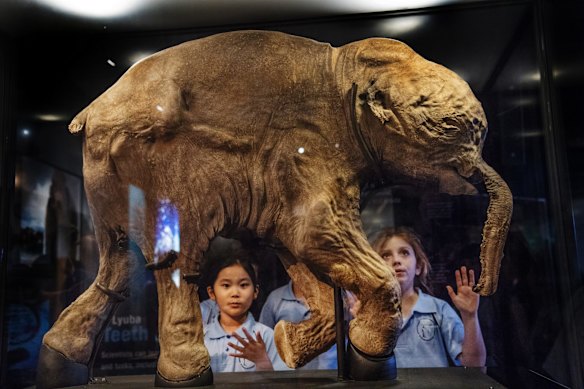
The Human Genome Project was a $US3 billion moonshot completed in 2003, allowing us to read our entire genetic code. Then came CRISPR, the editing tool used to tweak or delete strips of DNA. It has been harnessed to treat sickle cell disease, fix some types of blindness in a small trial, shred cancer tumours and attempt to eventually “de-extinct” woolly mammoths by making mutant Asian elephant cells.
Where will writing DNA lead us? According to synthetic biologist Andrew Hessel, who spearheads an American effort to make artificial chromosomes, writing DNA could cure any disease, undo every genetic affliction, and detonate a “modern Cambrian explosion of new creatures of all shapes and sizes” (Hessel is a futurist, it should be noted, a species prone to fabulism).
Cai is more cautious. “That transition from reading to writing is quite difficult,” he says. “Kids can read lots and lots of books, but when they write the first piece of a more imaginative piece of work, it’s very challenging. But I think we’re really at a cusp of making that transition now.”
What 98 per cent of our DNA does is a mystery. This so-called “dark genome” doesn’t code for proteins and was once considered junk, useless as evolutionary leftovers such as tailbones and wisdom teeth. But scientists are beginning to discover that this shadow realm can drive gene expression and cellular function. Building synthetic chromosomes casts a torch into this darkness, sorting the critical parts of it from the chaff.
And what of sci-fi fears of altering human chromosomes and the changes being passed to children? It’s unlikely the current iteration of the UK project, though, will get as far as building an entire human chromosome, according to analysis by Francis Crick Institute lead Professor Robin Lovell-Badge. He also stressed no one’s trying to make a synthetic human, yet: “We have no idea how to do this and it is likely to be very unsafe.” A more realistic early application is growing disease-resistant cells from synthetic DNA that could repopulate blighted livers or hearts.
One anxiety that hangs over synthetic biology is the accidental – or deliberate – rise of new infectious foes. Lovell-Badge advocated for the engineering of a “kill switch” into any synthetic human chromosome: an easily triggered mechanism that can self-destruct any artificial life gone awry. Such a trigger is under consideration, Cai says. “Our job is to try to quantify the risk, but also make sure the benefit outweighs the risk.”
The imagination of the public, reared on the sci‑fi visions of Jurassic Park, Gattaca, Alien: Earth and other Hollywood mutants can sometimes overstate the capabilities, and therefore risk, of synthetic biology. Take the idea of backyard bioterrorists brewing up new viruses. “The thing is, synthetic biology is really hard,” says Macquarie University bioethicist Professor Wendy Rogers. “The idea that some lone terrorist can order some DNA components and make a weapon in his garage is fantastical.” State actors with well-geared labs, she says, are a more troubling threat.
‘You kind of all of a sudden realise you have so much power over life itself. It’s a very humbling experience.’
Patrick Cai, professor of synthetic genomicsThere’s also the matter of who might own synthetic chromosomes. In 1995, Myriad Genetics filed an Australian patent over the BRCA1 gene, which increases a carrier’s chance of breast and ovarian cancer. The patent gave the company exclusive rights over the isolation and diagnosis of the genes, preventing other labs from offering alternate – and cheaper – testing. Queensland breast cancer survivor Yvonne D’Arcy took the company to the High Court, which ruled in 2015 that genetic material cannot be owned.
“The patent system is not really set up to deal with things like DNA,” says Dr Alison McLennan, a legal expert in synthetic biology at the University of Canberra. “For naturally occurring human DNA, we don’t invent it, it’s just there.” That changes with synthetic DNA, which can be patented and owned. “Is that the kind of thing that we should give exclusive rights over – should anyone be able to control who can access it, who can benefit?”
Those in the field are keenly aware that society may buck against their offerings, as many have rejected vaccines and GM foods. Paulsen’s centre and the UK synthetic human genome project have bioethicists and social scientists baked into their structures to study public fears and build social licence. A 2021 study showed curiosity, hope, fear and anger overrule facts in people’s assessment of synthetic biology. Scientists must win hearts, not just minds, in their quest to write the genetics of a new world.
Cai once worked as an engineer, coding computers. Now he’s coding life. Does it feel different? “I think it’s both exciting but also a bit worrying, if that’s the right way to say it,” he says after a pause. “You kind of all of a sudden realise you have so much power over life itself. It’s a very humbling experience.”
Synthetic biology in Australia has reached a funding cliff. Paulsen’s Centre of Excellence is coming to the end of its funding cycle while the other major hotbed of activity, CSIRO, has lost pace in the field. Paulsen’s uncontainable energy has bent towards keeping the show on the road.
In a Parliament House alcove last month, Paulsen hosted a charm offensive event where the centre’s start-up founders showed off biodegradable buttons built by saltwater bacteria out of seaweed. Some are looking to countries such as Japan and the US, which have federal strategies in synthetic biology and deep investments in biotech infrastructure. Australia lacks both. “We’ve spun out 12 start-up companies that have collectively raised $230 million of venture capital and created 200 jobs, and those companies have a collective valuation in excess of a billion dollars,” Paulsen told the crowd, including a smattering of MPs. “I’m going to say that’s a 40-to-one return on government investment.”
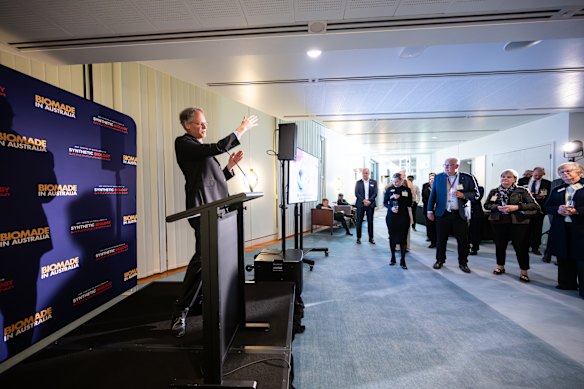
Back in the lab, research has focused on the new frontier of “biohybrids”, where biology fuses directly with computers, in part an effort to keep funding boards jazzed about synthetic biology. Paulsen and Erpf have kidnapped an engineering student and charged him with splicing yeast with photoreceptive genes that can be controlled with blue light: an effort to meld yeast with the electrical.
Goold, for his part, has won a $US400,000 grant from US conservation organisation Revive & Restore to fund his next project with DPI. He’s using lessons from Yeast 2.0 to hunt heat-resistant genes in microalgae, with the hope insights may be transferred to kelp and save their imperilled underwater forests. “This technology is successful if it gives us the security that we can operate as ‘businesses as usual’, despite things like climate change and scarcity,” he says. “Australia needs to come up with its own solutions.”
Three technologies will define the next century. AI gets enough airtime. Quantum computing received $1 billion of government funding in a single whack in 2024. Synthetic biology is the third wheel in this revolutionary triad. How well Australia capitalises on its promises is yet to be seen.
In Synthia lies another quote scientists wrote in the language of life. “See things not as they are,” reads the line from American Prometheus, the biography of atom-bomb physicist J. Robert Oppenheimer. “But as they might be.”
Get the best of Good Weekend delivered to your inbox every Saturday morning. Sign up for our newsletter.
Read more from Good Weekend: