 1 month ago
15
1 month ago
15
In an industrial enclave on Sydney’s north shore, a new generation of sporting dreams is being turbocharged. Young legs hone explosive power. Arms pump iron under the careful eye of strength and conditioning coaches. Adolescent limbs recover in ice baths and infrared saunas. At this gym, designed specifically for 12 to 18-year-olds, sport is serious business.
It’s not the main game for these kids; they’ll do their soccer, footy and basketball training elsewhere. This MTE (Mentoring the Elite) academy is for what has become the off-field essentials, such as recovery sessions, speed coaches, psych support, diet, strength. Founders Ryan and Sarah Comerford came up with the idea of a one-stop-shop because they were spending $600-$700 a week on this stuff for their own footy-playing boys.
“There are a lot of parents out there who don’t know where to start,” says Sarah, as she explains the rationale behind their gym. “They don’t know about proper nutrition, they don’t know that to make them the best they can be, [young athletes need] a lot more assistance than just running around on the field once a week.”
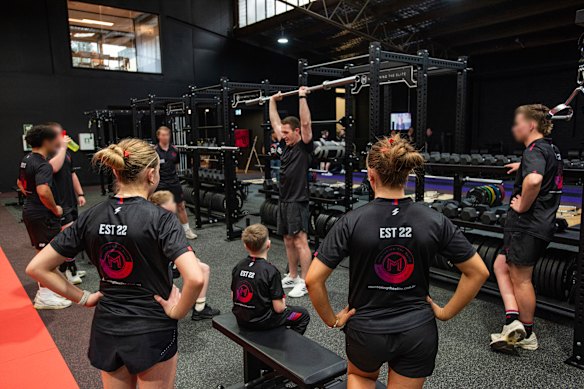
Mentoring the Elite is a sports academy for 12 to 18-year-olds that aims to help them avoid the pitfalls young athletes can encounter.Credit: Steven Siewert
The Comerfords have tapped into the zeitgeist. In suburbs of Sydney, Melbourne and beyond, youth sport is no longer about mucking around. Kids as young as 10 are training daily, specialising early and poring over their statistics and rankings while juggling school, club and rep competitions. With that comes high pressure, early injuries and an intensity that can suck the joy out of sport. Many kids don’t play enough sport but, increasingly, some are playing too much.
Australian Institute of Sport director Matti Clements is worried. She fears that in many families, becoming an elite athlete is now the goal, rather than just having fun.
“It’s probably a product of the broader parenting style in Australia – music lessons, swimming lessons, netball and a tutor rather than just let the kids enjoy stuff and relax – this over-orchestrated parenting,” she says.
“Let’s just let them enjoy it rather than training and coaching them as if they’re on some pathway that they’re not. We have to stop thinking that every single kid who participates is on a trajectory to the Olympic or Paralympic Games.”
Sporting glory – Baggy Green caps, premiership titles, gold medals – has always been highly prized in Australian culture. The benefits of sport for a kid are myriad. On top of physical fitness, it fosters friendship, discipline, resilience, self-esteem and focus.
But there are greater material rewards for sporting success now, too; the money is bigger, sponsorship deals more valuable, and for high-performing teens, there are opportunities for sports scholarships at universities in the United States. Many parents think their children’s chance of success will be maximised if they choose a sport early and train hard. They follow the playbook of famous prodigies – Tiger Woods playing golf at age two, Andre Agassi with a tennis racquet strapped to his hand at three (he later spoke about the trauma this caused).
Yet years of research shows the opposite; for young people, intensive training – particularly in a single sport – leads to stress, injuries and burnout. An 2019 analysis of 22 studies on early specialisation found not a single one identified a benefit. Another found that it can hinder kids; those who played three sports at 11, 13 and 15 were more successful at a national level than those who played only one. A 2024 German study found only 10 per cent of exceptional kids went on to be exceptional as adults, while most of the highest-achieving adults hadn’t been superstars as kids.
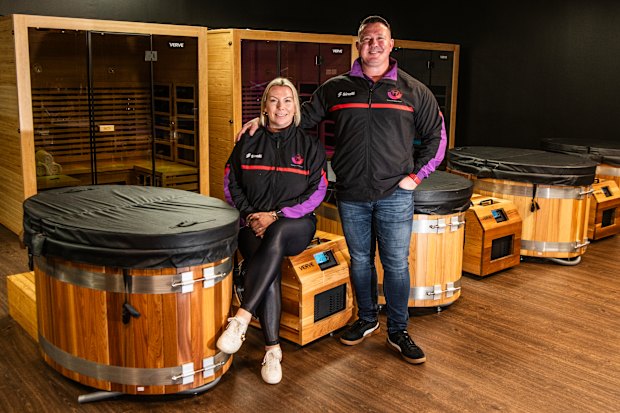
Ryan and Sarah Comerford decided to open a gym for youth athletes after their experience with their own boys.Credit: Photo: Steven Siewert
Norway has just outperformed far bigger nations at the Winter Olympics, and that is widely credited to guidelines around youth sport that are designed to foster enjoyment. There is no score keeping until age 13, kids are encouraged to play more than one sport, results are not posted online, there are no national competitions for children, and the motto is “joy of sport for all”.
Rosemary Purcell, a psychologist with expertise in elite youth sportspeople and their mental health, says the theory set out in the 2008 book Outliers that it takes 10,000 hours to achieve mastery at something seems to have captured the imagination of some parents but “was never devised in a sports context”, she says. “It’s a concept that has been misapplied. As a general rule, if you’re specialising before the age of 12, that’s probably way too early.”
In Clements’ view, children should not specialise before they are 15.
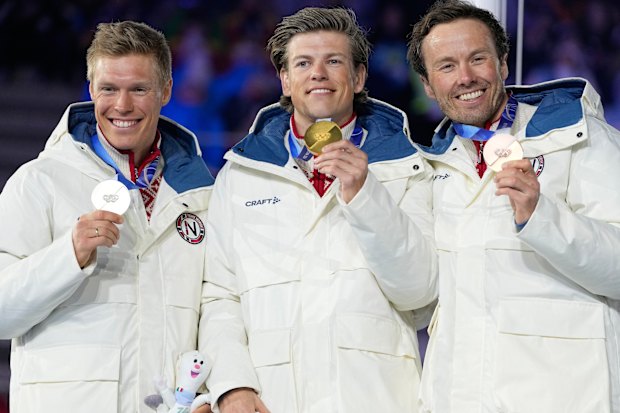
Norway won all three medals in a recent Winter Olympics cross country skiing event. Credit: AP
Gearing a child’s identity towards sporting success also sets them up for disappointment. “Too much can change,” says Alexia Bates, who is the co-founder of Study and Play USA, which helps Australian athletes apply for sports scholarships at US universities, and who doesn’t begin working with athletes until they are in their early teens. Kids might stand out at age 12, but their peers catch up. “Then you’re having an identity crisis at 15; ‘I used to be this, and now everyone is getting as tall as me, or everyone’s starting to take it as seriously as I do’,” she says.
Injuries to the anterior cruciate ligament in the knee – which are potentially career-ending – are becoming an increasing problem. Girls are more susceptible. One Australian hospital said the number of knee reconstructions it was performing on under 18s had increased by 171 per cent over the past decade. “You’re getting younger athletes focusing earlier on sport, they’re losing their agility and so have higher rates of injury,” says Christopher Vertullo, a knee surgeon. “They’re also taller and heavier than in the past – that increases their injury rate.”
Australian government guidelines say children should not specialise until they’re 13 at the earliest, they should not play more hours a week than their age (if they’re 10, it should be no more than 10 hours), and that their ratio of organised sport to free play should be no more than 2:1.
Libby Trickett began swimming as a kid and became an Olympic gold medal winner at the summer games of 2004, 2008 and 2012. She’s now passionate about letting kids enjoy sport without pressure and questions whether parents who drive young kids are really trying to fulfil their own thwarted dreams.
In a recent Instagram post, she discusses chatting to her own children’s swimming coach, who, unprompted, offered to share their personal bests. Most parents knew their kids’ PBs, the coach explained, except the parents who had been elite athletes themselves. “It really kind of shocked me that parents would be putting any attention to their kids’ personal best times, kind of at any age or stage but certainly for 10-year-olds,” she said. “Your child’s performance at the age of 10, 11, 12, 15, means nothing to their potential.”
In another post, she was even more blunt: “Stop living vicariously through your kids,” she said. “Let their own passion find its way.”
Georgina Rowe is living proof that a later start does not preclude success. She was a kayaker at high school, with the most stellar cheer squad any teen could ask for; her aunt, Shelley-Oates Wilding, was a two-time Olympian in canoeing. But as soon as she hit year 12, Rowe “didn’t want a bar of it”. She was sick of the daily grind.
A pivotal moment was her last day of year 12, when she had to choose between muck-up day and a race in Penrith. She felt guilty about letting her supporters down, but missed the race. “I chose what was right for me,” she says.
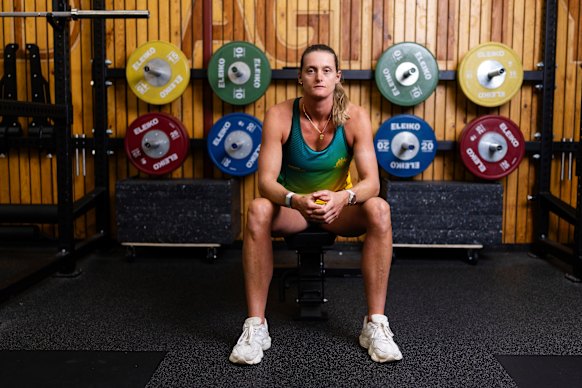
Georgina Rowe took up rowing in her 20s and has competed at two Olympics. Credit: Alex Ellinghausen
Rowe was in her mid-20s when she was training on an indoor machine for surf club rowing, and someone pointed out that her results met national standards. She made her Olympic debut at the delayed 2020 Tokyo games and rowed in the women’s eights at the Paris Olympics in 2024.
Dodging curveballs
For Ryan and Sarah Comerford, the MTE gym isn’t about adding to the kids’ workload. They say it helps enthusiastic sports people avoid common pitfalls, including injuries. It’s about supporting them physically, showing 12 to 14-year-olds what life would be like as an elite athlete if they choose that path, and teaching life skills that will be useful regardless of whether the teen achieves their dream.
Ryan cites centrality of recovery, diet and developing mental resilience. “Professional sport is going to throw some serious curveballs at them,” he says. “There’s adversity they will face, there are teams they’re not going to make, there’s a coach that will come in who may not like them, and it’s really their ability to be able to cope with those situations.”
The biggest curveball may be that they fall short of their dream. The difficult truth is that most kids never get there. Or if they do, they might play only a season or two then be dropped.
Colin Sanctuary from the University of Newcastle recalls working for a British soccer academy. “There would have been four or five hundred kids in that whole program,” he says. “I can only remember one player making it to the elite level.”
If they fail or fall at the final hurdle, mental and emotional recovery can take years. Jamason Daniels became a rookie for the Western Bulldogs AFL team in the 2008 draft. In 2010, after a spate of injuries, he was delisted. Years later, on social media, he shared the devastation he felt when his dream came crashing down. How he cried for eight hours, and then realised that he’d put everything into AFL. “I had nothing,” he said. “No job, no money (the base wage for a rookie was about 40k …) and lastly, no qualifications.” He got a job at McDonald’s.
In the United Kingdom, soccer club Crystal Palace last year opened a dedicated support centre for young players released from its academy to help them manage the rejection. When former NBA star Charles Barkley gives talks at disadvantaged schools in the United States, he asks the kids whether they want to be a doctor (a few hands) or a sports star (most of them). Then he delivers a reality check about how much spare time should be spent shooting hoops versus studying maths. “You have a better chance of being a doctor,” he says, “than being in the NBA.”
From the AIS, Clements has no control over how clubs push their grassroots athletes. But she hopes the institute’s example will trickle down. This month, the AIS released world-first guidelines for federations on how to manage high-level athletes who are under 18, to ensure that their social, academic and well-being needs are met, as well as their sporting ones. It discusses issues such as safeguarding from abuse, sport-life balance, and the particular physical challenges of adolescents.
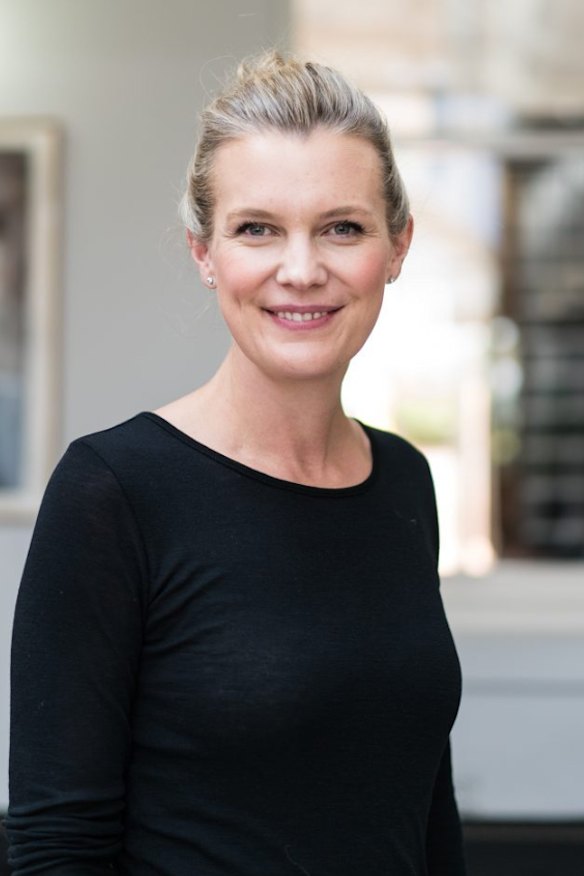
Australian Institute of Sport director Matti Clements fears that in many families, becoming an elite athlete is now the goal, rather than just having fun.
It calls on federations to recognise and celebrate achievements outside high-performance sport, and warns of the risks of premature specialisation, inappropriate training loads and confusing chronological and biological maturity. It stresses the importance of sleep and rest, encourages coaches to adjust programs when athletes have growth spurts, and calls on sports to consider the importance of broad physical skill over the technical mastery specific to their sport.
“Our view is that if we can set the standard for the elite athletes, then we can start having some conversations about the poor coaching and behaviours within participation [club level],” she says. “[At an elite level], we are not promoting early specialisation – we’re suggesting kids try a whole heap of different sports. Let’s just let them enjoy participating. Some will go on to be Olympians, some won’t, but let them enjoy it rather than training and coaching them as if they’re on some pathway that they’re not.”
Start the day with a summary of the day’s most important and interesting stories, analysis and insights. Sign up for our Morning Edition newsletter.