 1 month ago
25
1 month ago
25
On a beautiful beachfront on the Vanuatu island of Efate there sits a brutalist concrete resort that is ambitious, striking, and entirely unfinished. For a decade the resort has stood as a ghost structure, a shell just metres from the tidily clipped lawns of functioning luxury hotels.
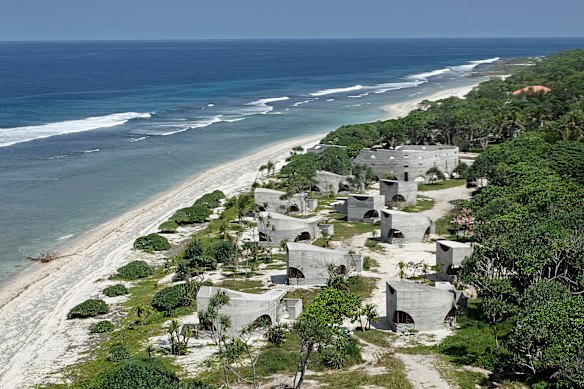
On Spring Street, opposite Parliament House, over lunch in the clear daytime light of the Supper Club, restaurateur Con Christopoulos pulls out his phone to show me photographs of La Plage du Pacifique, as it was to be known.
It is the hotel he tried to build with his then-partner, architect Kristin Green.
“Kristin and I were madly in love, and we built this resort, and we never finished it, then we broke up and it’s just sitting there,” says Christopoulos, staring at the screen. He pauses, then laughs. “Maybe it’s waiting for the next true love?”
That unfinished hotel is perhaps the perfect metaphor for Christopoulos, a man driven by a sometimes senseless compulsion to build, even when business logic suggests he should stop.
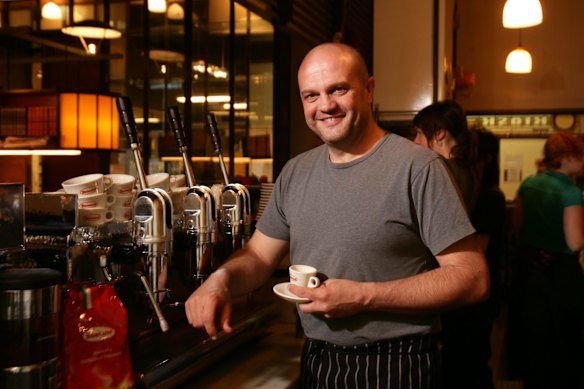
Christopoulos, 62, is not Melbourne’s most famous restaurateur. He is no polarising celebrity chef. Hell, he’s not even a chef, though he knows how to cook – a skill learned from his Greek mother, and from filling in on the line when his staff were away at trade school. While peers like the controversial Chris Lucas and empire builder Andrew McConnell try to occupy the main stage, Christopoulos operates subtly.
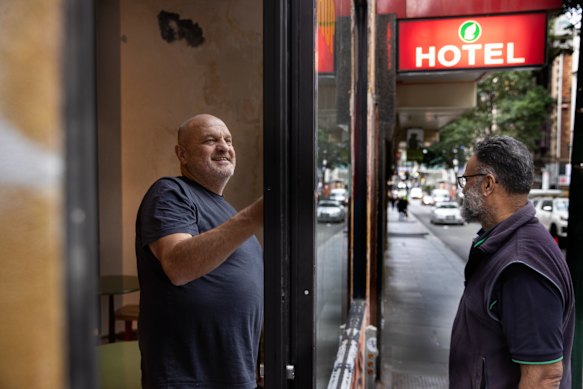
Yet look down the list of venues he co-founded – Degraves Espresso, Cafe Segovia, Supper Club, The European, Siglo – and the evolution of Melbourne’s city centre over the last three decades is laid out for you.
Sometimes, Christopoulos himself ponders why he keeps opening new venues. “I wonder ‘Why? What am I doing?’ But if I didn’t have these venues, I’d probably just be 40 kilos heavier and sicker.”
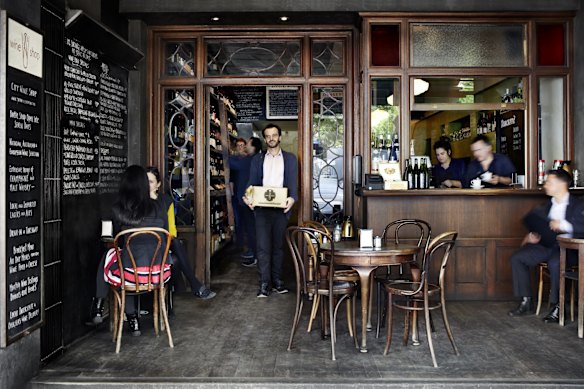
Perhaps more than any other operator, he has influenced the city’s laneway and European dining aesthetic. He dominates the top end of Spring Street with what has become almost a mini-campus: City Wine Shop, The European, a gelateria, and Spring Street Grocer. It is a precinct that caters to politicians, theatre-goers, hospitality workers and the passing public alike. Linked via a tiny laneway are two other venues he has a hand in: Butchers Diner and Angel Music Bar.
His latest projects – a restaurant named Roma and a more casual bar and diner named Sergio’s at the entrance to the 120 Collins Street office tower – will occupy long-abandoned spaces once of high ambition. The office space Roma will replace was empty for several years before his arrival.
It’s a hell of a journey just getting Christopoulos to sit down to discuss all of this. I start messaging him in mid-November and get no response. I try multiple times across multiple apps then, fearing I’m verging on stalking, move onto his marketing person, who says Christopoulos will be available soon. Weeks pass. When I’m about to write this profile without Christopoulos, I’m told Con will be available the following day. Coincidentally, I’m meeting a politician that day at City Wine Shop and, while there, ask if Christopoulos is in. He boarded a plane to Europe that morning, staff tell me. Christopoulos’ marketing person assures me Con will be back in 10 days. Ten days come and go.
It isn’t until I embark on a pilgrimage to the site of every CBD venue that Christopoulos has opened since 1990 – texting him a picture of my list covered in scrawled notes, and telling him I’m writing the profile with or without him - that Christopoulos finally acquiesces.
Imagine any other restaurateur proving this difficult to convince to be profiled?
At first, I wonder if his reluctance is because Roma and Sergio’s are running behind schedule. They are late – they were due December, and now he’s predicting April – but I soon realise it’s not that. Without an imminent opening that needs hype, Christopoulos simply doesn’t need or want the publicity.
“It’s not about showcasing the owner. Times are tough, and we don’t want to be highlighting the owner when we’ve got a lot of staff working hard,” he says with great charm when we finally meet.
Christopoulos is also wary of claiming sole credit. Over four decades, he has always partnered with others, as a way of sharing the risk and the work, and the rewards when things go well.
The partnerships have led to a dizzying array of projects. A search of Christopoulos’ businesses reveal he is currently a director of, and shareholder in, 17 separate companies, and was previously a director of another seven.
Christopoulos’ instinct for business came early. He grew up in Essendon, in a Greek family shaped by migration and enterprise. When his parents came from Europe, they bought a milk bar and little Con would be underneath the counter in a bassinet while his mother served.
Early in his career, he fell in love with the splendour of five-star hotels, convinced they were his destiny. He worked at the Southern Cross Hotel – back then it was Melbourne’s grand stage on the corner of Bourke and Exhibition streets. “It was the hotel in Melbourne,” he says. (It’s long since been demolished; government offices now occupy the site.)
Ultimately, he set his sights lower. He opened his first venue, Bar Biffi, in South Melbourne in 1984. Then for three years with brother George he ran Port Melbourne’s Rose and Crown Hotel – bought by real estate father Harry, who still owns the freehold on the building.
His first recognisable success came after a long trip through South America. In 1990, he opened Café Segovia in Block Place. It arrived at a moment of collapse for the rest of Melbourne: a recession had wiped out most of the city’s white-tablecloth restaurants, and chefs with classical training were suddenly opening their own places, serving restaurant-quality food at cafe prices. Mario’s in Brunswick Street, Fitzroy, is the best example that still exists. “For me, Segovia was a bit of Brunswick Street in the city,” he says.
All over Melbourne, following the recession, cafes popped up bursting with personality. “No one had money so we all built them ourselves,” says Christopoulos. “We all thought we were artists and true Bohemians, but we also had this backbone of real skill.”
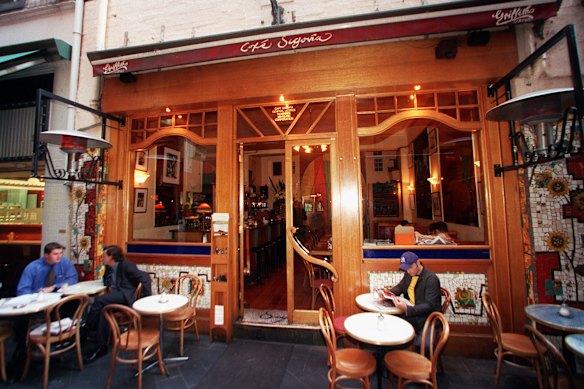
At the time he opened Café Segovia, just a handful of people lived in Melbourne’s city centre. Christopoulos, part of Melbourne City Council’s early residential conversion program Postcode 3000, lived in Excelsior House, a heritage building on Elizabeth Street near Flinders Street.
He remembers taking over Segovia, giving it a lick of paint, “and the regulars were picketing”; they wanted things to stay just as they were. Coffee, too, was controversial. “Back then, if you served your coffee too strong, and it wasn’t hot enough, they threw things at you.” In time, the cafe adapted, becoming a bar at night, aligning itself with a city centre slowly rediscovering its streets.
After selling Segovia and going to Europe for travel, on the streets of London Christopoulos ran into a couple of guys who had worked for him at Segovia. A year later, in 1996, the three opened Syracuse and Degraves Espresso together.
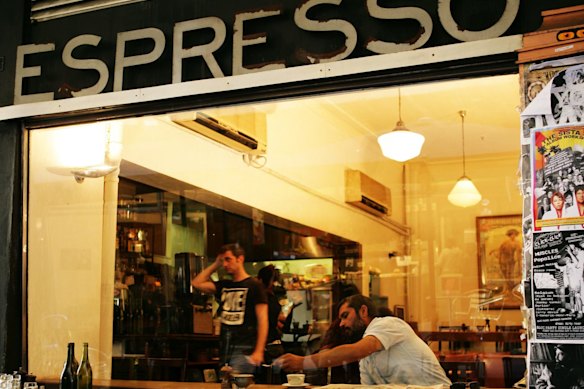
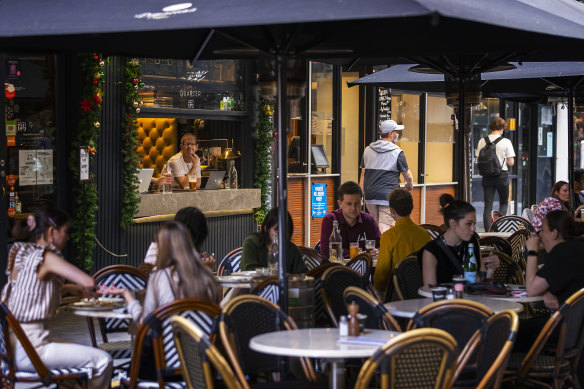
Syracuse was a hit, and also quietly radical – an early adopter of a tapas menu. But it was Degraves Espresso, which opened within a month of Syracuse, that came to define a certain type of Melbourne dining and coffee culture. When it opened, the street had a butcher, a fruit vendor, a couple of hairdressing salons and one struggling cafe. Its success obliterated any other type of industry remaining. Today, there is virtually nothing but cafes on this narrow street, now photographed daily by tourists seeking out Melbourne’s “laneway culture”.
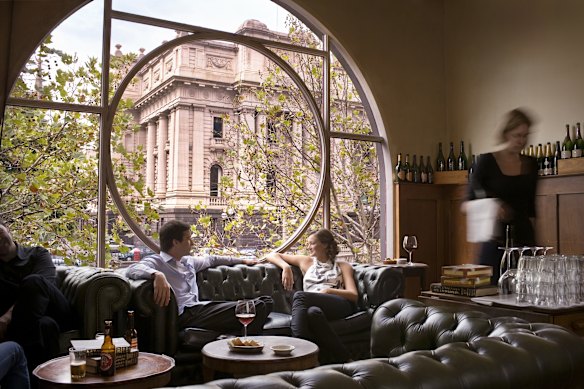
Then came the Melbourne Supper Club, opened in 1998. The Spring Street site had chewed through tenants before Supper Club became an overnight success. Its subsequent expansion was driven less by strategy than by regulation – particularly new laws banning smoking indoors. An attempt to prevent smoking bans from affecting the business pushed the business upwards – Siglo, the rooftop bar, took its name from a cigar.
Not every experiment worked. Take St Kilda Snack Bar, a short-lived restaurant on Fitzroy Street that lasted 10 months. “That was a complete disaster,” he says of one of his rare forays off the Hoddle Grid.
The venues he co-owns often develop from architectural impulses – or accidents. Kirk’s Wine Bar in Hardware Lane was supposed to be either a fish and chip shop, or gelato. During renovations, the builder cut a hole in the bowing floorboards. “We dropped a coin in and it went splash,” says Christopoulos. Floorboards were pulled up, water pumped out and downstairs was a cellar. Gelato was set aside, and a wine bar was built. The resulting spiral staircase became a design anchor, replicated next door and extended upward into the French Saloon and, eventually, Le Pub.
When the pandemic hit in 2020, only government support kept the lights on. Balance sheets recovered, but asset values did not – pre-COVID, Christopoulos valued his businesses in the millions. “Now they’re worth nothing,” he says.
Asked why a Greek restaurateur has rarely focused on Greek food, he points to the 1980s, when he was told 50 per cent of the meals eaten out in Melbourne were Italian. “If you opened a Greek restaurant, you were fighting over 1 or 2 per cent of the market.”
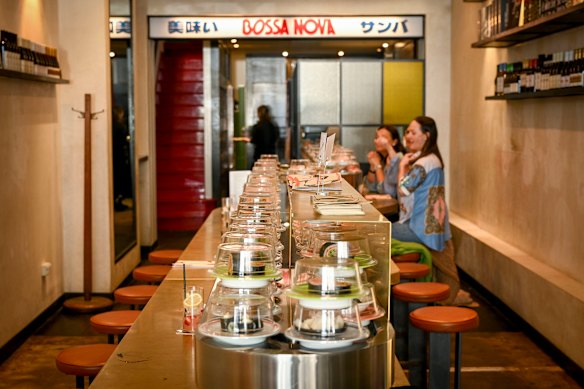
That didn’t stop him from launching Kafeneion, a Greek pop-up on Bourke Street, with partner Stavros Konis in 2023. It was a raging success – yet he shut it down at that venue and moved it to Spring Street while it was still booming to replace it with a sushi train, Bossa Nova.
Central Melbourne has changed since the pandemic. Mondays and Fridays often feel deserted; office towers empty earlier. “People aren’t coming back to the city to work. There are days when there’s just literally no one around. The politicians say ‘Our numbers are up’. And you will say ‘Okay’,” Christopoulos says, rolling his eyes.
Surviving three decades in Melbourne’s culinary scene requires more than just pushing through tough economic periods; it demands the ability to negotiate delicate professional relationships. Many in the industry read Ian Curley’s departure from the European back in 2017 as a business divorce between the pair, who had then worked together for 11 years.
“Ian Curley has decided to move on,” a press release describing the move at the time said, raising eyebrows in the city’s culinary circles.
While Curley remains tight-lipped about what happened between the pair while running The European together, choosing not to dwell on the past, it did not result in a permanent parting of ways.
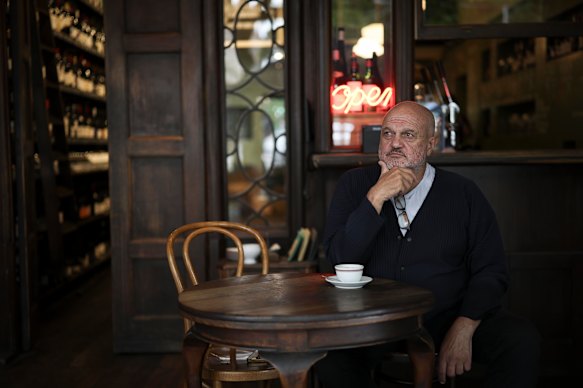
Today, the former executive chef at The European still co-owns French Saloon, Kirk’s Wine Bar, and Kirk’s Cellar Dining with Christopoulos. Christopoulos always had the ambition, Curley says.
But more than that, he argues his business partner possesses something rarer: intuition. “He has the knack of knowing exactly what this city needs next.”
That knack was often at odds with council regulations in the 1990s. Long before those rules were loosened, Christopoulos was pioneering the European-style laneway culture that now defines Melbourne’s identity.
“I used to clash with the council there” over street furniture, Christopoulos recalls of Degraves Street. “They didn’t like the furniture I had outside the cafe.” Today, ironically, that laneway could barely fit in more street furniture.
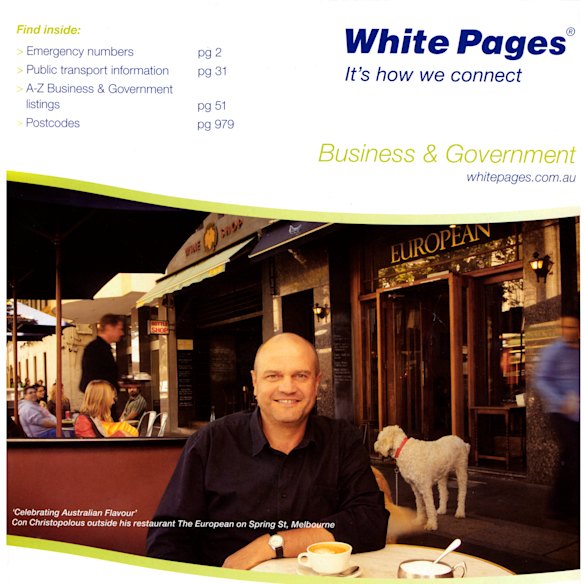
His role in defining the city’s mood was once used to sell the city to itself: on the 2008 cover of the long-defunct White Pages, Christopoulos sits before The European, in a snapshot of the era he helped create.
If Christopoulos can intuit the shifting needs of the city, it is perhaps because he has never truly left it.
Once, Christopoulos lived in a luxurious South Yarra terrace. Now, following a divorce, he lives back in the CBD, near the venues he built. Asked if he has made a lot of money from the industry, he shrugs. “If I have, it’s only because I’ve been at it for so long.” Money is both the driver of the hospitality business and is its central illusion, he says: “The margins are pathetic.” He points to the Supper Club kitchen, noting a recent renovation cost $1 million; in 1998, Christopoulos says the entire fit-out for the Supper Club and The European cost $250,000.
He also says there is no exit strategy now the asset values of hospitality businesses have evaporated since the pandemic. “If I wanted to retire and sit on the beach, I’d have nothing to sell,” he admits. “I’d get something, but it wouldn’t even be set-up costs.”
Christopoulos is a golf fanatic – his portrait on his WhatsApp profile is the US Masters logo, and golf was what led him to Vanuatu. But his golf handicap – once as low as six – has, he says, “gone to shit” because the latest recalibration of his empire has tied him to the city centre.
You get the sense that Christopoulos wants to be tied to the CBD because it offers a canvas for opening new venues that a quiet retirement never could. He has seldom ventured outside that city centre. “I love the city compared to the suburbs because as soon as you go out in the burbs, you’re a bigger fish in a smaller pond,” he says. “In the city, I’ve got broader appeal. The market finds me.”
For 30 years, the market has done just that.
Start the day with a summary of the day’s most important and interesting stories, analysis and insights. Sign up for our Morning Edition newsletter.