 2 months ago
49
2 months ago
49
Khaled Sabsabi is pouring cinnamon tea into little Turkish glasses, explaining how easy it is to make. Put a handful of sticks of cinnamon into hot water and boil for a while. Sugar? Not needed. Remarkably simple and, as it turns out, delicious.
We’re sitting in the garage he’s converted into a studio at his home in Green Valley, near Liverpool in Sydney’s west. Here, too, is his friend and collaborator, curator Michael Dagostino. Sabsabi has laid out dates and walnuts to accompany the tea, and the sun is streaming in. The garden beyond is green from summer rain. It’s all very pleasant and Sabsabi is very hospitable. One thing strikes me, though: he’s not smiling. Not with his mouth, nor with his eyes, which are dark and intense. He’s looking closely to get a sense of me. Not unfriendly, but wary.
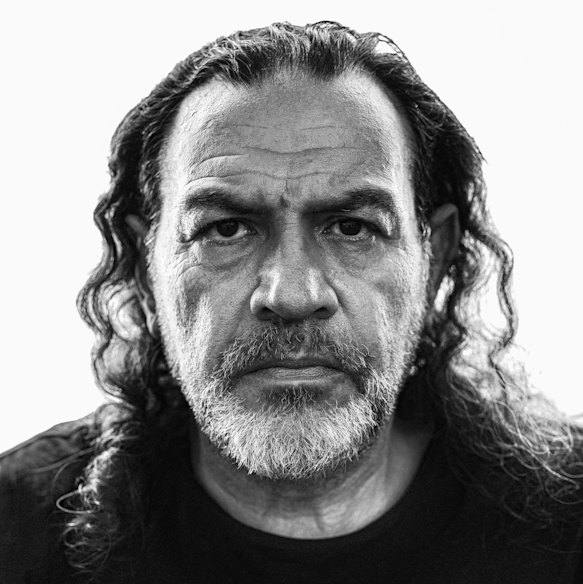
This is understandable. For one thing, he’s busy, and I’m a distraction he doesn’t need. It’s February 2026 and in a few months’ time, the 60-year-old artist will represent Australia at the most prestigious contemporary art show in the world, the Venice Biennale. When it opens on May 9, Sabsabi will feature in not one but two exhibitions. As his Venice project director Mikala Tai says, “It’s like having twins.” He has a lot to do between now and then.
For another, I’m a journalist, and Sabsabi’s been cast in a bad light by some people in my line of work over the past year. By some politicians, too. And some social media warriors. “Terrorist sympathiser” is a neat catch-all for what’s been suggested, on the basis of two artworks he created two decades ago.
What happened is this: in February 2025, Sabsabi was announced Australia’s representative to Venice. Six days later, amid furore over those two works, his appointment was rescinded. Five months on he was reinstated, with apologies thrown in by federal arts funding body Creative Australia, which did the selecting, deselecting and selecting again.
If it hadn’t been so devastating, it would be funny, in a darkly satirical, Utopia kind of way. But it’s been traumatic for all involved. For Sabsabi that meant nightmares, dropping seven kilograms due to stress, feeling like he couldn’t go to the shops for fear of what strangers were saying about him. At one point, he felt his health was so compromised, he might just finish creating this work then call it a day on exhibiting. It was hard for Dagostino, too, who, on top of supporting Sabsabi and working out what the heck they should do, had his day job running the University of Sydney’s Chau Chak Wing Museum to tend to.
While some won’t care to acknowledge this, it was also terrible for those at Creative Australia, from the board that made a pressure-cooker decision then had the humiliation of unwinding it, to the CEO and staff who were suddenly the pariahs of a sector it was their raison d’être to represent, to defend, against politics and politicking. So, not funny.
The only thing Australians outside the small visual arts world know about Sabsabi is the controversy.
Sabsabi and Dagostino have pulled out of this interview once already, agreeing to go ahead again only after we meet for coffee and I explain that I want to tell readers about the artist behind the controversy. That the only thing Australians outside of the small visual arts world know about Khaled Sabsabi is the controversy. Don’t they deserve to know a bit more about the artist representing their country at Venice? Doesn’t he deserve for the general public to know a bit more about him, too?
One of Khaled Sabsabi’s strongest childhood memories is of holding on to his grandmother Khadija Kurdi’s skirt as he’s pulled away and put into a car. It’s 1976 in Tripoli, Lebanon’s second-largest city, and he and his younger brother Hussam are living with their grandmother and their aunty Hanan. The civil war began the previous year and he’s seen awful things. Bodies piled on top of each other in a truck out the front of their house. People searching that pile for family members. He’s spent days hiding in the family basement as the neighbourhood is shelled, then, when the house looks like it might collapse, running through sniper fire to get to safety.
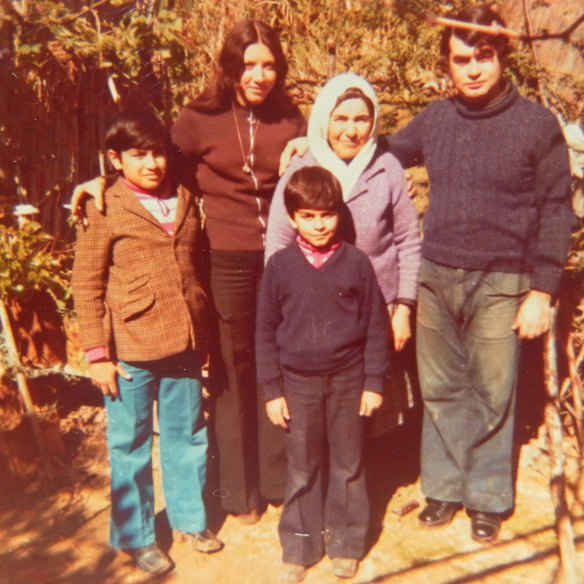
It says something about the nature of trauma that Sabsabi keeps his comments to me about this time deliberately general; I find the specifics in a piece he wrote in 2016. “Factions around the neighbourhood, more militia present, people carrying guns,” is all he says to me about this time. “For a year-and-a-half, that was quite a difficult period on many fronts.”
His father had left for Australia in 1969, his mother a couple of years later, initially taking the boys with her. She sent them back to their grandmother after a few months, however, so she and her husband could work night and graveyard shifts in various factories to save the money to bring the kids back permanently.
When the war started, Sabsabi’s elderly grandmother got a job cleaning houses, often paid with wheat, flour or sugar. She taught him, he says, “the fundamental essence of humility, and reliance on whatever means you have. To be content with what you have.”
Leaving her, then, to fly to Australia at age 11 and be reunited with his parents, was hard. “We knew we were in a war situation. We felt the impact, saw the death, the ugliness of conflict. Still, I didn’t want to leave my grandmother.” He thinks he and his brother were smuggled out of Lebanon via Syria but is not sure. Memory is funny like that. “All I remember is being pulled away from my grandmother, then being put in a car, then everything went black.” The next thing he knew, they were on a plane, Australia bound.
When Khaled Sabsabi landed in Auburn in Sydney’s west, the only words of English he knew were “yes”, “no”, “I beg your pardon”, “how are you” and “my name is”. At Auburn North primary school, the only person “brave enough” to help him in class was a Turkish boy named Ali. “He didn’t understand Arabic but he would try to translate through hand gestures, pointing and so on.” Sabsabi was picked on, bashed and caned without really understanding why. A group of Anglo boys, he says, took him away from school one time and stubbed their cigarettes out on him.
A fairly typical 1970s migrant welcome, then.
Granville Boys High was better. As Sabsabi’s body filled out, he discovered an aptitude for rugby league and cricket, which delivered him an acceptance he’d not previously enjoyed. He also found art, through a substitute teacher who turned up when the regular one was away. She showed the boys paintings by the likes of Picasso and Dali, then hauled one of the students to the front of the class to act as a model. “Try to rethink this,” she said. “Draw this model beyond what you’re seeing in front of you.”
Sabsabi drew the boy in various stages of repetition, from big to small, as if in motion. The teacher told him to wait in the classroom while she went to get someone. Sabsabi assumed he was in trouble but when she returned it was with the head of department, who asked if he’d picked his electives for years 11 and 12. He had, and art wasn’t one of them. “Don’t worry, you’re going to do art,” he was told.
It was the first time Sabsabi had been praised for anything other than sport. Laughing now, he explains how he really doubled down on art in HSC. “I ended up doing the major artworks [for the prac exam] for six of my friends – everyone wanted a different style.” One of those friends got a better prac mark than he did. “I thought it was hilarious.”
What Sabsabi dreamed of doing after school was not art, though. He wanted to become an aeronautical engineer. “I cried when I got my HSC results,” he says. “I’d worked so hard but I didn’t have enough marks.” He did get an offer to study engineering in Melbourne but now it was his mother’s turn to cry.
“What am I going to do?” Sabsabi says of the choice he faced. “You’ve already been displaced, migrated.” Family was everything. “We were once separated. Why would we want to be separated again?”
Later, he tells me that while his father is still alive, living with dementia, his mother died unexpectedly in 2012. She was only 64 – four years older than he is now. “You think you’ve learnt everything life has to dish out until you lose your mother,” he says. “The whole world flips again.” For weeks, I can’t stop thinking about this simple but profound observation. As I do, I realise that the two most formative emotional influences in his life were women. I find out later that the aunty he lived with in Lebanon has recently died, too. A third influence and link to his place of origin, gone.
Lisa Havilah got to know Sabsabi in the late 1990s and early 2000s, when she was working at the Casula Powerhouse Arts Centre. It was a time of cultural ferment in western Sydney, with government money pouring in around the Homebush-centred 2000 Sydney Olympics, the art school at Western Sydney University gaining attention for its innovative output, and exhibitions staged that spoke directly to their communities, with titles such as Arabmade, Viet Nam Voices and Anita and Beyond, the latter about the impact of the 1986 rape and murder of Blacktown woman Anita Cobby.
Havilah is now in charge of Powerhouse Parramatta, a new cultural edifice due to open by year’s end. As such, she’s thought a lot about the rise of artists like Sabsabi. “Khaled was part of a cohort pushing a new type of contemporary practice, one that was very socially engaged, telling new versions of history and really embedded in their community,” she says. Havilah points to Sabsabi’s 2014 work, Organised Confusion, which features video of crowds chanting in unison at Western Sydney Wanderers soccer games, as emblematic of his style. Rhythmic, poetic, not just representing the community, but of it. Filmed at a local soccer game.
Sabsabi ended up studying land surveying after leaving school, but didn’t stick at it for long. His parents had a home-based business recording and selling Arabic music on cassettes, and he helped them out. It was the mid-1980s, and while much of Australia was listening to Jimmy Barnes and John Farnham, Sabsabi was responding to music coming out of the Bronx, namely, hip-hop. “Someone standing behind something that looked like a turntable, repeating the loop, the backbeat … I was like, ‘Wow, this is incredible,’” he says. “It felt familiar because it was rhythmic.”
Then came movies such as Breakin’, and everyone in his neighbourhood began busting out moves. “Auburn and Granville were starting to be a bit more culturally diverse, there were Greeks, Lebanese, Christians, Muslims,” he says. What brought them together was rap: “‘Hey, I can do this move, I can do that move …’ you felt like you belonged to a community.” Sabsabi loved that the lyrics were about the everyday, often amplifying the kind of social issues he and his peers were experiencing. Harassment, violence, drugs, relationship woes. “Hip-hop was a university.”
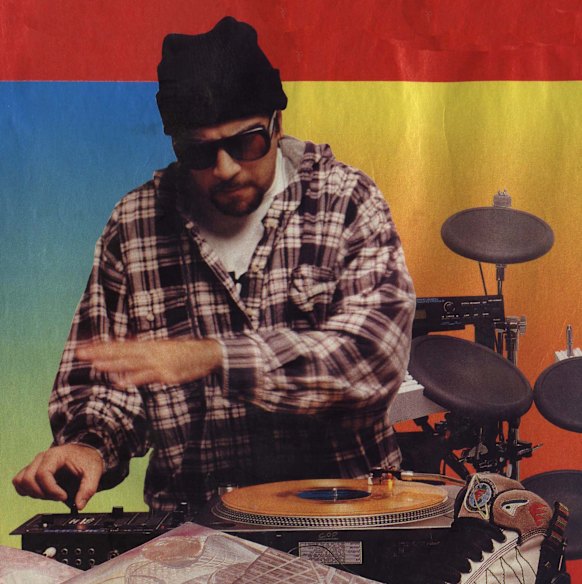
There wasn’t much money in it and the neighbours hated the ruckus when Sabsabi’s crew practised in his garage (his house was firebombed once, though he never found out who did it), and he became well known in the scene. His hip-hop name was Peacefender, which remains his Instagram handle. To make money, he took other jobs such as driving a forklift at a brewery, and “picking up six tonnes of chicken at an abattoir at 4am and delivering it to Lidcombe by 6am”. When a theatre company in Auburn was staging a rap play, they asked him to sense-check the music. “It was definitely not hip-hop, it was more like aerobics music,” Sabsabi says with a laugh. “I was like, ‘You call that hip-hop?’ Ego the size of a planet.” He asked for the tape, remixed it overnight and delivered it back to them the next day.
That was his introduction to theatre and, in return, the theatre introduced him to the concept of workshopping – that is, collaborating with others to create a performance piece. He and his theatre colleagues started doing this in prisons, hospitals and youth centres. “It was about an exchange – you’re offering something and in turn, you’re receiving something. It’s not just being extractive.” From here he got involved in community support work, and was employed over the decades at various migrant, youth and health organisations, where he often used rap and workshopping to teach communication and other skills to marginalised people.
An invitation to contribute to Casula Powerhouse’s 1998 Arabmade exhibition led to the creation of his first artwork. It featured two kilograms of Lebanese ground coffee, which he mixed with glue and painted onto large swathes of material which he then hung on the walls. Called Aajyna, the work included a vibrating bass note, emitted from speakers laid on the gallery floor. It’s probably the only work he’s made referencing his childhood in Lebanon, he says: “Seeking refuge in discarded buildings during the civil war … the dampness and uncertainty, muffled explosions, the whole tension that creates.”
He went back to university in the late 1990s to do a master’s of art at Sydney’s College of Fine Arts and, in 2002, with the help of an arts council grant, revisited Lebanon for the first time. He’d been taking drugs, had split from the mother of his then young son and was grappling with what it meant to be Muslim in the wake of America’s 9/11 terror attacks. He didn’t find peace in Lebanon – rather, he discovered the migrant’s curse that you belong in neither place. He realised, also, how difficult it still was there, particularly compared to his life in Australia.
What he did find, though, through reconnecting with a cousin, was Tasawwuf, or Sufism, the mystical strand of Islam which looks to resolve the tension between inner and outer worlds. “It’s about controlling the ego to get more attuned with the heart,” he says. “When you talk about annihilation within Sufism, it’s about annihilation of the ego, of the self, to be able to tune yourself with your inner self.”
In 2010, he created a work about a western Sydney community of Sufi Muslims, Naqshbandi Greenacre Engagement, which went on to win the 2011 Blake Prize for religious art, the first Islamic work to do so. The multimedia piece features a 90-minute video of people in a scout hall, wearing everyday garb, chanting and going about their religious business in a low-key, even mundane, way.
‘It upset the stereotype of the “angry” Arab, of the “dysfunctional” migrant community, by presenting something full of love.’
Art dealer Josh Milani“It took my breath away,” says Brisbane art dealer Josh Milani. “It was post the Iraq war, post the Cronulla riots. There were tensions around our Islamic fellow citizens and here was this beautiful video of a Sufi community practising in a scout hall in Greenacre. It upset the stereotype of the ‘angry’ Arab, of the ‘dysfunctional’ migrant community, by presenting something full of love.”
Milani has been Sabsabi’s art dealer for more than a decade now and has had time to work out what drives him. “The art world is full of people who are deeply ambitious for themselves, who will do anything for the spotlight,” Milani says. “He’s the opposite of that.”
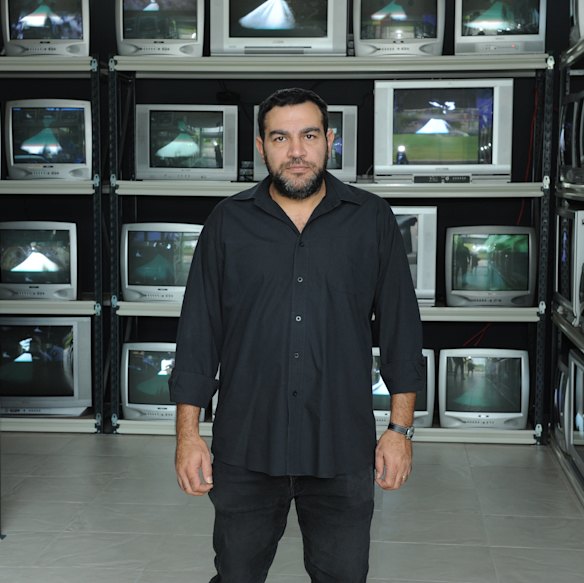
Elizabeth Ann Macgregor makes a similar point when she talks of meeting Sabsabi in 2005, at a public forum for a Museum of Contemporary Art (MCA) exhibition on Lebanese artist Mona Hatoum. “He stood up at the end of the forum and said, ‘I am overcome that an artist with a similar background to mine with a fabulous international reputation is here in Australia, but I would also like to say that there are artists with similar stories working in western Sydney,’” says Macgregor, MCA director at the time.
“He said it very respectfully, there was no anger. It could have been aggressive, or an attack, but it wasn’t, it was just a gentle reminder to us that sometimes, there are artists on your doorstep that you need to look at. And we did need that reminder.”
She asked her team to make sure they included western Sydney artists in their upcoming studio visits. “What was noticeable about Khaled was it was all about drawing our attention to the very interesting phenomenon of what was happening in western Sydney. He talked more about other artists than himself.”
Sabsabi has never left western Sydney, working, getting married again and raising his three children there. But he and his art have gone out to the world, included in biennales, triennales and other group exhibits in places as far-flung as Argentina, China, India, Morocco, Germany and Colombia. And now, in Venice, where the two inter-related exhibits will explore themes related to Sufism. Featuring video, painting and sound, plus scent in one of them, the aim is to take the viewer on a physical and metaphysical journey, at the end of which they realise they’re back at the beginning. “Tasawwuf, universal reverberation – the pulse of the eternal,” Sabsabi says. “It’s this idea of continuously, as a human, learning and unlearning, going through that cycle and understanding who we are as humans.”
It’s a funny thing, the Venice Biennale – a 131-year-old show dedicated to the most contemporary of art, set in one of the most olde-worlde cities on the planet. It’s staged in the gardens, or Giardini, on the city’s eastern flank, which are dotted with 29 national pavilions, simple structures that are filled every two years with art by each country’s selected representative. In the alternate years an architecture biennale is staged along similar lines, and in both, the pavilions stay open from May to November.
The art we’re talking about can be weird, wonderful and WTF – sometimes all at once. Think large-scale installations, photographs, sculpture. Lots of video, not so much painting. You might come out of the South Korean or Japanese pavilion, wander through the gardens, then pop into Venezuela or indeed, Australia. The exhibits are not overtly nationalistic, but the art aficionados who attend enjoy discussing them by country and tend to often agree on who is good this year, and who’s a dud.
“Did you see Poland? Magnificent.”
“What the hell was going on in Russia?”
“Oh you’ve got to get to Egypt. And Serbia. Odd, but I loved it.”
It’s often called the Olympics of art, but it’s not really. The only competition is for a handful of awards including the Gold Lion for best pavilion, which Australian Archie Moore won in 2024.
Australia secured one of the last spots in the Giardini in 1988 and in 2015 rebuilt its pavilion, the $7.5 million cost footed largely by philanthropic art lovers. Many countries don’t have a garden pavilion and, if they want to participate, must hire a venue elsewhere in town and try to lure visitors across canals and down alleyways to see their show. So Australia’s prime location is a big deal, and we take it seriously. About $1.5 million is slated for staging this year’s pavilion show, the majority raised from private donors and $500,000 coming from the Australian taxpayer via Creative Australia. Artists who’ve flown our flag in Venice over the years include Sidney Nolan, Patricia Piccinini, Tracey Moffatt and Howard Arkley.
Alongside these pavilions is a group show held in the nearby Arsenale, the artists in it selected by a curator of significant esteem. To be included in this exhibit is, in contemporary art circles, considered a greater “made it” stamp than to show in a national pavilion, with all the country-level politics and compromises the latter involves.
It’s one of the big plot twists in the imagined Khaled Sabsabi Does Venice satirical TV show that after everything went down last year, Sabsabi will end up becoming the only Australian artist to ever show in tandem in both the national pavilion and the Arsenale, a dual honour only given to any artist a handful of times in the Biennale’s history.
Khaled Sabsabi had applied for the Venice gig three times before and didn’t expect to get it this time around. An Arab-Australian, a Muslim, an artist of and about western Sydney – his selection was surprising to some, given global tensions around the Middle East, significant to others. “It was a moment for us as a nation to own this part of our history and identity, and to celebrate it in a positive way,” is how Milani puts it. “A leading cultural body was embracing Khaled with a heroic certitude, saying, ‘We’re putting you out there as one of us’ and in the process, shifting what we see as Australian art.”
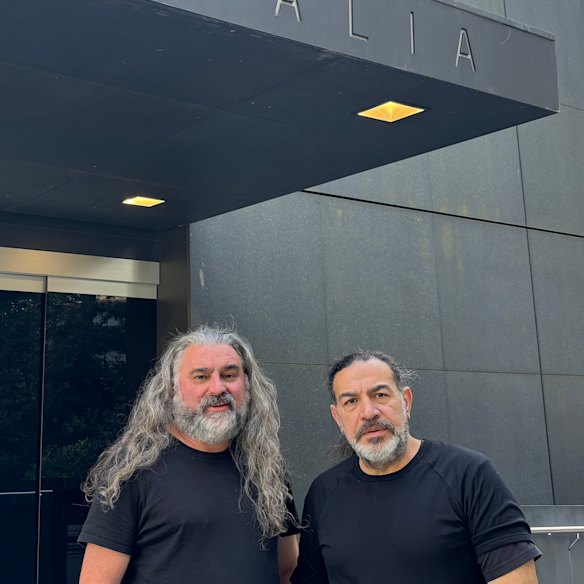
Sabsabi had six days to bask in that certitude. Then, on February 13, 2025, following an article in The Australian, opposition arts spokesperson Claire Chandler stood up in Parliament and asked why the Albanese government was “allowing a person who highlights a terrorist leader in his artwork to represent Australia on the international stage at the Venice Biennale?” She was referring to Sabsabi and his 2007 work, YOU, which features images of the then Hezbollah figure (later leader) Hassan Nasrallah with shards of light beaming down on him. She then mentioned Sabsabi’s 2006 work, Thank You Very Much, which features video of the Al-Qaeda terrorists flying planes into New York’s Twin Towers on 9/11, followed by the words “thank you very much”, spoken by then US president George W. Bush. “Will the Albanese government immediately reverse the decision for Mr Sabsabi to represent Australia at the Venice Biennale?”
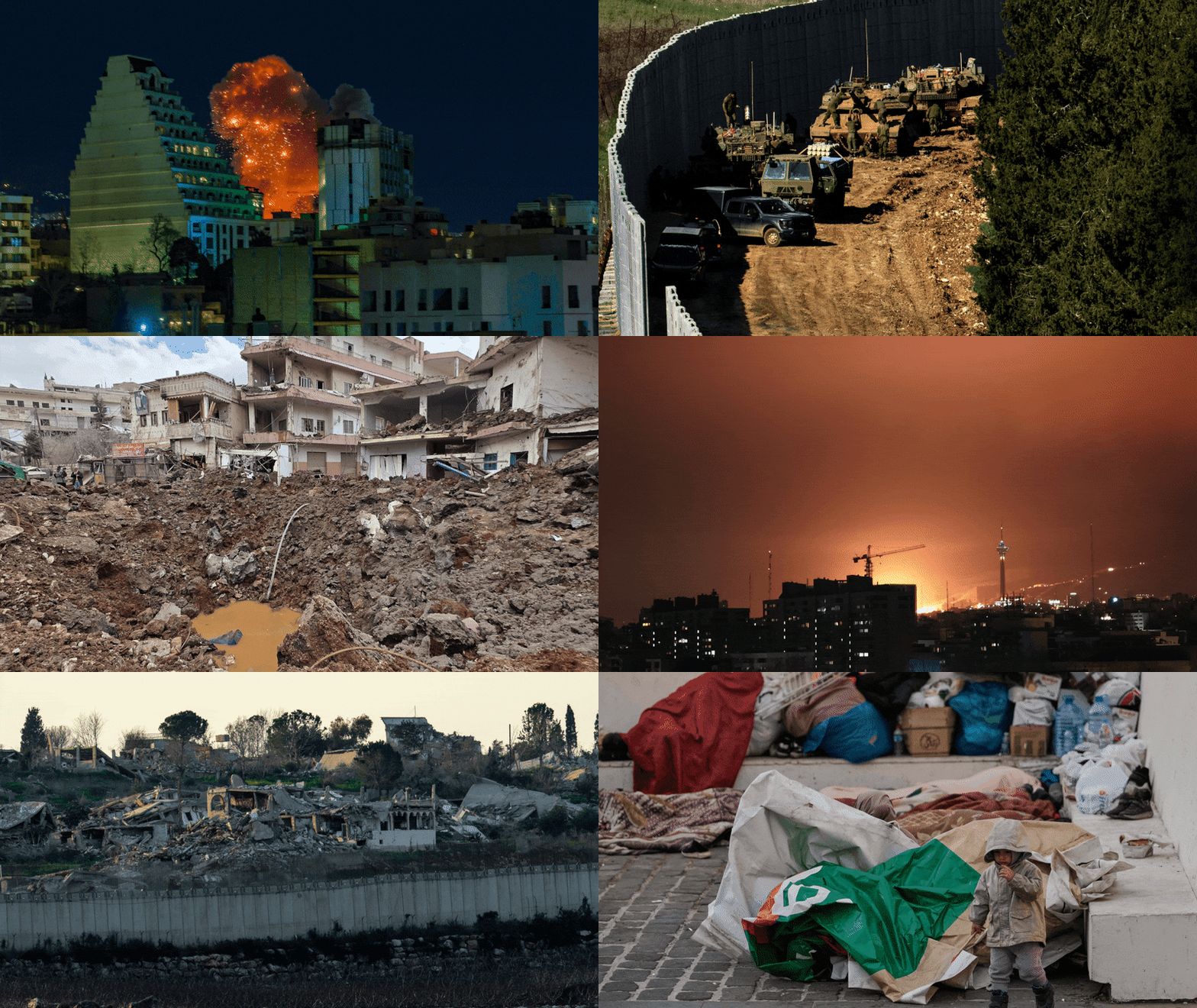
Tensions around the Middle East had been extreme since Hamas attacked Israel on October 7, 2023, killing 1200 of its citizens and kidnapping about 250 others as hostages (168 were returned alive to Israel, some not until October 2025). Israel’s massive military response killed at least 70,000 Palestinians over the next two years and reduced large parts of Gaza to rubble. In Australia, as elsewhere in the world, all this cleaved the community in two. There had been pro-Palestinian rallies, synagogues firebombed and Jewish businesses attacked. Only weeks before Sabsabi’s Venice announcement, a caravan had been discovered in outer Sydney packed with explosives and antisemitic material, not yet known to be a hoax. The Jewish community felt its warnings about rising antisemitism were falling on deaf ears.
A federal election was looming – which nobody yet knew would lead to a Labor landslide.
Various phone calls were made, including from arts minister Tony Burke to Creative Australia CEO Adrian Collette. A Creative Australia board meeting was hastily convened for that night. After a tense few hours of deliberation, the board decided to rescind Sabsabi’s commission. The accompanying press release said that while it was not an “adjudicator on the interpretation of art”, the board felt the risk of a “prolonged and divisive debate about the 2026 selection outcome” posed an “unacceptable risk to public support for Australia’s artistic community and could undermine our goal of bringing Australians together through art and creativity”.
‘If they want you to stand down, they’re going to have to spill your blood and clean up the mess.’
Art dealer Josh MilaniJosh Milani was driving from Cairo to Alexandria with another of his artists on February 13, 2025, when his phone rang. It was Sabsabi, who’d just received a call from Collette. “They’ve asked me to withdraw,” the artist told his dealer. “What should I do?” Milani asked him what he thought he should do. Sabsabi said he didn’t want to withdraw. “Well, if they want you to stand down, they’re going to have to spill your blood and clean up the mess,” Milani recalls saying. He worried that if Sabsabi stepped down voluntarily, it would appear akin to admitting there was ill intent in the contested artworks.
Milani read the news of Sabsabi’s cancellation on his next pit stop. Blood had indeed been spilled. His first concern was for Sabsabi’s wellbeing. “The sheer emotional whiplash of having been held up to the highest position in Australian art, then dumped, in front of all your peers, the international media, with children, a wife, an ageing father. I was worried for him personally.”
Things moved swiftly. Creative Australia’s head of visual arts, Mikala Tai, resigned that night, as did her program manager, Tahmina Maskinyar. Tai was affronted that, after all the work they’d put into the selection, nobody had asked for her or her team, let alone the artist himself, to address the board and explain the controversial works. Artist and board member Lindy Lee woke the next morning and also resigned, posting a statement to her social media saying that while the cancellation had been “made in good faith” and that “nobody except those involved can ever know how fraught and heartbreaking that meeting was”, she’d come away feeling deeply conflicted. “I could not live with the level of violation I felt against one of my core values – that the artist’s voice must never be silenced.”
Investment banker, philanthropist and art collector Simon Mordant, who’d agreed to be global ambassador when Sabsabi was appointed, pulled his money and resigned his role, too. He had close links with both the Biennale and Sabsabi, developed over many years and many conversations. He’d worked with Sabsabi on a NSW government visual arts board, where he found him diligent and thoughtful, and co-funded with Creative Australia the Rome residency that Sabsabi had won in 2023. He’d entertained him at his home in Umbria. “I would never knowingly support an artist or art that glorifies terrorism, racism or antisemitism, or that went against my values,” says Mordant, who is Jewish by heritage.
Milani and Dagostino, meanwhile, organised a meeting with the Creative Australia board, urging them to reconsider. “I said, ‘You’ve made a rushed decision, it’s harming Khaled’s livelihood,’” says Milani. “‘I know you’re not malicious. When you’ve done the wrong thing and it’s led to a gross injustice then the right thing to do is correct it, and the sooner you do it, the less harm done.’”
Petitions were launched and art magazines ran articles contextualising Sabsabi’s work, and more than $200,000 was crowdfunded for him to keep making the work and get it somehow to Venice. Elizabeth Ann Macgregor publicly condemned the decision, saying among other things that YOU had been in the MCA’s collection since 2009 and none of the 60,000-plus members of the public who’d seen it had complained about it. Behind the scenes, Mordant and Tai started speaking with the Arsenale curatorial team to see if they’d include Sabsabi’s cancelled work in their group show. Also apparently working hard to smooth things over was Creative Australia board member Larissa Behrendt, a lawyer who’d not been at the February 13 board meeting. Sabsabi’s team, meanwhile, began exploring legal avenues for redress.
On the other side, somebody put together a dossier subtitled Soft Jihad in the Gallery: How Ideology Masquerades as Multiculturalism, which analysed a number of Sabsabi’s works. The unnamed author (or authors) write in the executive summary that Sabsabi’s work “appeals to the viewer’s sense of justice, yet rarely confronts the extremist ideologies or authoritarian forces it tacitly echoes”, that it goes beyond expressing resistance to “invoking, supporting and reinforcing extremist ideology through symbolic language”.
Reporters discovered that Sabsabi had signed petitions in 2023 against the Israeli government’s sponsorship of a Sydney Festival dance show, and in 2024 against Israel’s participation at that year’s Venice Biennale, and that the MCA’s initial description of YOU said it was “suggestive of divine illumination”.
All in all, if the cancellation had been done to avoid a divisive public debate, it was backfiring badly.
Labor won the federal election and arts practitioner Wesley Enoch took over as Creative Australia chair. The board asked recently departed Art Gallery of NSW director Michael Brand, an Islamic art specialist, to speak to it about Sabsabi. The AGNSW had held a solo show on Sabsabi in 2020 and Brand knew him well. “There’s nothing in Khaled as a person, who I’ve known for 10-plus years, and nothing in his work, that would cause a reasonable person to suggest he’s a proponent of any sort of violence,” says Brand, who has since joined the Creative Australia board.
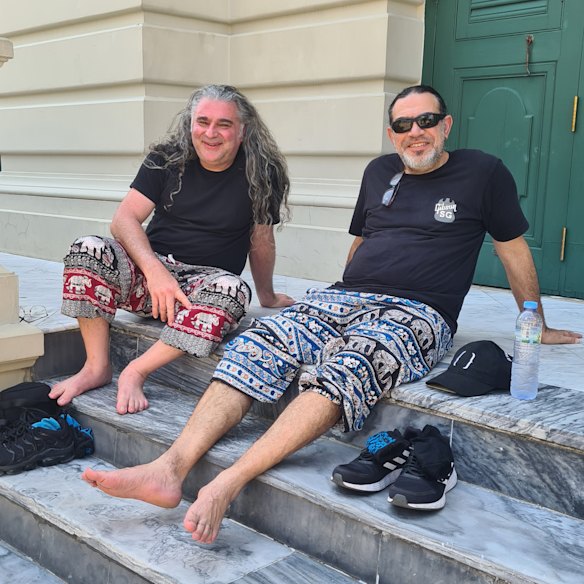
The artist, meanwhile, escaped to Bangkok, borrowing the studio of friend and fellow artist Abdul Abdullah. Yes, to get away from the noise, but also to keep working. “For us, it’s always been about the work,” he says. “I’m an artist, Michael’s a curator, that’s what we do, it’s how we manifest ourselves and share with the world.”
Five months after the whole firestorm began, following an independent report commissioned by Creative Australia that concluded “a series of missteps, assumptions and missed opportunities” was to blame, Sabsabi was reinstated.
Back in his Green Valley studio, I ask Sabsabi about the two works that led to everything. He sighs. He must have known this was coming. “They’re about propaganda, the power of propaganda, how it can be used and seeded and distorted,” he says. “I’ve always, always, always said personally that hate and violence are only going to cause more hate and violence. We need another way. That’s essentially the works for me. That’s really it for me.”
Dagostino jumps in. “There’s a difference between art and propaganda. Propaganda is singularly focused, with a clear intent. Art is the complete opposite. With Khaled’s practice, the idea is there’s no fixed position. There are multiple interpretations. You see what you want to see in that work.”
What about signing the two petitions against Israel? “I don’t support the censorship of any artist. Nothing changed for me when I signed that Sydney Festival petition. I signed it because I support Palestinian people, a two-state solution.” He was protesting the Israeli government, not its citizenry, Sabsabi says. “I’m Arab, I’m Muslim. I have family members who are intermarried with Palestinians, my aunties, cousins, they’re Palestinian. So it’s family, also.” That won’t seem consistent with creative freedom to many; the artists still lost out. It’s notable, though, that Sabsabi’s signature does not appear to be on any of the current petitions to oust Israel from the 2026 Biennale.
Mordant signed back on as global ambassador and has led the fundraising campaign that’s raised $850,000 from private donors to help stage Sabsabi’s Venice exhibits. Some donors who’ve given previously have dropped out, he says, but new donors have come in. And the Arsenale confirmed it would include Sabsabi in its group show.
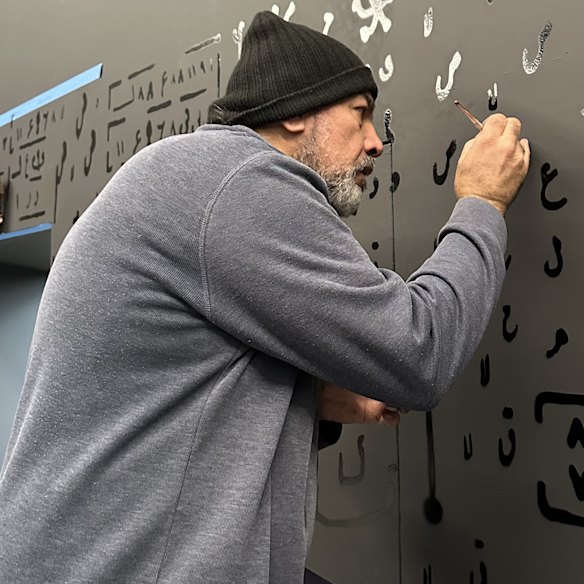
I spy a box of small abstract paintings, dozens of them, on Sabsabi’s studio workbench, and ask about them. They are some of the 400 postcard-sized paintings he’ll shortly be shipping to Venice, where they’ll be presented to some of the visitors to the pavilion – maybe every 1000th person, that’s still to be decided. The recipients will be invited to send them back in eight years’ time, when they’ll feature in an exhibition, the details of which are necessarily, at this point, unknown. “It’s not a marketing ploy, it’s part of the work,” Sabsabi says. “Come eight years’ time, some will be lost, some will be destroyed.” Who knows where any of us will be then, he says. If we’ll even be alive. “Whenever there’s a void, that still contains the story.”
There are lessons in the whole saga. If your processes are sound, back your decisions. Be thorough in your risk assessments – so you know how to defend a work or an artist if they’re suddenly in the spotlight. Don’t let risk assessment become risk aversion. And keep politics out of it.
Somehow, through all this, Creative Australia and Sabsabi and Dagostino stayed respectful enough of each other for a path to be found back. In the end, that says something about all involved. “I gave up being reactionary a long time ago,” says Sabsabi. Adds Dagostino: “We hold no grudges.”
Would they have a cinnamon tea with any of their detractors? “Look, we bring ourselves,” says Sabsabi. “If you come with an open hand of friendship or understanding, my door is open. But if you come to threaten me – I don’t have the health for that any more.”
Get the best of Good Weekend delivered to your inbox every Saturday morning. Sign up for our newsletter.