 1 hour ago
2
1 hour ago
2
It is 6.47am on a Friday morning (14 degrees, feels like nine) and the latest episode of “The Peter Bryden Malinauskas Show” sees a tall streak in a sharp blue suit running at a fair clip alongside Adelaide’s River Torrens. Peter Malinauskas, the 193-centimetre, 79-kilogram South Australian premier, accompanied by his thermos of instant coffee and his mobile phone containing 3483 contacts, is once again cutting it fine.
He has three minutes to rush from an ABC News Breakfast outdoor interview to a nearby live cross on Seven’s Sunrise so he can spruik Gather Round, the AFL’s four-day football festival, where all 18 teams play the entire round of nine matches in South Australia. After four years, it’s a huge success, this year selling 270,018 tickets and flooding local venues with revenue-generating interstate visitors.
It’s the sort of major event that state governments love, so much so that back when South Australia’s negotiator-in-chief got wind that the AFL favoured handing the initial opportunity to NSW, he said to himself, “Nah, that’s bullshit” and stole it out from under them in a celebrated lobbying campaign during the 2022 grand final.
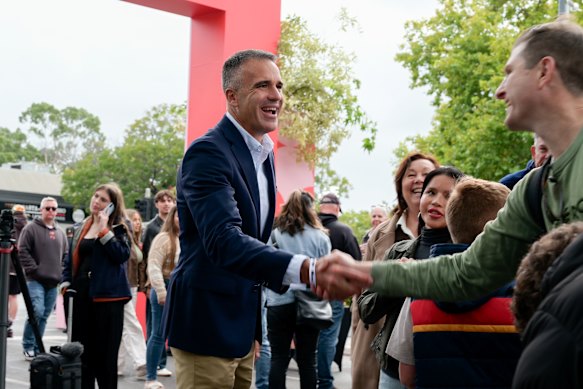
Once again, people are the reason the popular Labor premier is on the crease of lateness. Malinauskas will chat to anyone and they all want to talk to him. People are amazing things, he says, the human condition endlessly diverse. “And that is … captivating, I find.”
The Malinauskas Show has been running for 45 years, the tale of an eager Catholic grandson of Lithuanian, Hungarian and Irish immigrants who in the words of one prominent South Australian politician “has risen to the top without touching the sides”.
The buzz around this political show is now global. The idea to ban social media for kids is getting rave reviews in the UK. Standout scenes include poaching major events (Gather Round from NSW, MotoGP and the Australian Open golf from Victoria), bouncing steel tycoon Sanjeev Gupta out of Whyalla Steelworks, and wooing singer Katy Perry to come and tour.
But there’s also a tough side. In 2011, as a youthful unionist, he is said to have told the then premier Mike Rann it was time to quit; he wore a concealed wire tap for a police investigation into an ALP colleague; and more recently ignited a cancel-culture firestorm after criticising a writer invited to Adelaide Writers’ Week.
Malinauskas (the first premier of South Australia with a non-Anglo surname) celebrated his crushing election victory in March (winning 34 out of 47 seats in the state lower house while reducing the Liberal Party to five) by reciting a Henry Lawson poem. He has views on everything from the political to the personal, the rise of One Nation, boosting the state economy, to the magnificence of healthy sexual relationships and the opposition he faces, including daily defiance from his 11-year-old daughter.
The Sunrise audience of footy fans are pumped when he appears. “Let’s enjoy our premier,” a man in a Richmond cap says excitedly. “He’s the best.”
The premier’s two TV interviews this Friday are followed by three breakfast events, with food and speakers on stage for invited guests – just some of the 34 engagements planned across the week. After he finishes his Sunrise interview, a grey-haired man hands Malinauskas his 17-month-old granddaughter to hold, so that the time little Elsie met Mali – as the premier is universally called – can be preserved in photographic posterity.
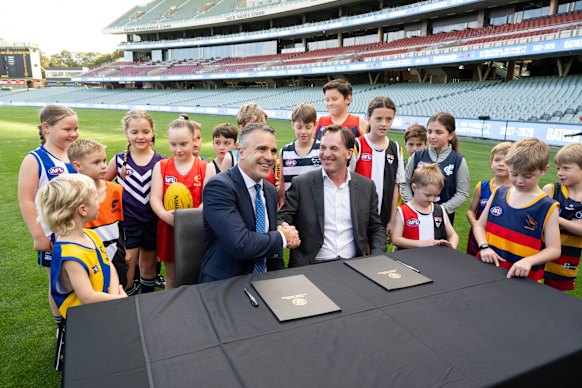
For Mali, Gather Round (which was renewed for three more years in early June), is the biggest platform in the country he can use to sell South Australia as Australia’s future, with its 5 per cent State Final Demand growth for the full year in 2025 (a key economic indicator, eclipsing the national rate of 2.9 per cent), its naval shipbuilding and future AUKUS submarine program, and its 70 per cent share of the nation’s critical mineral copper reserves.
As the admiration and adoration stack up, it becomes apparent that many people within and without the state feel Australia’s future will be Peter Malinauskas. “First impressions matter in politics, and I liked him from the off,” says Alastair Campbell, former director of communications for one-time UK PM Tony Blair. The pair met when Campbell was in town in 2024 for a live The Rest Is Politics – the popular podcast – event.
“I was struck by the sense that he really sees politics as the vehicle to make big change for the better, and I think he has done that in many ways,” Campbell tells Good Weekend. The podcast awarded Malinauskas its 2024 Foreign Politician of the Year for championing the idea of a social-media ban for under 16 year-olds, which was adopted federally and is taking off globally. “His social-media initiative, like a lot of good ideas, has taken off not just across Australia but in different parts of the world. That is leadership, and he has without doubt got a lot of the qualities you need for leadership in the modern age.”
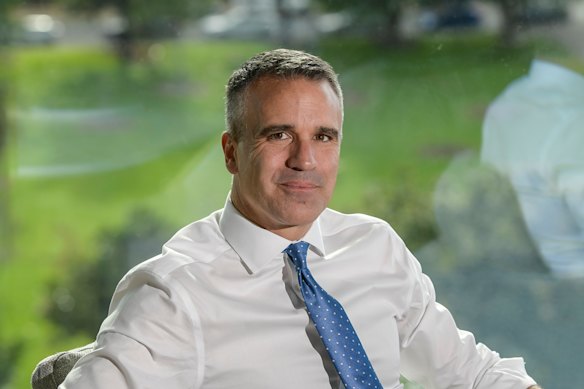
On the ground, those modern leadership qualities can feel less like politics and more like a celebrity cult. A female office worker sidles up in a cafe and asks if she can “fan girl” the premier for trying to bring Formula 1 back to Adelaide. A barista at the convention centre holds aloft a coffee cup – he remembers the premier’s order: almond latte, extra hot.
His charismatic attractiveness is undeniable. A friend who is a South Australian board director sent me the famous pic of a shirtless Malinauskas taking his kids swimming during his victorious 2022 state election campaign, adding the words, “Don’t be wooed by his eyes.”
“He’s the premier from central casting,” says Clem Macintyre, emeritus professor at Adelaide University. “He is telegenic, he is charismatic, he is good-looking, he presents as convincing and serious … He is what he seems to be.”
The football crowd – buzzing that the man with the initials PM could actually become PM – isn’t interested in the other side, the unsolved problem of ambulance ramping (overcrowded hospitals leaving patients stuck in ambulances), the fiasco of the cancelled Adelaide Writers’ Week, the algal bloom off parts of the coastline, bitter anger at the ambitious premier’s enthusiasm for the controversial redevelopment of a 38-storey tower behind Parliament House and the possible culling of more than 700 Park Lands trees to facilitate redevelopment of the MotoGP street circuit and the upgraded North Adelaide Golf Course – the latter to accommodate the Australian Open and troubled LIV Golf tournament.
Residents and Adelaide Lord Mayor Jane Lomax-Smith are up in arms at the government takeover of the city’s iconic parklands for the projects, which has been labelled “draconian”. Even the Labor faithful worry the premier is far too presidential, that South Australia is not so much a one-party state as a one-person state. The future script is yet to be written but the question must be asked: Will Peter Malinauskas go too far?
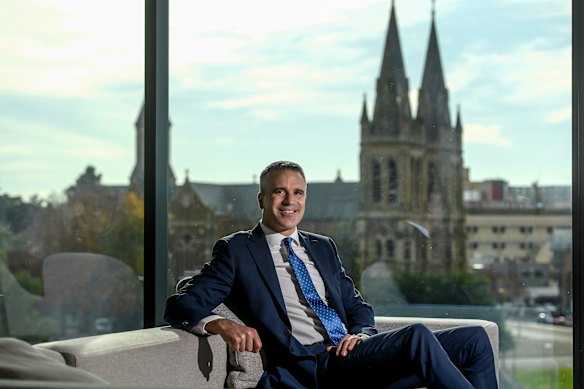
The location of our interview is the Oval Hotel Adelaide. It’s an unspoken but obvious flex at a visiting east-coast journalist, as neither the SCG or MCG can boast anything similar: a well-appointed 138-room, five-star boutique hotel housed entirely inside Adelaide Oval’s eastern stand.
The hotel dining room looks out over the famous oval and is opened early just for us. The premier walks in accompanied by Seven Network AFL commentator Brian Taylor, with whom he has just been recording a podcast.
We start facing each other across a table set for dinner but soon Malinauskas shifts his chair to stare out over the oval, his introspection occasionally punctuated by a football siren. At one point, the atmosphere intensifies, when discussing the Writers’ Week fiasco, and his thoughts are accompanied by a definite tap – the premier has picked up a teaspoon and is driving it onto the white linen surface.
People in public life tend to put up with a lot of shit, I say, asking if his Catholic faith helps him endure it. He says it’s not like that. “In terms of providing a ballast, a sense of perspective, it’s important to me.
“I don’t talk about my faith very much,” he adds. His parents took their three children to church weekly, something he cannot do with his own four kids “and that’s probably another source of guilt”. He is in politics because he wants to create a fair and just society “that aligns with the social justice mission that I think is very much connected towards the best values embedded in Christianity and Catholicism”. But not exclusively, he adds.
Discussing religion is normally off limits for wary politicians. Campbell himself stepped in when Vanity Fair once asked Blair about his faith with a blunt, “I’m sorry, we don’t do God.” But Malinauskas is fine to do God. Religion is clearly important to the socially conservative premier, who says he has “grappled” in the past over legislation on abortion and voluntary assisted dying, before voting in favour. Both are now legal in his state. However, in June, Malinauskas voted in favour of a bill to restrict late-term abortions. He was one of nine lower house MPs to do so – the bill was comfortably defeated 36-9. The legalisation of prostitution, which he did not support, remains heavily restricted in South Australia.
It is here that I get into a slight amount of trouble. Malinauskas points out that journalists asking about religion always go straight for the questions about what faith prompts believers to reject, not the bills it leads them to support. He is right, but addresses his rejection of the prostitution bill.
“I’m not going to win any friends saying any of this, but anyway, whatever,” he says in answer to my question about why he was opposed to the legalisation of prostitution. “It’s about human dignity, right?”
Malinauskas worries women and men, through prostitution, will find themselves in vulnerable sexual situations governed by power and money imbalances that create an environment of servitude. “I just don’t know if that’s something we should be actively encouraging,” he says. “I want young women and men to be enjoying the magnificence of a healthy sexual relationship – not one manufactured out of any form of power imbalance. I don’t think that’s a revolutionary view, or a particularly conservative view, for that matter. I think it’s a progressive view.”
Growing up, the vintage years of this show saw the three Malinauskas siblings – first-born Peter, younger sister Elizabeth and brother Rob – tasked by their dad, also called Peter, a public servant in a housing trust, to watch the news, think about it, and bring their well-thought-out responses on what they had watched – such as a Paul Keating interview – to the dinner table.
Both his father and mother Kate, a librarian for The Advertiser newspaper, “were very big on being objective,” their son says. “I did not know who they voted for. I look back on it now, and I think it was more instructive than I ever would have thought it was at the time.”
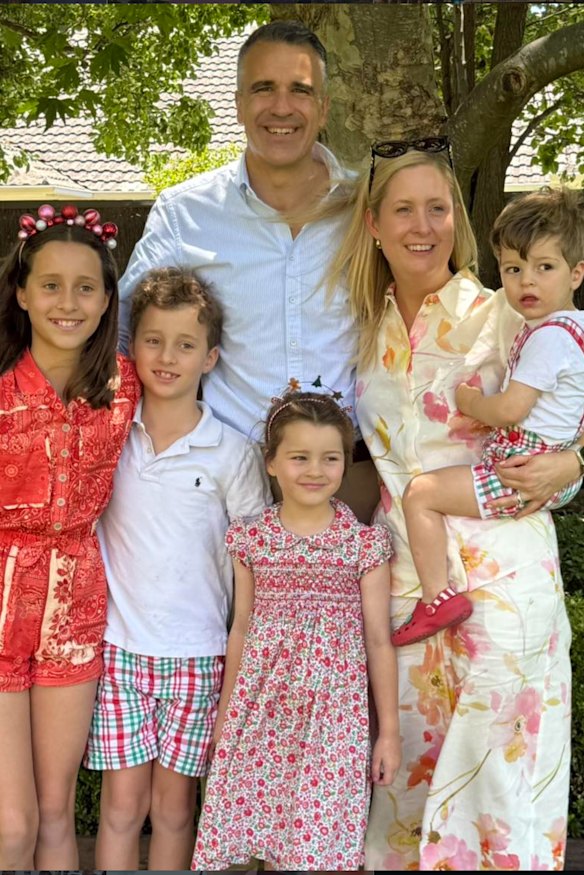
Now he tries to instil the same in his four kids: Sophie, 11, Jack, 8, Eliza, 6, and George, 2. “Whether I’m doing a very good job of it, is a matter of debate,” he says ruefully, almost to himself. Who’s debating that? “Ah, me in my mind, because I’m not around nearly as much as Mum and Dad were around for me.” Does he feel guilty about that? “Absolutely, I do.”
Peter Malinauskas’s maternal family were Irish Catholic, while he was named for his paternal grandfather, Peter, a Lithuanian who opened a fish-and-chip shop in Adelaide after moving there with his Hungarian wife, Eta. Both had fled communism in post-World War II Europe.
“They were pretty determined when I was a youngster to impress upon me how lucky we are to be living in a place like this,” Malinauskas told me in 2023, one year into his premiership, during an interview for The Sunday Age. About his school years at Adelaide’s Catholic Mercedes College, he added, “I can honestly say that I’ve never really bore witness to racism.”
Since being elected premier in 2022, he has instituted spotlight-grabbing changes: the nation’s first Indigenous Voice to Parliament, and amalgamating two universities – University of Adelaide and University of South Australia – into a new institution called Adelaide University.
In 2024, he commissioned former High Court chief justice Robert French to research a social-media ban for children. French concluded a federal approach would be better, so Malinauskas went to national cabinet, which eventually resulted in the federal government’s national ban in December 2025. In 2024, South Australia’s ground-breaking political-donation restrictions were passed, which largely ban donations to political parties and candidates, replacing them with public funding.
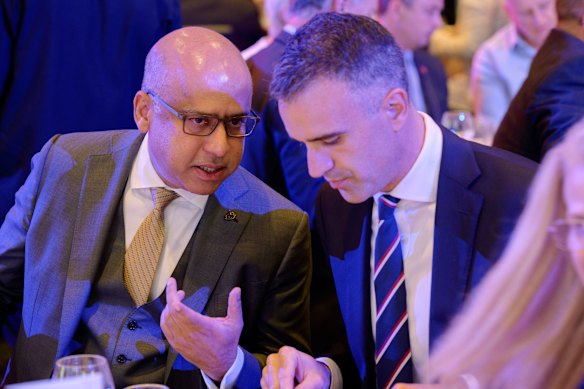
In February last year, Malinauskas removed global industrialist Sanjeev Gupta from control of the Whyalla Steelworks in an extraordinary white-knuckle legislative manoeuvre that could have easily derailed. Malinauskas had lost patience with the magnate, who had repeatedly delayed vital infrastructure investments. And the steelworks in the upper Spencer Gulf was not paying its bills, leaving local businesses to wither.
The manoeuvre to oust Gupta involved rushing amendments to the Whyalla Steel Works Act 1958 through both houses of parliament in great secrecy with bipartisan support and minimal debate time. After the bill received royal assent from the governor, it placed the government at the front of the queue and enabled it to call in its enforceable debts, which let it swiftly appoint KordaMentha as administrators and strip Gupta’s company of control.
“It required extraordinary, discreet and deliberate tactical legislative advancement to be able to enliven that provision, and that’s how we pulled off what we did,” Malinauskas says, recalling the intensity of the process.
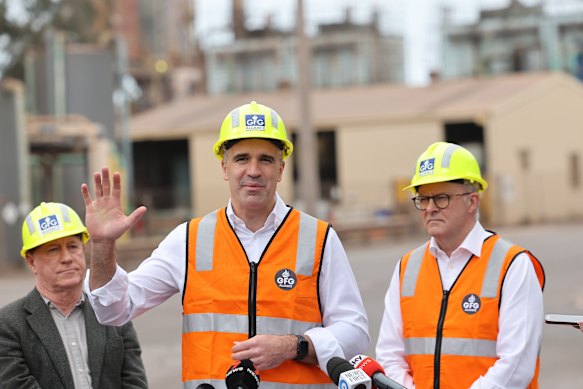
The steelworks are still in administration. He hopes they will be sold by year’s end in a process he calls “reindustrialisation, in a modern form” that would benefit tens of thousands of people. It would be a “game changer for sovereign capability on producing steel, which you can’t build a bloody thing without”, Malinauskas says. Such a radical move to strip a tycoon of control has not dimmed the business communities’ ardour for the premier; in some cases it has increased their admiration.
Before this, Gupta had been a regular visitor to South Australia and his company had sponsored the premier’s football team, Port Adelaide. That was then. Now: “I have no need to engage,” the premier says, referring to Gupta only as “the former owner”.
Sounds a bit ruthless, I suggest.
“Yeah, it was.”
His effort to win the first Gather Round contract over the weekend of the 2022 grand final is now famous, culminating with the premier bending the ear of AFL commissioners in the MCG Olympic Room and triumphing over assumed winner Sydney. (Meanwhile, the Geelong Cats did the same to the Sydney Swans on the field, winning by more than 80 points.) Two years later, Malinauskas returned to the MCG grand final with a new target: pre-match entertainer Katy Perry. The US recording artist had left Adelaide off her planned 2025 tour.
Malinauskas got on the phone to his state Treasury officials and promised to underwrite ticket sales if promoters were unable to sell out in Adelaide. The promoters then excused themselves to take the deal to the recording star, but Malinauskas wasn’t about to be left behind. “I thought, ‘Not without me you are not,’ ” he said later. Malinauskas invited himself along so he could meet Perry and lobby her personally.
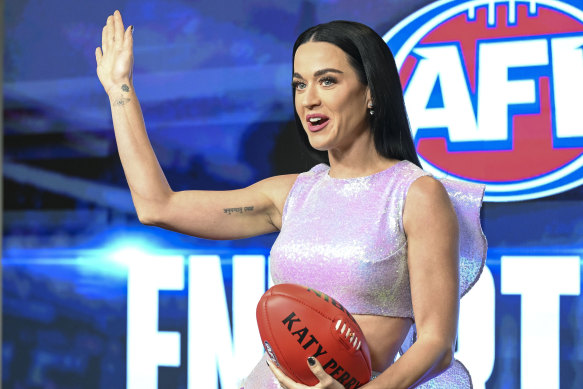
The deal was done, the singer was snapped fist-bumping the rock-star premier at the MCG in a corporate box, and on stage at the Adelaide Entertainment Centre, Perry personally apologised. “I was acting really silly,” she told the screaming fans before pointing out “the Premier Mr Peter”. “You demanded that I come to Adelaide, so thank you, sir.” Perry played four nights.
In the newsroom before my trip to Adelaide, I find a small badge on a nearby desk. I decide it’s a sign and to gift it to Malinauskas because, in a way, he owes this badge everything. When I tell Malinauskas I have a gift for him, I can tell he finds it weird (it is weird) but he goes with it because he is a polite man, and a man used to receiving people’s 11-month-old granddaughters.
On the badge are three letters: SDA. The Shop, Distributive and Allied Employees’ Association, one of Australia’s largest unions. Without its power in South Australia, and its transformative power on a young eager University of Adelaide commerce student and night filler at Woolworths at Mitcham in Adelaide’s east, Malinauskas would never have become premier.
The first mention of Malinauskas in newspaper archives is a short report from 2007 stating “the union movement in South Australia is being rejuvenated with youth”. It reports Peter Malinauskas, 27, would replace Don Farrell as secretary of the Shop, Distributive and Allied Employees’ Association, “the most powerful union position of the state”.
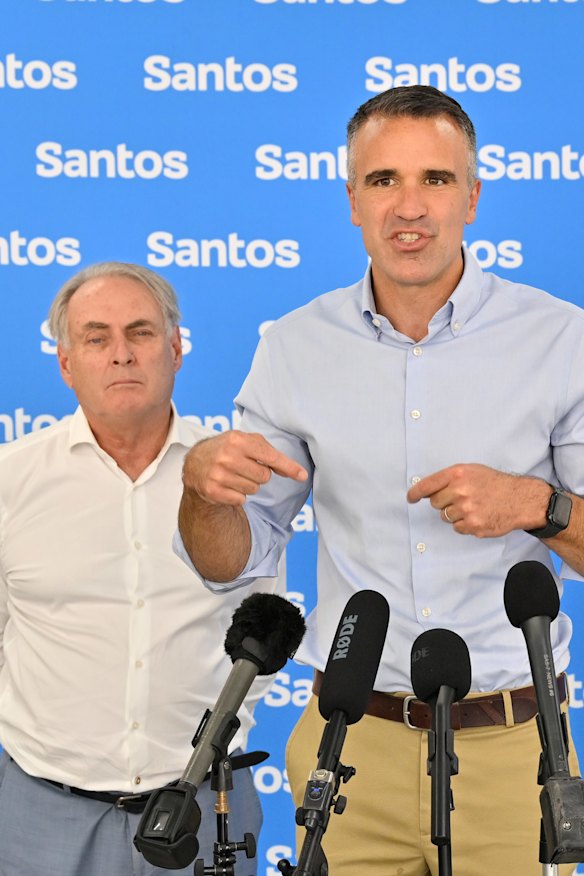
Farrell, now federal trade minister, says the pair’s fateful meeting in 2001 nearly didn’t happen. Farrell wasn’t keen to meet the young Woolworths worker that his old school friend, Father Peter Kennedy, knew from Mercedes College. And Malinauskas’s mother, Kate, wanted to get to a family lunch. But meet they did, and Farrell was so impressed he hired the university student as a casual union organiser on the spot. His spur-of-the-moment hire later proved his worth. “He signed up 1500 members in a single year. It was a record,” Farrell recalls.
The lives of mentor and mentee are still entwined. Malinauskas met his wife, Annabel West, after Farrell’s older daughter introduced them. And Farrell’s son-in-law, Laurence Ben, is an assistant minister in the Malinauskas government.
The SDA was a significant pathway to politics and, alongside church and family, shaped Malinauskas’s world view. It taught him how to negotiate with the owners of capital and “understand they don’t come from a place of being wrong, or evil or mean-spirited”. He learnt successful negotiation was all about understanding their position. “Even though you might disagree with them, which often I did.”
Malinauskas was aged 30 and running the shoppies union in South Australia when his own negotiation with the boss became highly publicised. He was accused of being a “faceless man”, the party’s right-wing power broker who tapped premier Mike Rann on the shoulder in August 2011 and told him he had lost factional support. Rann announced his resignation decision days later.
Even now, Malinauskas, who maintains friendly relations with Rann, doesn’t want to say much. “It was really unfair and unfortunate, and it was very regrettable from my perspective,” he says of the way the incident was reported.
Some characterise the famous meeting where Malinauskas told Rann he’d lost support as standard factional management that has made the South Australian Labor Party the best-run in the land. Others feel the meeting was actually part of a planned transition process that blew up after the news leaked.
So, is Malinauskas saying that the reporting of the infamous tap on the shoulder incident was a mischaracterisation of what actually happened?
“Honestly, I couldn’t overemphasise that. Yes.”
On the ABC News website is a short clip headlined “SA premier becomes emotional in press conference”. It shows the tough unionist’s eyes well up as he discusses Adelaide Writers’ Week. Malinauskas tells journalists he does his best to examine his conscience and offer a view “consistent with the interests of compassion and treating people with decency and humanity”.
‘The racism accusation gnawed at me because it’s so contrary to everything I believe in.’
Peter MalinauskasAt the time, pro-Palestinian activists had accused him of racism. “My motivation for the decisions I took on Writers’ Week were strictly in accordance with my abhorrence of racism in all its forms,” he says now. “The racism accusation gnawed at me because it’s so contrary to everything I believe.”
Yet Malinauskas fell out of favour with a huge swath of the culture community over his intervention back in January, which became national news. Following the Bondi terror attack, in which 15 people were killed, Malinauskas had written a letter strongly objecting to the Adelaide Writers’ Week festival inviting Australian-Palestinian author Dr Randa Abdel-Fattah to the event.
The governing Adelaide Festival board, which had requested the letter, was split, but ultimately cancelled its invitation to the academic and outspoken Israel critic, prompting a mass author boycott. Most of the board resigned, Writers’ Week was cancelled and the broader arts festival teetered as Britpop legends Pulp, hired with extra funding provided by the premier to perform a free opening concert, contemplated joining the boycott.
“Writers’ Week,” Malinauskas says now, in a tone somewhere between resignation and exasperation. “I don’t know what I would do differently if I had my time again. Which is not the answer that most people want to hear.”
Judy Potter, a former chair drafted in by a desperate government, promised to fix the festival if given full authorisation. Malinauskas agreed. Potter promptly apologised to Abdel-Fattah and invited her back in 2027. Pulp agreed to perform, the broader Adelaide Festival was saved from collapse and Abdel-Fattah accused the premier of defamation in a letter sent by her lawyers – who at the time of writing had not lodged any court documents (Abdel-Fattah has since indicated she would not be pursuing the action).
But the arts community remains deeply unhappy. The premier was “foolish” to accept an invitation from the chair of the board to express his opinion, says Greg Mackie, a senior public servant during the Rann premiership, who also helped to program Adelaide Writers’ Week and founded the Festival of Ideas. “It was clueless to the cultural politics that all this was imbued with.”
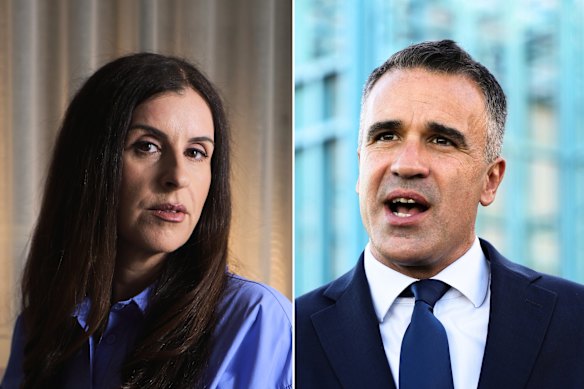
It seems naive to think that a powerful premier could let a board know his attitude and then assume that because he had reassured them of their independence they wouldn’t follow his advice. But Malinauskas says he knew the political consequences would be ugly no matter what his stance. So he took the stance his conscience dictated.
“One of the accusations that gets bandied around the place is that I care about sports and not the arts. I cop that, fine. Not accurate in my view,” he says. “While I cannot talk about the arts as an aficionado, like I care about a footy game, I absolutely appreciate its importance to society writ large.”
South Australian Greens senator in the federal parliament, Barbara Pocock, says Malinauskas’s Writers’ Week actions were “truly a debacle”. “The premier interfered. He leant on the group that was authorised to put together the event. And I think that was a real disappointment.”
However, it did nothing to move the needle at the South Australian state election in March, which was an unprecedented triumph for the premier and Labor. Pocock notes that despite Mali’s popularity, nearly one in four South Australians voted for One Nation. “I think he’s been very careful in his language about One Nation voters, and cautious about attacking them,” she says.
His respectful attitude in dealing with retail-sector bosses, which he deployed to overcome opposition to his Voice to Parliament in his first term, is now being engaged to counter One Nation.
At his second state election victory celebration, the premier did something politically unusual. He read out a poem, The Duty of Australians by Henry Lawson, later telling ABC Radio he wanted to warn progressives against sneering about patriotism and the flag as it only helps One Nation.
In this it is clear his grandparents’ experience fleeing post-war Europe and setting up a fish-and-chip shop in the Adelaide suburbs had a profound effect. “They came here with nothing and the country gave them a chance. And gave them everything,” he told The Sunday Age in 2023.
With all the fan-girling and baby-holding, receiving the McKinnon Prize for political leadership and a Roy Morgan approval rating of 61 per cent at the March election, it seems fair to ask how Malinauskas stops his ego soaring into orbit. “Oh, others sort that out for me. Mates, wife, close colleagues who speak truth to power and take great virtue in it,” he says, before expanding on his theme. “Watch the ABC. Listen to talkback, read Facebook comments. That will sort your ego out pretty quick.”
“He is an excellent retail politician, probably second to none,” says Greg Mackie. But one who is “purposely presidential, for better and at times for worse”. But the government’s pro-development and major events “blind spots” causes him to add: “Many of us rusted-on Labor voters are losing faith.”
Active Facebook denunciator Stewart Sweeney, once a policy adviser to Don Dunstan, the progressive former Labor premier in the 1960s and 1970s who also attracted a celebrity fervour, criticises the premier’s “gold rush of new towers” and “sugar hit of constant subsidising of sports events, music events, any kind of event” that will generate “fly-in, fly-out, visitors” at the expense of building a more sustainable economy.
South Australia is a small state with 1.9 million people, but its smaller economy is faster-growing. State debt is $35.5 billion, forecast to swell to $49.2 billion in 2028-29 and $53.6 billion in 2029-30, largely as a result of two significantly large infrastructure projects, the Torrens to Darlington motorway project and the New Women’s and Children’s Hospital. “It’s a tough gig,” Sweeney says. “That’s why you need more considered, longer-term thinking.”
Pocock says the state’s significant problems include rising house prices, widening inequality and an increase in homelessness. “While the premier had success in the election, these are problems which aren’t going to go away. We also have seen a real challenge to face up to the ecological challenge of the Murray River and the warming of our ocean, which led to a very harmful algal bloom.”
Opposition is coalescing around the premier’s enthusiastic backing for the 38-storey tower to be built by the Walker Corporation between Parliament House and the Festival Theatre, and his wresting control of the North Adelaide Golf Course from the Adelaide City Council for upgrades to accommodate both the Australian Open and LIV Golf, the latter of which has an uncertain future now the Saudi government is withdrawing funding.
Pocock says: “I am extremely concerned about the government’s tendency to deal openly and directly with very wealthy big-end-of-town players like Walker Corporation, which is a huge, private, billion-dollar corporate entity, and fail to take local soundings from people who care a lot about what our city looks like.”
Episodes of exuberance lead to accusations that Malinauskas gets too full of himself, yet even critics of his centralising of power say it has been transformative: “It seems like a long time since Sydney and Melbourne have taken us seriously,” says a prominent SA politician.
At a Gather Round opening function at Penfolds Magill Estate, attended by a who’s who of east-coast chief executives, Malinauskas brilliantly parodied US President Donald Trump’s expletive-laden negotiations with Iran over the Strait of Hormuz by telling the business and sporting elite: “I am going to post on Truth Social: ‘Sign the Gather Round extension you f---ing crazy bastards.’ ”
The crowd loved it. But later at an AFL business lunch, the compere asked him: If he had a daughter in her 20s, which AFL footballer would he most like her to date? “Not Lachie Neale,” he joked. (Neale recently split from his wife, and stepped down from the captaincy of the Brisbane Lions, amid accusations of infidelity.) The response drew laughter but also gasps. “Too soon?” he queried.
Later he ponders if he had gone too far. “I like the AFL a lot, right? And I’m very fond of its people, but sometimes it takes itself a bit too seriously. In politics, you get hardened to criticism. And you learn how to deal with it. I can see plenty of other organisations that are a bit more brittle when they get critiqued.”
Federal politics seems off the agenda. As one observer said, if Malinauskas seriously wanted to be in federal parliament, he would be there by now. Perhaps in the federal electorate of Adelaide, which maps onto the premier’s state electorate of Croydon, where Malinauskas lives in a typical suburban home on a typical suburban street, albeit one with a high wall and security camera. “I don’t think he has any desire to do Canberra,” said one colleague. More recent speculation is that he will remain in the state and develop a business career.
The man in possession of a Stakhanovite work ethic rises at 4.30am and hits the gym at 5am “on the dot” with a civilian mate who is a teacher and has little interest in the goings-on inside the bubble. Then it’s back to a chaotic family breakfast before the day’s official business.
“One of the best things about state politics versus federal politics is, sure, I don’t get home until the kids are in bed. But I do get home,” he says. “I travel a bit around the state, but I spend more time, spend more nights in my own bed than another one.
‘You just do as much as you can while you can, and hope you’re still normal at the end of it.’
Peter Malinauskas“And then, in the morning, I see the kids,” adding that his three older children fight more than he would like during the “chaos” of family breakfasts, but then dote on their younger brother, George. His eldest daughter Sophie, who turned 11 in April, shows “all the signs of having Dad’s worst personality traits, which worries me to buggery” by demonstrating capacity for independent thought.
But this seems exactly what Peter and Kate Malinauskas taught their three children growing up in the 1980s and 1990s in the Adelaide suburb of Colonel Light Gardens. “But that doesn’t have to translate to active defiance at the age of 11, does it?”
When at school, he dreamt of playing professional cricket or AFL but quickly realised he wasn’t good enough. Now his dreams are different: “I would very much love and hope that one day I’m having Christmas lunch with my adult children, who are happy, and I can reflect on having made a contribution to society professionally.”
The light across Adelaide Oval is already changing as the day moves forward. There’s another lunch to get to, a Sunday Footy Show appearance.
“It’s not lost just how temporary all of this is,” Malinauskas says. “[This is] something I try and remind myself of frequently, because it allows you to treat it with the preciousness that it deserves. A sense of preciousness, it’s rare,” he says. “So you just do as much as you can while you can.
“And then hope you’re still normal at the end of it. And your family still wants to talk to you.”
Get the best of Good Weekend delivered to your inbox every Saturday morning. Sign up for our newsletter.
Read more from Good Weekend: