
 1 month ago
45
1 month ago
45
10 minutes ago
Liv McMahonTechnology reporter
 Getty Images
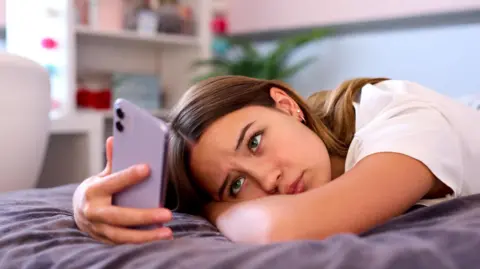
A social media ban for under-16s has been announced by the UK government. It will be introduced in early 2017.
The goverment is also considering an overnight curfew and measures to stop infinite scrolling among under-18s.
Keeping children off social media is the best way to keep them safe online, Prime Minister Sir Keir Starmer said.
Which social media platforms will be banned for under-16s?
The ban will cover platforms including Snapchat, TikTok, YouTube, Instagram, Facebook and X, the government said.
A complete list of which platforms the ban will apply to has not been released. However, the government said it would cover those "whose purpose is to enable social interaction and which allow users to post material".
Features including livestreaming and strangers being able to contact children will also be restricted.
The government said it did not intend to include messaging services like WhatsApp and Signal in the social media ban.
Most social media platforms already require children to be over 13 to create an account and use their services.
What measures are planned for under-18s?
The government said that for the "high risk" functions of livestreaming and chat with strangers, restrictions would be on by default for under-17s "to prevent a cliff-edge at 16".
It said it was also looking into overnight curfews and breaks in infinite scrolling for under-18s, with more detail on this to be set out in July.
AI "romantic companion" chatbots, which are designed to simulate sexual relationships or role play with users, will have to enforce a minimum age of 18.
AI chatbots more widely will have to restrict "intimate functionalities" for under-18s, the government said.
When will the social media ban be introduced?
The prime minister said the government plans to pass regulations before Christmas.
This would allow the ban to be introduced by spring 2027.
The announcement follows a public consultation which received more than 116,000 responses.
The government said "highly effective age assurance" measures would be used to check the age of those using social media.
This typically involves requiring companies to use tech that accurately estimates or verifies someone's age - such as face scans or asking for ID.
The regulator Ofcom has been asked to carry out a rapid study to identify the best ways to verify if someone is over 16.
A number of platforms, including porn sites, are already required to carry out these checks. Ofcom has fined several platforms for not complying.
But concerns have been raised about tools such as virtual private networks (VPNs) being used to get around these measures.
How have families and children reacted?
Among those who have called for social media to be banned for under-16s are bereaved parents.
Mariano Janin, whose daughter Mia died aged 14 after she was a victim of cyber-bullying, said the announcement had left him "speechless".
"I think it's a change in the right direction, it won't be easy, but it will be possible," he said.
Lisa Kenevan, who believes her son Issac died aged 13 after taking part in a viral trend, told BBC Breakfast that while parents wanted the ban "a lot sooner", the announcement means "we're in a good place now".
However, speaking ahead of the announcement, Ian Russell - whose daughter Molly took her own life at the age of 14 after viewing harmful content online - accused the government of rushing restrictions for political reasons. He said "sledgehammer techniques like bans" only cause more problems.
Some teenagers have expressed concern about how a social media ban will affect their ability to connect with friends and express themselves.
George, who is 14, told BBC Radio 4's Today programme he felt people his age should be able to make their own choices because "we're beyond people saying what we have to do".
Lilly, 15, from Cumbria, said apps like TikTok allow her to "communicate more", for example by allowing her to post videos of her performing.
What have social media firms said about the ban?
Facebook and Instagram-owner Meta said a ban would not achieve the goal of keeping teens safe online.
"As we've seen in Australia, bans risk isolating teens from online communities and information, and driving them to unregulated alternatives that lack built-in protections and parental controls," it said.
It said restrictions should be "underpinned by an age verification system on devices", so that people aren't asked to "hand over ID to dozens of individual services".
YouTube said it was a "vital resource for young people" and also said the ban risked pushing children towards "anonymous, less safe services".
Snapchat said the majority of time on its platform was in private messaging between friends and family and that a ban "may simply push them to less safe platforms".
What is Australia's social media ban and what have other countries done?
Australia introduced a social media ban for children in December 2025. The UK government said it would follow this model.
The most popular sites in Australia are now required to prevent children from being able to set up new accounts. Existing profiles belonging to under-16s had to be deactivated.
Australia's rules apply to 10 platforms: Facebook, Instagram, Snapchat, Threads, TikTok, X, YouTube, Reddit and streaming platforms Kick and Twitch.
The fact that it did not include gaming platforms Discord and Roblox was criticised by some.
More than six months on, implementing the policy remains difficult.
One student told BBC News that in her grade of more than 170 students, she knew of only three who had been booted off social media.
And 70% of parents have told Australia's internet regulator their children were still on these platforms.
No fines have been handed out yet but the eSafety Commission is investigating potential non-compliance by Facebook, Instagram, Snapchat, TikTok and YouTube.
According to the Organisation for Economic Co-operation and Development, 25 countries have social media age restrictions in force, enacted, or under active consideration.
In Spain and Portugal politicians have announced plans and partly voted the rules in. Their bans are likely to come into force this year.
Governments in France, Malaysia, Denmark, Indonesia, Norway and Canada are also in the process of bringing in a ban.
Laws have been passed in several US states but these are being challenged in the courts.



















































