
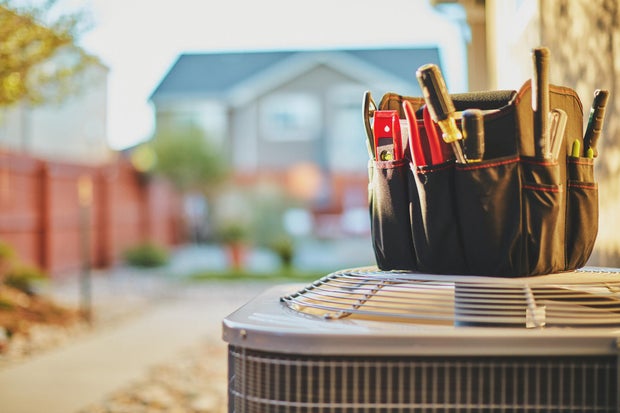
 The choice between repairing and replacing your AC unit can have a big impact on your homeownership costs.
Catherine Lane/Getty Images
The choice between repairing and replacing your AC unit can have a big impact on your homeownership costs.
Catherine Lane/Getty Images
Few household problems create more frustrations or more sticker shock than a malfunctioning air conditioner. One day, your system is keeping your home comfortable without issue, and the next you're facing an unexpected service call, a costly repair estimate, or, in some cases, a recommendation to replace the entire unit. And, with homeowners already juggling higher costs for everything from insurance to utilities, a major HVAC issue can feel like a particularly difficult expense to absorb.
One of the main challenges is that air conditioning problems don't always come with an obvious solution. A technician may identify a failed component that can be fixed relatively affordably, while another issue could point to bigger problems developing within the system. That can make it difficult for homeowners to determine whether paying for AC repairs is a smart investment or whether it would make more sense to put that money toward a replacement.
The choice between repairing and replacing your AC unit can have a significant impact on your immediate budget and your long-term homeownership costs. So, before committing to either option, it's important to understand the circumstances in which repairing an air conditioner may be the more financially sensible move — and when a replacement deserves a closer look.
Find out how ARS can help you keep your HVAC costs low now.
When should you repair an AC unit instead of buying a new one?
If your AC system isn't working properly, replacing it may seem like the safest option. In many cases, though, repairing the unit could be the more cost-effective choice. Here are some situations in which repairing your air conditioner may make more sense than investing in a new system:
The unit is relatively new
Age is one of the biggest factors in the repair-versus-replacement decision. Most central air conditioning systems have an expected lifespan of roughly 10 to 15 years when properly maintained. If your unit is only a few years old and experiences a mechanical issue, replacing the entire system is often unnecessary. Many newer systems still have significant useful life remaining, making repairs a better financial value.
In some cases, your AC components may even be covered under a manufacturer's warranty, which can significantly reduce your out-of-pocket repair costs. So, before considering replacement, check your warranty status and consult a licensed HVAC professional to determine whether the issue appears to be isolated or is indicative of larger problems.
Learn more about your affordable AC and heating options with ARS.
The repair cost is relatively low
A common rule of thumb used by HVAC professionals is to compare the repair cost to the value and age of the system. While there is no universal formula for doing so, many experts suggest that if the repair cost is minor relative to the cost of a replacement system, fixing the unit is usually the better choice.
Replacing a central air conditioning system can cost several thousand dollars, while many common repairs — such as replacing capacitors, contactors, thermostats or electrical components — may cost only a fraction of that amount. If a repair can restore reliable operation without requiring additional major work in the near future, it generally makes little financial sense to replace the entire unit prematurely.
The problem is isolated and not recurring
Not every AC breakdown signals that the system is nearing the end of its life. Sometimes a unit experiences a one-time issue caused by a failed component, an electrical problem or a clogged drain line. If the system has otherwise performed well and hasn't required frequent service calls, repairing the specific issue is often the most practical approach.
On the other hand, if you're facing multiple breakdowns every year or are continually replacing major AC parts, replacement may eventually be the more economical solution. The key to determining which route makes more sense is to determine whether the problem is isolated or part of a larger pattern of deterioration.
Your energy bills haven't increased dramatically
One of the reasons that homeowners choose replacement is to improve efficiency. Older systems can consume significantly more electricity than modern high-efficiency units, leading to higher monthly utility bills.
However, if your current system is still operating efficiently and your energy costs remain relatively stable, replacing your AC unit may not provide enough savings to justify the upfront expense. In those cases, repairing the unit may allow you to extend its lifespan while postponing a major capital expense.
That doesn't mean efficiency should be ignored, however. If an HVAC technician identifies substantial performance issues that are driving up energy consumption, it may be worth comparing the long-term operating costs against the cost of replacement before making a decision.
The repair doesn't involve a major system component
Some repairs are far more significant than others. For example, replacing a small electrical part or fixing a refrigerant leak is very different from replacing a compressor, evaporator coil or multiple major components at once. When major system parts fail — particularly on older units — the repair costs can rise quickly and eventually approach the price of a new system.
If the issue involves a relatively inexpensive AC component and the rest of the system remains in good condition, repairing the unit often provides the best return on investment. But if multiple major parts are failing simultaneously, replacement may offer the greater long-term value.
The bottom line
Deciding whether to repair or replace an air conditioning unit requires balancing immediate costs against long-term value. In many situations, repairing a system makes sense when the unit is relatively young, the repair is affordable, the issue is isolated and the system continues to operate efficiently. However, recurring breakdowns, major component failures and advanced system age can shift the equation toward replacement. Before making a decision, consider obtaining estimates from a qualified HVAC professional like ARS and compare both the short-term and long-term costs of each option. A thoughtful evaluation can help ensure you spend your money where it delivers the greatest value.
Edited by Matt Richardson

















































