
 5 months ago
84
5 months ago
84
Iran's government calls for 'human chains' at possible US targets
The UN chief and the Pope have condemned US President Donald Trump's threat that "a whole civilisation will die tonight" unless Iran agrees a deal to end the war and unblock the Strait of Hormuz.
UN Secretary General António Guterres said he was "deeply troubled" by statements suggesting populations would bear the consequences of political and military decisions. Pope Leo XIV said such threats were "unacceptable".
As the 00:00 GMT deadline approached, mediator Pakistan called for a two-week extension to allow further diplomacy.
Trump had previously told Iran to accept his terms or see bridges and power plants destroyed. Iranian authorities urged people to form human chains near potential US ad Israeli targets.
It came after the US and Israel intensified their strikes across Iran on Tuesday, saying they had hit military targets on the Kharg Island oil terminal and eight railway bridges.
Iran's Revolutionary Guards meanwhile launched more ballistic missiles towards Israel on Tuesday and claimed to have struck a ship in the Gulf and a Saudi petrochemical complex.
As Trump's deadline neared, regional mediator Pakistan asked the US president to extend it by two weeks to "allow diplomacy to run its course".
"Diplomatic efforts for peaceful settlement of the ongoing war in the Middle East are progressing steadily, strongly and powerfully with the potential to lead to substantive results in near future," Prime Minister Shehbaz Sharif wrote on X.
Sharif also asked Iran's leaders to "open Strait of Hormuz for a corresponding period of two weeks as a goodwill gesture".
White House Press Secretary Karoline Leavitt said the president "has been made been aware of the proposal, and a response will come".

 EPA
EPA
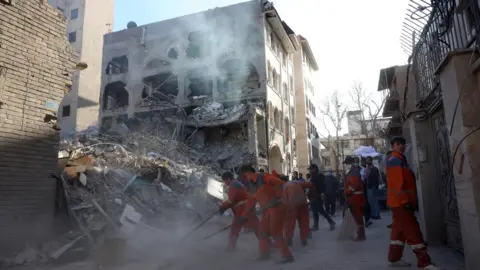
A synagogue in Tehran was destroyed in a strike that Israel said targeted an Iranian military commander
Trump issued an apocalyptic warning to Iran's leaders to increase the pressure on them to reopen the Strait of Hormuz, a narrow Gulf waterway through which about 20% of global oil and gas shipments pass.
"A whole civilisation will die tonight, never to be brought back again. I don't want that to happen, but it probably will," the president wrote on Truth Social.
"However, now that we have complete and total regime change, where different, smarter, and less radicalised minds prevail, maybe something revolutionarily wonderful can happen, who knows? We will find out tonight," he added.
He said the US military could destroy every bridge and power plant in Iran within four hours if his deadline passes without a deal.
Vice-President JD Vance also said he hoped for a deal but that the US had "tools in our tool kit we have so far decided not to use" against Iran if that was not possible. He did not elaborate, but the White House later denied that he was alluding to nuclear weapons.
A White House official also said that US forces had carried out strikes on military targets on Tuesday on Kharg Island, the main terminal for Iranian oil exports in the Gulf. Iran said its oil facilities were not disrupted by the attack.
Israel's Prime Minister, Benjamin Netanyahu, meanwhile said Israeli fighter jets had attacked railway tracks and bridges across Iran on Tuesday which he alleged were used by Iran's Islamic Revolutionary Guard Corps (IRGC) to transport personnel, weapons, and the raw materials to produce them.
"I tell you constantly that we are crushing the terrorist regime in Iran. But we are doing so with even greater vigour, and with increasing force," he declared in a video.
Iranian officials told state media that a railway bridge in the central city of Kashan was struck, killing two people, along with a section of tracks in Karaj, near Tehran.
Iranian media also reported that 18 people were killed in strikes in Alborz province, and that the Rafie‑Nia synagogue in the capital was destroyed in a strike.
Israel's military expressed regret over what it described as the "collateral damage" to the synagogue, saying the strike had targeted a senior Iranian military commander.
Iranian President Masoud Pezeshkian earlier claimed that more than 14 million Iranians had "so far registered to sacrifice their lives to defend Iran".
Dozens of people formed human chains on bridges and at power plants, according to images published by Iranian state media.
The IRGC promised to retaliate beyond the region if "the American terrorist army crosses the red lines".
The powerful armed force threatened to target infrastructure to "deprive the United States and its allies of oil and gas in the region for years".
Earlier, the IRGC said it had attacked a major Saudi petrochemical complex in the eastern city of Jubail with missiles and drones, after similar plants in southern Iran were attacked.
Saudi Arabia's defence ministry said debris from intercepted ballistic missiles fell in the vicinity of energy facilities in the east of the kingdom.
 Reuters
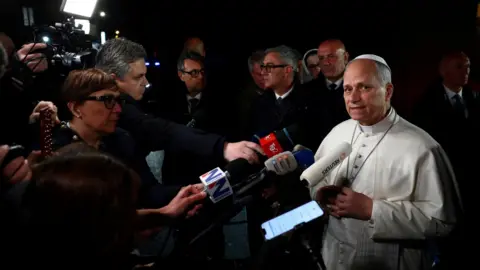
Pope Leo called all parties to the conflict to "come back to the table" for negotiations
The UN secretary general was "deeply troubled by statements suggesting that entire civilian populations or civilisations may be made to bear the consequences of political and military decisions", his spokesperson told reporters in New York.
"There is no military objective that justifies the wholesale destruction of a society's infrastructure or the deliberate infliction of suffering on civilian populations," he added.
Guterres called for stepped-up diplomatic efforts to find a peaceful solution and said his personal envoy, Jean Arnault, was travelling to the region to support them.
The UN human rights chief, Volker Türk, meanwhile said he deplored "the tirade of incendiary rhetoric being used in the Middle East war by all parties", calling it "sickening".
"Under international law, deliberately attacking civilians and civilian infrastructure is a war crime," he warned. "Anyone responsible for international crimes must be held to account by a competent court."
Pope Leo, the first American leader of the Roman Catholic Church, told journalists outside his residence in Castel Gandolfo: "Today... there was this threat against all the people of Iran, and this is truly unacceptable."
"There are certainly questions of international law, but much more than that, it is a moral question," he said.
He also called all parties to the conflict to "come back to the table" for negotiations.
 Reuters
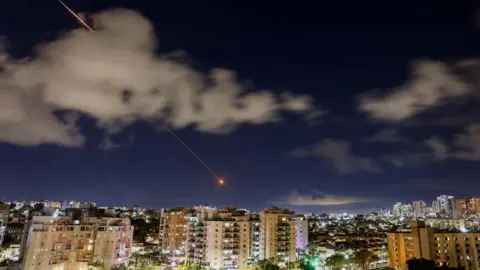
A missile interception attempt in the sky above the Israeli city of Ashkelon on Thursday night
In late March, Trump sent Iran a 15-point plan for a peace deal via Pakistan. It was not published, but it reportedly addressed Iran's ballistic missile and nuclear programmes as well as access through the Strait of Hormuz.
Iran's leaders rejected Trump's demands as excessive, and responded by sending what Iranian state media described as a 10-paragraph proposal aimed at securing a "permanent end" to the war, including a protocol on safe passage through the Strait of Hormuz.
Almost 3,600 people, including at least 1,665 civilians, have been killed in Iran since the start of the war on 28 February, according to US-based Human Rights Activists News Agency.
More than 30 people have been killed by Iranian missile and drone attacks on Gulf Arab states, while 24 people have been killed in Israel and the occupied West Bank, local authorities say.
Thirteen US service members based in the region have also been killed during the conflict.

















































