
 3 months ago
58
3 months ago
58
As thousands of Australians turn out at property auctions across the nation’s suburban front lawns and apartment lounge rooms this weekend, there will be one silent but interested onlooker.
Anthony Albanese’s biggest political and economic gamble – the decision to overhaul the three shibboleths of Australian tax law – will go on the line at every one of the 1994 auctions scheduled for Saturday and Sunday.
The prime minister knows the changes, which include an end to the ability of an investor to negatively gear an existing dwelling, will be front of mind among those holding an auction paddle as they seek to buy their own piece of the Australian dream. A dream that has, for too many, turned into a nightmare over the past quarter of a century.
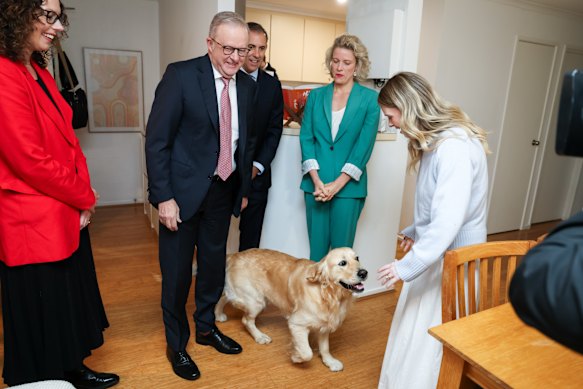
Once, the Coalition claimed to be on the side of the modest home owner. This week, it was Albanese accusing the party of Robert Menzies of betraying the young people of Australia who wanted their own home.
“We are the party of home ownership. We want more family homes. They want to lock young people out of home ownership,” he said.
Treasurer Jim Chalmers had been signalling for months that his fifth budget would be ambitious with a tax package at its centre. He did not disappoint.
It includes limiting negative gearing, the ability for an investor to offset their losses on a property against their total taxable income, which has been part of the Australian tax system since 1922, to people prepared to build a new home.
The capital gains tax 50 per cent concession, introduced by the Howard government, will revert to its pre-1999 structure under which the value of taxable assets was adjusted to the inflation rate. Both capital gains tax and family trusts will be hit with a 30 per cent minimum tax rate.
All three measures have been examined by governments of all colours since the turn of the century. Treasury, the Productivity Commission and even the Reserve Bank have urged reform of each or all of the tax arrangements.
Their pleadings had come to nothing or had been rejected by voters. But that changed on Tuesday night as Chalmers breached election promises made by himself and Albanese by pushing ahead with the biggest tax reform package since 2010.
Chalmers said the changes would deliver a “fairer tax system for workers, first home buyers and future generations”, such as those who will be bidding on a home this weekend.
“We all know about first home buyers rocking up to auctions and being outbid by people who might already own multiple properties,” he said this week. “We’re trying to level the playing field at auctions ... so that people can find these more affordable options.”
But critics characterised it as an attack on aspiration, a new front in Labor’s enduring “class war”.
Liberal leader Angus Taylor, who started the week dealing with the catastrophic 31-point collapse in his party’s support in the regional seat of Farrer, said he would inflict electoral pain on Albanese all the way to the next election.
“We’re going to make life hell for this government because this is an assault on aspiration. It is an assault on hard-working Australians,” he said.
Other critics went even further, including some who warned the changes would induce both huge falls and increases in house prices that would be exacerbated by rent increases ranging between zero and $160 a week.
The Daily Telegraph went so far as to use a Communist-era hammer and sickle in its coverage, almost as if Karl Max had been inspired to write the Communist Manifesto because of Australia’s CGT system.
Some economists said the government could have gone further with its overall tax package.
But once its elements, which included a new $250 working Australians tax offset, its $1000 standard tax deduction, a $20,000 instant asset write-off for small businesses, a loss carry-back for firms with a turnover of less than $1 billion, and a major change to research and development taxation, were revealed, it was clear Chalmers and Finance Minister Katy Gallagher had put in place a substantial package.
It was accompanied by deep cuts, led by far-reaching and much-needed changes to the NDIS, and a suite of productivity reforms that are estimated to cut business red tape while growing the economy by $13 billion a year.
Accompanying the details was something highly unusual for a budget. The federal Treasury added 50 pages to the main budget document, effectively arguing the case for the tax changes. It was the first time such a large piece of analysis had been included in a budget since 2010, and it dwarfed that effort (which put the case for the then resource super profits tax).
The case, at least in the eyes of Treasury, was that the mix of Australia’s negative gearing, CGT concession and trust arrangements has meant people invest their savings to chase lower tax rather than build a productivity-enhancing new company or asset.
That’s closely associated with an issue that has been of concern for some time, and not just in Treasury. The tax system encourages people, almost universally older and more well-off people, to borrow large amounts to buy existing investment properties.
The combination of chasing tax benefits with big mortgages translates into higher and higher house prices. Since the turn of the century, the average mortgage has soared by 400 per cent to $735,000. In NSW, it has reached $860,000.
Sydney is by some measures the second most expensive city on the globe: the median house price is almost 14 times the median income.
With Melbourne, Brisbane, Perth and Adelaide, Australia has five of the 20 most expensive cities in the world (it would be six, but Canberra is considered too small).
A lack of supply remains the key cause for such high prices. This week, the government threw another $2 billion at helping local councils and utility providers to build the infrastructure needed to support new homes.
But according to the Treasury, the current tax system also plays a role. “Low effective tax rates on property investments caused by the interaction between the 50 per cent CGT discount and negative gearing create strong incentives for investors to take on highly leveraged housing investments,” it said.
“This leads to higher house prices – as investors bid up the price on a scarce resource to receive the concession.”
In other words, no matter how many extra homes you build, the tax system is working against lower prices and smaller mortgages.
Analysts with Macquarie said removing negative gearing on existing properties could reduce the borrowing power of potential investors by between 10 and 20 per cent.
Social media was quickly filled with investors who had been told how much they could borrow to buy another investment property this weekend had fallen because of the government’s changes.
Treasury also delivered some of the first research into who benefits from the combined tax reduction offered by negative gearing, the CGT concession and family trusts. Over a lifetime, the answer was simple: the top 1 per cent of Australians, people with average incomes of more than $800,000, gained a tax subsidy from the rest of the nation’s taxpayers worth more than $700,000.
The bottom 90 per cent gained less than $50,000.
Over a decade, the three tax changes will raise about $100 billion.
That will help pay for other changes announced this week. About $22 billion will be returned to taxpayers via the working Australians tax offset. The standard deduction is expected to cost well over $10 billion, while the reforms to business tax are worth more than $15 billion.
That’s just the cost.
Combined with everything else, including a change to research and development taxation that heavily targets young businesses that are prepared to spend big on new ideas, Treasury says the tax package will lift productivity and deliver long-term economic benefits.
The standard deduction, for instance, is expected to save the nation’s taxpayers $380 million a year in compliance costs. Businesses are forecast to save 10,000 hours a year in paperwork because of the new permanent instant asset write-off.
The debate over tax and reform carried into Angus Taylor’s budget-in-reply speech, in which he vowed to oppose the changes around negative gearing, CGT and trusts, while also revealing his plan to index income tax thresholds to inflation.
Many developed nations, such as the US, Canada and France, have long indexed their tax thresholds to inflation as a way to prevent bracket creep, which is the way a person’s average tax rate increases due to how the tax system hits higher wages.
Malcolm Fraser and John Howard introduced this process to Australia in the late 1970s, but it lasted less than two years.
High inflation meant the cost to the budget of increasing thresholds was enormous. It also meant workers were getting tax cuts that could then be turned into extra spending, adding to an already high inflation rate that was being supercharged by the decade’s oil shocks.
Taylor’s indexation plan is estimated to cost about $23 billion over four years, but by the middle of next decade, the cost is north of $100 billion. Add in the plan to oppose the CGT, negative gearing and trusts changes, that’s a $200 billion budget hole just waiting to be filled.
All of the proposed tax reform is being discussed during a period of extraordinary economic uncertainty.
The Strait of Hormuz has now been closed for more than 10 weeks and an estimated 2000 vessels are stranded there.
The International Energy Agency this week reported that cumulative supply losses from the region now exceeded 1 billion barrels. More than 14 million barrels of oil are now shut in the Persian Gulf, something the agency described as an “unprecedented supply shock”.
Demand for oil is falling across the globe as high prices hit the petrochemical and aviation sectors in particular. But supply is still a long way short. All up, global stockpiles are being run down by almost 6 million barrels a day.
The budget is built upon a best-guess that oil prices subside from $US100 a barrel to about $US80. That pushes inflation to 5 per cent by June before tumbling to 2.5 per cent next year, while ripping about half a percentage point of growth out of the economy.
To offset the impact of the war, Chalmers and Gallagher had to shoehorn $14 billion worth of spending into the budget (including the $3 billion cut in fuel excise).
But Commonwealth Bank commodities analyst Vivek Dhar says that if the strait remains closed, global oil stockpiles will tumble to “worrying low levels” between mid-June and mid-July, which would lead to oil reaching about $US150 a barrel.
Neither side of politics, with their grand tax reform plans, is prepared for what that might do.
It is a reminder that as much as governments, and oppositions, may argue they have their hands on the levers of the Australian economy, what happens overseas is often far more important.
Both the 2008 and 2020 budgets were upended by events outside the control of Australian treasurers. The fallout from the global financial crisis lingered for the best part of a decade, while the pandemic delivered the steepest collapse in GDP since the Great Depression, before unleashing an inflation-fuelling supply chain headache on the world.
Today, it’s the war against Iran.
It was during World War II, last century’s most terrible era, that Robert Menzies used his famous “forgotten people” speech to argue that the family home was an expression of both frugality and patriotism.
He outlined a vision for what would become the Liberal Party, centred on the family home.
“Your advanced socialist may rave against private property even while he acquires it; but one of the best instincts in us is that which induces us to have one little piece of earth with a house and a garden which is ours; to which we can withdraw, in which we can be among our friends, into which no stranger may come against our will,” he told radio listeners on May 22, 1942.
“If you consider it, you will see that if, as in the old saying, ‘the Englishman’s home is his castle’, it is this very fact that leads on to the conclusion that he who seeks to violate that law by violating the soil of England must be repelled and defeated.
“National patriotism, in other words, inevitably springs from the instinct to defend and preserve our own homes.”
Albanese is no Menzies when it comes to political rhetoric. And the thought of channelling the Liberal Party’s founder, and the nation’s longest-served prime minister, would be anathema to him.
But in his own way, he went to the essence of Menzies and what current policy settings mean to future Australians.
“We can’t be a society where we simply lock out a younger generation forever,” Albanese told radio listeners in Perth, where house prices have surged by 26 per cent over the past 12 months.
“It wasn’t just young people raising this with me as I went around the country. There’s parents and grandparents as well, saying, ‘I’m worried that, you know, young Jimmy or young Mary, my kids or grandkids, will never be able to own their own home’.
“That’s part of the Australian dream. So this is about levelling the playing field.”
How level the field has been made will be determined at those 1994 auctions this weekend.
Start the day with a summary of the day’s most important and interesting stories, analysis and insights. Sign up for our Morning Edition newsletter.

















































