
 1 month ago
52
1 month ago
52
Sigrid Thornton says it’s not in her nature to play Cupid, but there was a time, many years ago, when she gave it a shot. “I set up some dear friends who are still dear friends. They got married and the marriage lasted a long time, but sadly it didn’t last forever. I don’t know what that says about my matchmaking skills,” she says, laughing.
The 67-year-old stalwart of stage and screen is about to play one of theatre’s best-known marriage brokers. As Yente in the musical Fiddler on the Roof, she’s a one-woman dating agency (or “shadchanit” to use a Hebrew word), a gossipy widow who “matches” the Jewish inhabitants of a turn-of-the-century shtetl in Russia. Yente’s criteria for eligibility are patriarchal and pragmatic, but never romantic. As far as she is concerned: “Even the worst husband, God forbid, is better than no husband, God forbid.”
Yente’s own marriage was a case study in pragmatism. Recalling her late husband, Aaron, she says, “too much brains he was not blessed with”. Aaron’s main quality was the ability to suffer in silence. In all other respects, “he was not much of a man”.
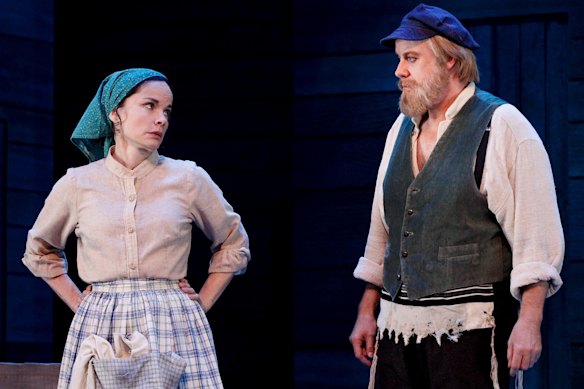
Thornton is no stranger to Fiddler on the Roof. About 10 years ago, she played Golde, the headstrong wife of the musical’s central character, Tevye, in an Australian production starring Anthony Warlow. She’s been lured back to the shtetl by the chance to play another of the musical’s indelible characters – “I laugh whenever I say Yente’s name, I can’t help it” – as well as the opportunity to work with Jordan Fein, a hotshot American director whose fresh take on the musical took London by storm.
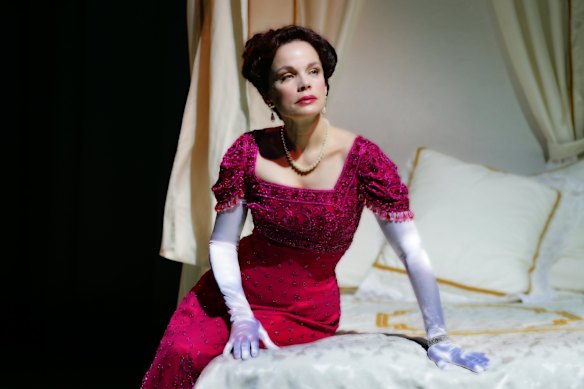
“For someone who’s not a professional singer, I’ve had some wonderful experiences working in musicals,” says Thornton, who also played fading actor Desiree Armfeldt in a 2009 Opera Australia production of Stephen Sondheim’s A Little Night Music.
“Working with an orchestra is a joyous experience. It’s very different to a straight dramatic performance and requires a very different skill in terms of timing. I don’t carry any songs [as Yente] which to some extent will make things easier for me. But singing [as part of the chorus] with all these wonderful trained singers will be a great pleasure.”
Thornton understands why Fein’s production has breathed new life into a show that first opened on Broadway in 1964. “I feel he’s made it more accessible in the sense that he’s contemporised it; he’s made it more applicable to today’s world,” she says. She’s not talking about the set or the costumes (some revivals have used modern dress as a framing device, but this isn’t one of them), but rather the show’s ability to make a story set in 1905 feel utterly germane. “It’s a real challenge to create something so new out of something that is so well-known, and I’m very excited to be part of it.”
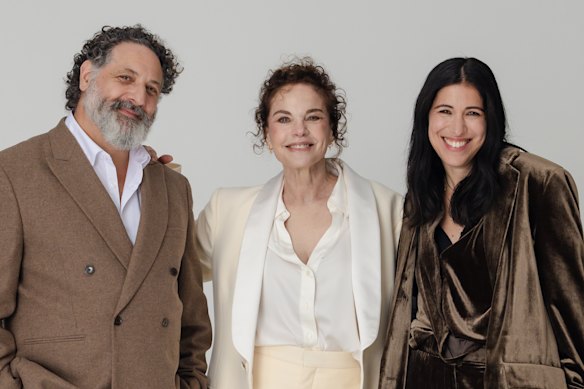
Originally performed in London’s Regent’s Park, an outdoor setting that allowed the show’s big ballad, Sunrise, Sunset, to be sung against a darkening sky, Fein’s production attracted rave reviews and a record-equalling 13 Olivier Award nominations. For the Australian production, Thornton joins a cast that includes musical theatre stalwarts Troy Sussman as Tevye and Alexis Fishman as Golde. The titular fiddler, who in Fein’s production becomes Tevye’s shadow, a melodic expression of his thoughts and words, will be played by Sydney violinist Ben Adler.
The show’s stripped-back set is a representation of the Anatevka shtetl dominated by a wheat field that appears to be ripped from the ground. It was designed by British theatre designer Tom Scutt, who is Fein’s offstage partner. Scutt won the Olivier Award for Best Set Design, one of three trophies including Best Sound Design and Best Musical Revival the show picked up last year.
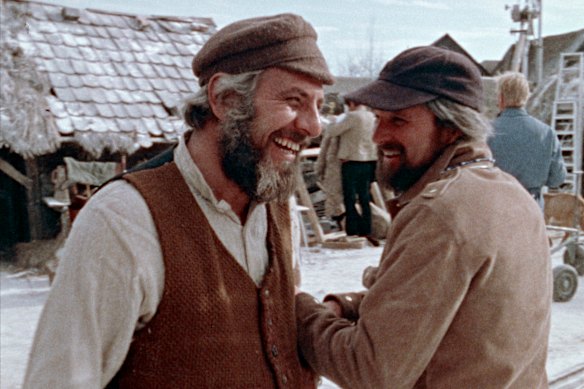
Fiddler on the Roof is part of the musical theatre canon, a show burned into the public consciousness by the 1971 movie starring Chaim Topol and countless revivals at theatres large and small. Most people know its signature tune, If I Were a Rich Man, and its nonsensical refrain, “all day long I’d bidi-bidi-bum …” The original production, which starred Zero Mostel, was a hit straight out of the box, becoming the first musical in Broadway history to pass the 3000-performance mark.
Our hero is Tevye, a poor Jewish milkman who has five daughters. Yente wants the eldest, Tzeitel, to marry the village’s wealthy butcher, Lazar Wolf. The match offers the prospect of comfort and prime cuts, but Tzeitel has no interest in the much older man. She loves a poor tailor called Motel and defies the shtetl’s rules by getting engaged to him. Two of Tzeitel’s sisters, Hodel and Chava, also follow their hearts and the old world order begins to crumble. As an increasingly frantic Tevye tries to balance faith, tradition and family, his community faces an existential threat: expulsion by order of the Russian tsar.
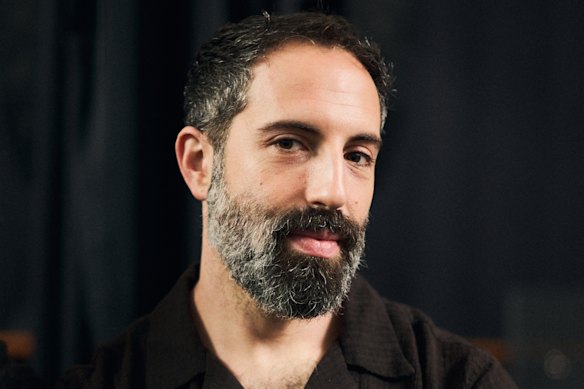
Fein, a 39-year-old who wears a beard that wouldn’t look out of place in Anatevka, followed up Fiddler on the Roof with a London production of Sondheim’s Into The Woods. It garnered 11 Olivier Award nominations and prompted The New York Times to describe him as “the fast-rising American director wowing the West End”. Not bad for a man who has yet to acquire a Wikipedia page.
Fein knows that some people are snobbish about musicals, but has little time for such prejudice. “When people say they don’t like musicals, I think it’s like people saying they don’t like ice-cream – there are so many different flavours,” he says. “I’ve never seen people respond to theatre quite as strongly as they do to a musical that affects them. They [musicals] are so important because they are able to articulate things that we can’t put into words, that we can’t intellectualise. They tap into something that is deeply emotional and human that the plain, spoken word can’t always achieve.” He pauses. “Some people will hate that I’ve said that, but it doesn’t matter.”
Another criticism levelled at established musicals is that their familiarity has made them sclerotic; they’re museum pieces that defy reinterpretation. Under this definition, one Yente is much like any other Yente. Thornton bristles at the idea.
“There are so many ways to interpret the raw material,” she says. “Just because it’s been done many times in certain ways doesn’t mean someone can’t come in with fresh eyes. That is drama right there. Very often, if you’re working with a classic text, you can identify 20 different interpretations that have come before. There’s no desire on my part, or most actors’ part I’d argue, to duplicate something that’s come before. You’re going for a different take that’s uniquely your own.”
Fein, who saw his first production of Fiddler on the Roof at the age of eight, has a personal connection to the musical. He grew up in a Jewish household in Philadelphia, and says “Fiddler is literally my family’s story”.
“My grandmother’s parents came to America from just outside Kyiv in 1910, for exactly the same reasons as the community of Anatevka. It wasn’t something we talked about when I was a kid, but I was lucky that my grandmother, Rea, was still around when I started working on the piece. Asking her questions made me feel really close to the musical and my family.”
Why so? “I’m in a place in my life where I can understand my parents as humans, not just parents,” he replies. “My dad is a Tevye in so many ways and I can understand and respect that now. It’s the same with Golde; she’s remarkable. She’s the only reason the house is running and things are happening. The two of them are just doing the best they can in impossible circumstances.”
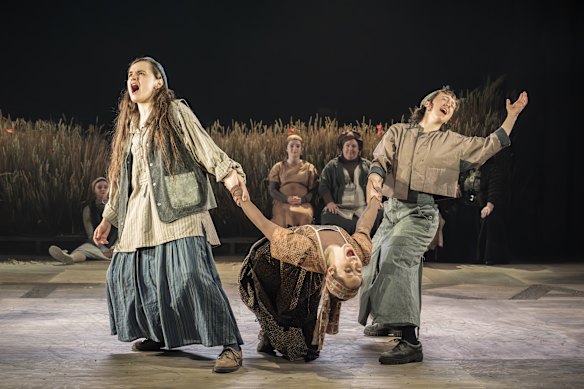
When Fein considers reviving an established opera, musical or play, he always asks himself the same questions: why are we doing this now, what is its relevance to today’s world? When he began studying Joseph Stein’s book and the songs written by Jerry Bock and lyricist Sheldon Harnick, he quickly acquired a new appreciation for a musical he thought he knew back-to-front.
“The thing that really surprised me is how funny it is; it’s genuinely funny,” he says. “I was also struck by the fact this is the story of parents who learn about love from their children. I connected with that quite deeply.”
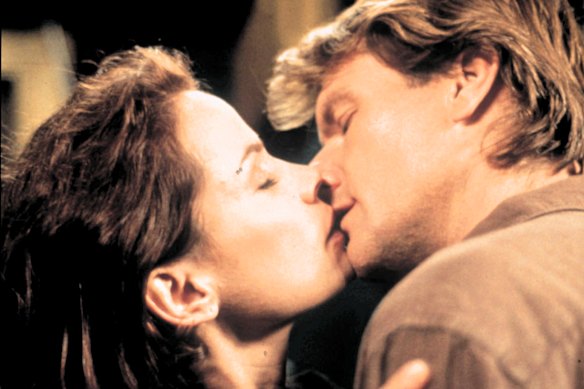
After decades in the public eye playing strong-willed characters ranging from Jessica in The Man from Snowy River to Laura in SeaChange, Thornton has her own set of criteria for choosing projects. “I don’t say yes to everything; I follow my gut, my instincts,” she says. “These days, I’m more interested in the process of making something happen with a group of people rather than the finished product. That’s the thing that most excites me – work that can take you in all sorts of directions.”
Fiddler on the Roof’s exploration of family dynamics and the comedy derived from Tevye’s exasperated conversations with God, and Yente’s thoughts on marriage never obscure the fact it is a deeply political work. Its backdrop is state-sanctioned violence, persecution and displacement. Anatevka’s villagers are just some of the millions of Jews driven from their homes in Russia by the pogroms that took place between 1880 and 1914.
It can be argued that Fiddler presents a rather sanitised version of this dark period of history. For example, The Constable, the character representing the brutal Tsarist regime, is depicted as an affable man who’s apologetic about the violence he’s orchestrating. Even so, the musical’s subject matter prompted the producers of the Regent’s Park production to hire extra security when its London run coincided with Israel’s attacks on Gaza following the surprise assault by Hamas on October 7, 2023.
In August 2024, a video purporting to show an altercation in a Regent’s Park cafe between pro-Palestinian demonstrators and Jewish theatregoers was widely shared and interpreted as evidence Fiddler on the Roof had become a lightning rod for anti-Israel protests.
Neither Fein nor Thornton dodge the question when I ask about the incident. Fein says: “There actually wasn’t a protest. The cafe is close to the park and it was a coincidence that there happened to be a [pro-Palestine] march that day. It never affected the performance. From the outset, the producers were aware of what could happen so things were put in place. But we as a company and a creative team never had to navigate any of that.”
He adds: “It was actually a really interesting moment in seeing the way the internet works. It was quite sobering. It had nothing to do with us, it was just proximity.”
Fiddler on the Roof is indeed deeply political, says Fein, but dispossession is a universal theme. “This is a piece about a community being destroyed by political powers beyond their control,” he explains. “I think that is political and personal and anyone who tries to separate the two is wrong. That is the tragedy of it. When you watch it, it unfortunately rhymes with so many situations that are happening in the world right now.”
Thornton concurs. “The way I see the show is that it is a humanist piece about community, connection, family love and dispossession. All of these things loom large in today’s world, not just in terms of those two communities [Israel and Gaza], but with many, many more. I see this show as emblematic rather than specific, and I think it prompts a very important conversation.”
Thornton, who is shooting a film before she starts rehearsals for Fiddler on the Roof, and has signed up for a play when it ends, seems to be as busy as ever. I ask her, mischievously, what her late mother, Australian feminist, author, and academic Merle Thornton, would make of Yente, a woman who is, surely, an instrument of female repression. Thornton, who describes herself as a “proud feminist”, begs to differ.
“What’s interesting about the story is that Yente is sidelined to some extent by progress, but she doesn’t let it beat her. She’s determined to find a place for herself. All of the women, even though they’re locked into certain traditional expectations, are very strong characters in their own right.
“At the end, when the community is forced to leave their homes, Yente has quite a good head on her shoulders. She is devastated, but she’s not going to let it beat her. She has a plan. The worst has happened, but she believes you must put one foot in front of the other.”
Or, as Yente herself puts it: “What’s the use of complaining? Other women enjoy complaining, but not Yente. Not every woman in the world is a Yente.”
Fiddler on the Roof is at Sydney’s Theatre Royal, July 31-October 3, Brisbane’s Glasshouse Theatre from October 9 and Her Majesty’s Theatre, Melbourne, from October 31.

















































