Iran-backed Houthis entrance into war threatens another key shipping lane, and keeps oil prices soaring
Yemen's Iranian-backed Houthi rebels joined the war over the weekend, firing missiles at Israel for the first time since the U.S. and Israel launched their joint attacks on Iran a month earlier.
The attacks by the U.S.-designated terrorist group on Israel were limited, but they are being seen largely as a warning that it could get more deeply involved in the war.
The Houthis have previously attacked commercial ships in the Red Sea to disrupt the flow of oil, gas and other commodities through the Bab el-Mandeb strait. Along with the Strait of Hormuz, currently under a de-facto Iranian blockade, the two narrow waterways are the primary routes used by the Middle East's energy producers to get their products to the vast markets in Asia and beyond.
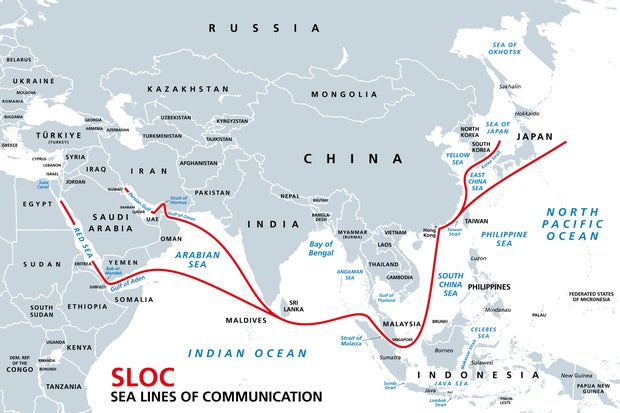 A map shows major routes for energy resources and other trade from the Middle East to Asia, including the Bab el-Mandeb strait and the Strait of Hormuz.
Getty/iStockphoto
A map shows major routes for energy resources and other trade from the Middle East to Asia, including the Bab el-Mandeb strait and the Strait of Hormuz.
Getty/iStockphoto
The Houthis warned more than a week ago that they could target shipping through the Bab el-Mandeb strait if Iran asked them to do so. They last attacked ships in the region in 2023, in retaliation for Israel's war against fellow-Iranian proxy Hamas in Gaza.
Retired Gen. Frank McKenzie, a former commander of the U.S. military's Central Command, told "Face the Nation with Margaret Brennan" on Sunday that he didn't believe the Houthis' entrance into the war would be a "game changer."
"They will have the ability to further stop slow traffic through the Bab el-Mandeb, going up into the Suez Canal," he acknowledged. "We have the ability to go down there and prevent that. It will require additional resources, but we have those resources, and we can certainly do it if that becomes necessary."
But given the inability of the U.S. to reopen the Strait of Hormuz thus far, despite a huge deployment of military personnel and assets in the region, Nomi Bar-Yaacov, fellow at the Geneva Centre for Security Policy, told The Associated Press on Monday that if the Houthis do follow through on their threat to the Bab el-Mandeb it could bring global energy markets to a "point where we have not been before."
"All eyes are on the mediation, but the oil crisis is, I think, at an unprecedented state," she said.
The concerns appeared to weigh heavily on energy markets Monday, with the price of international benchmark Brent around $115 per barrel in early trading.
Iran foreign ministry says no direct talks with U.S. yet, calls Trump admin's terms "excessive and unreasonable"
Iranian Foreign Ministry spokesman Esmail Baqaei was quoted by various Iranian state media outlets on Monday as saying the country had engaged in "no direct negotiations with the United States to date" and downplaying Pakistan's suggestion that such a dialogue was imminent.
"What has been raised are messages we received through intermediaries, indicating the U.S.' desire for talks," Baqaei said, according to various state-run Iranian news agencies.
"I don't know how many in the U.S. take claims of American diplomacy seriously! Unlike the other side, which constantly changes its position, our stance has always been clear. … We know exactly what framework we are considering. The messages conveyed to us have included excessive and unreasonable demands," said Baqaei, reiterating the Iranian regime's rejection of 15 points from the White House that were conveyed via intermediaries last week.
"The meetings held by Pakistan follow a framework that they themselves established and we did not participate in. It is good that regional countries are concerned about ending the war, but they should remain aware of which side started the conflict," Baqaei said.
"We must continue our work, engage in consultations, but our demands remain unchanged," he added.
Images show vital U.S. E-3 Sentry AWACS aircraft destroyed in Iranian strike on Saudi base that hurt 10 troops
The CBS News Confirmed team has verified images from the Prince Sultan Air Base in Saudi Arabia that show a U.S. Air Force E-3 Sentry AWACS surveillance aircraft destroyed on the tarmac after an Iranian missile and drone strike that left 10 service members wounded last week.
The E-3 Airborne Warning and Control System is a key piece of equipment for monitoring enemy activity and for mobile command and control that will, according to The Wall Street Journal, cost in the region of $700 million to replace.
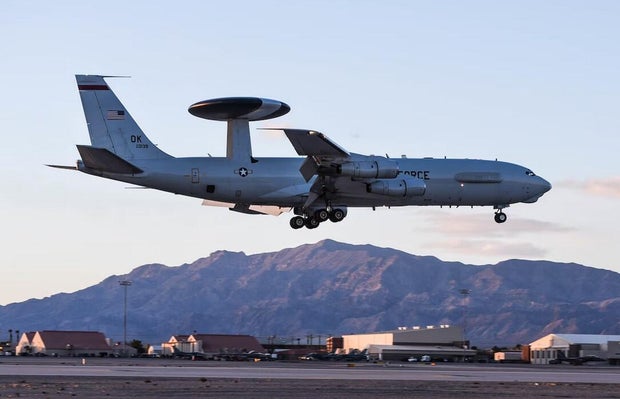 A 2020 U.S. Air Force file photo shows an E-3 Sentry Airborne Warning and Control System (AWACS) during a mission at Nellis Air Force Base, Nevada.
U.S. Air Force/Handout
A 2020 U.S. Air Force file photo shows an E-3 Sentry Airborne Warning and Control System (AWACS) during a mission at Nellis Air Force Base, Nevada.
U.S. Air Force/Handout
Multiple U.S. officials told CBS News over the weekend that 10 U.S. service members were wounded in the Friday attack on the base, including two left with very serious injuries and eight in serious condition, which are different categories under the military's casualty classification system.
Thirteen U.S. service members have been killed since the U.S. and Israel launched the war with Iran, and more than 300 more have been wounded in action, most of whom have returned to duty, a U.S. Central Command spokesperson said Friday.
Global oil prices soar again as concern over war's impact hits Asian markets particularly hard
Asian share prices mostly dipped Monday, as worries continued about soaring oil prices and the potential for further escalation in the U.S. war with Iran, but stocks posted moderate gains in early trading in Europe and U.S. futures were also higher.
Wall Street finished last Friday with deep declines, for a fifth straight losing week, its longest such streak in nearly four years.
Worries have been great in Asia about the effective lack of access to the Strait of Hormuz because of the war in Iran, as the region relies significantly on oil from the region.
In energy trading, benchmark U.S. crude jumped $1.95 to $101.59 a barrel and Brent crude, the international standard, soared $3.41 to $115.98 a barrel. Before the war, Brent had been priced at about $70 to a barrel.
Investors are now bracing for the war to last for some time, which would likely set off inflation in global markets and could stunt Asia's economic growth.
"Although we do not expect the conflict to be protracted, we anticipate heightened volatility in the near term," said Xavier Lee, senior equity analyst at Morningstar Research.
CBS/AP
Wave of Iranian missiles hits communities and an oil refinery in northern Israel
Israeli television channels reported at least one impact at an oil refinery in the northern city of Haifa on Monday, shortly after the military said it had detected new incoming missiles from Iran.
CBS News staff in Israel reported multiple impacts, which are often from debris of intercepted missiles or drones, across the north of the country amid a salvo of incoming fire from Iran and also Lebanon, where Iranian-backed Hezbollah is based.
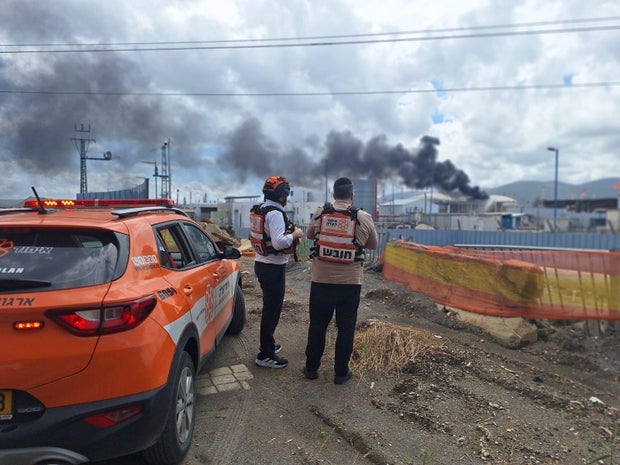 United Hatzalah paramedics observe smoke rising from near oil refineries in Haifa, northern Israel, after a salvo of missiles and drones launched by Iran and Hezbollah militants in Lebanon targeted northern Israel, March 30, 2026, amid ongoing U.S.-Israeli strikes on Iran.
Handout/United Hatzalah
United Hatzalah paramedics observe smoke rising from near oil refineries in Haifa, northern Israel, after a salvo of missiles and drones launched by Iran and Hezbollah militants in Lebanon targeted northern Israel, March 30, 2026, amid ongoing U.S.-Israeli strikes on Iran.
Handout/United Hatzalah
Television network Channel 12 showed thick black smoke billowing into the sky from the site.
Emergency response agencies Magen David Adom and United Hetzolah were responding to multiple sites of reported impacts, but there were no immediate reports of injuries.
CBS/AFP
Trump says U.S. has already gotten regime change in Iran and deal could be reached "soon"
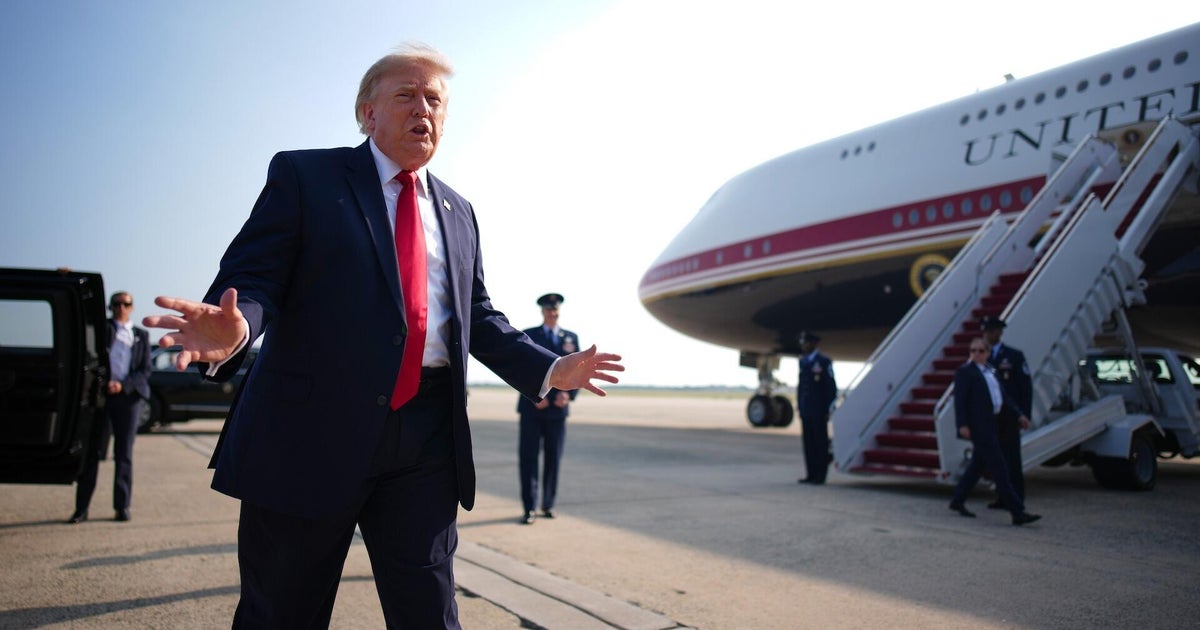
President Trump reiterated his stance on Sunday that the U.S. has already achieved regime change in Iran and a deal to end the war could be reached "soon."
Citing the number of Iranian leaders who have been killed in the month-long U.S.-Israeli war against Iran, Mr. Trump said the people now running Iran were "much more reasonable," despite ongoing Iranian missile and drone attacks across the region and the fact that the Islamic Republic's theocracy has signaled no public inclination to back down from the fight.
"We've had regime change," Mr. Trump told reporters on Air Force One. "We're dealing with different people than anybody's dealt with before. It's a whole different group of people. So I would consider that regime change."
Asked whether there could be a deal with Iran this week, Mr. Trump said, "I do see a deal in Iran. Could be soon."
Since the conflict began, Tehran has effectively shut down the Strait of Hormuz, through which about 20% of the world's crude oil typically flows, sending global oil prices soaring, but Mr. Trump said Sunday that relief was on the way in the form of concessions from Iran, starting with the imminent passage of more tankers through the waterway.
"They gave us, I think, out of a sign of respect, 20 boats of oil, big, big boats of oil going through the Hormuz Strait," he said, adding that the shipments would be "taking place starting tomorrow morning, over the next couple of days."
CBS/AFP