
NASA introduced the four astronauts of the next Artemis moon program mission on Tuesday, kicking off a year or more of mission-specific training for the Artemis III crew.
They are expected to launch into Earth orbit next year to test rendezvous and docking procedures with moon landers being built by SpaceX and Blue Origin — a critical milestone before the U.S. can send astronauts back to the moon for landing in 2028.
Meet the Artemis III crew
NASA Administrator Jared Isaacman announced the crew members at the Johnson Space Center in Houston. They are:
- Commander Randy "Komrade" Bresnik
- Pilot Luca Parmitano
- Mission specialist Frank Rubio
- Mission specialist Andre Douglas
Bob Hines was named the backup crew member.
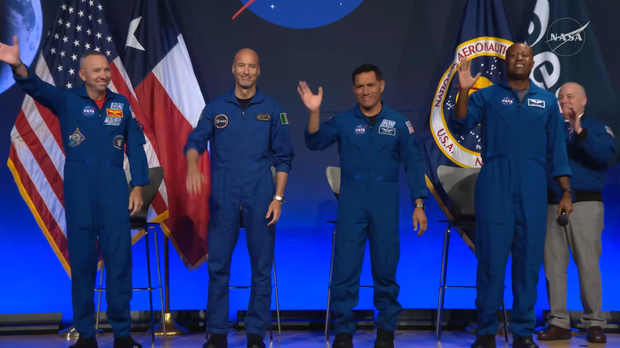 NASA introduced the Artemis III crew members at the Johnson Space Center in Houston on June 9, 2026. L-R: Randy Bresnik, Luca Parmitano, Frank Rubio and Andre Douglas.
NASA TV
NASA introduced the Artemis III crew members at the Johnson Space Center in Houston on June 9, 2026. L-R: Randy Bresnik, Luca Parmitano, Frank Rubio and Andre Douglas.
NASA TV
Bresnik, 58, a former Marine fighter pilot and "TOPGUN" graduate who logged 149 days in space during a space shuttle flight in 2009 and a long-duration stay aboard the International Space Station in 2017.
Parmitano, 49, an astronaut with the European Space Agency, was the first Italian commander of the space station and an Italian air force test pilot.
Douglas, 40, is a test engineer and Coast Guard reserve commander who will be making his first space flight on Artemis III. He served as a backup crew member for the recently completed Artemis II around-the-moon mission
Rubio, 49, is an Army Black Hawk helicopter pilot and a family-medicine physician. He spent a U.S.-record 371 days in space aboard the International Space Station in 2022-23.
"We are certainly humbled as a crew," Bresnik told the crowd at the Johnson Space Center, "being that unifying link between the phenomenal Artemis II mission we just had two months ago and the Artemis IV mission that will follow ours, where we will again ... land humans on another celestial body."
What the Artemis III mission will do
Launching atop a Space Launch System rocket in an Orion capsule, the Bresnik's crew will practice chasing down one moon lander at a time to make sure rendezvous and docking procedures work as planned before a future moon landing when those procedures will have to be carried out in lunar orbit.
The flight will pose a major test for mission managers and engineers with NASA, SpaceX and Blue Origin, who will have to launch multiple heavy-lift rockets in a matter of days and then coordinate their flights in a multi-vehicle sequence of tightly scripted maneuvers.
"This test flight will enable us to prove we can carry out highly choreographed operations with our (commercial) partners across hardware interfaces, software, propulsion systems and life support elements with crew in the high stakes space environment," said Jeremy Parsons, a senior manager in NASA's "Moon to Mars" program office.
"Are we able to launch in sequence with our partners across multiple launch pads and meet up at precise points in space? How do our spacecraft, designed and built across NASA and different partners, operate together in an integrated way in an unforgiving environment?"
He said "every aspect" of the Artemis III mission "will give us insight into how to refine our plans for Artemis IV and beyond, and buy down risk."
The Artemis III crew will carry out a mission similar to NASA's Apollo 9 flight in March 1969 when three astronauts tested the spindly lunar excursion module in Earth orbit. That flight came after a successful lunar orbit mission, Apollo 8, at the end of 1968.
Then the Apollo 10 flight tested the lunar module in orbit around the moon before Apollo 11 finally made the first moon landing in the Sea of Tranquility in July 1969.
The Artemis program's version of Apollo 8, sending Artemis II commander Reid Wiseman, Victor Glover, Christina Koch and Canadian astronaut Jeremy Hansen on a flight around the moon, was successfully completed in April.
Toward the end of Tuesday's ceremony, Wiseman passed a symbolic baton to Bresnik, a handoff from one crew to the next in NASA's drive to return astronauts to the surface of the moon.
"Randy, in your comments, I really loved when you said that you all are the link from (Artemis) II to the surface, and that really resonated with me," Wiseman said. "And you guys know, we've been carrying these batons around for way too long. So with that, the Artemis II crew, Komrade, hands you the baton. You've got the controls."
NASA's plans for a moon landing
As of now, Artemis III is the only test flight NASA is planning before making a landing attempt in 2028 with whichever lunar lander is available. By that point, one or both companies will have had to complete a successful unpiloted moon landing.
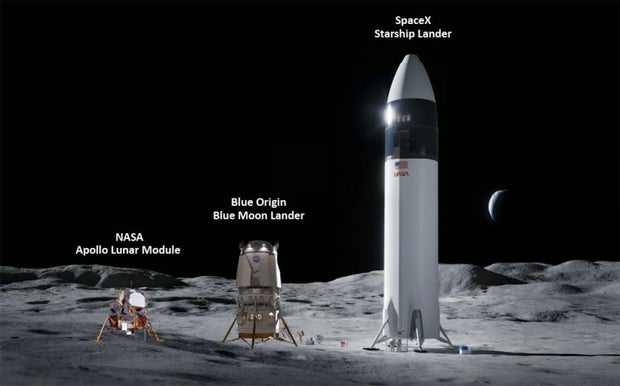 An artist's impression showing NASA's Apollo moon lander (far left), Blue Moon's Mark II lander (center) and SpaceX's Starship variant (right), drawn to scale, on the lunar surface.
NASA
An artist's impression showing NASA's Apollo moon lander (far left), Blue Moon's Mark II lander (center) and SpaceX's Starship variant (right), drawn to scale, on the lunar surface.
NASA
The Artemis III crew announcement comes as Blue Origin continues to recover from a catastrophic launch pad explosion May 28 that destroyed a New Glenn rocket like the one that will be needed to carry the company's Blue Moon Mark II lander into Earth orbit next year. The company's only launch pad, located at the Cape Canaveral Space Force Station in Florida, suffered major damage.
The Jeff Bezos-owned company says it expects to return to flight before the end of the year, but the mishap threw a wrench into the New Glenn launch schedule, delaying flights of the Blue Moon Mark I, an uncrewed lunar cargo ship, that was expected to have helped pave the way for the larger, more capable piloted version.
Whether the New Glenn rocket and pad 36 at the Cape Canaveral Space Force Station will be back in operation in time to launch a flight-ready Mark II lander in time for Artemis III remains to be seen.
SpaceX has had its own problems perfecting the huge Super Heavy-Starship rocket needed to launch that company's lander. It's not yet known when the Elon Musk-owned company will have its lander ready for an orbital flight test, but NASA is pressing ahead with plans for the Artemis III mission regardless.
If only one lander is available, the mission is expected to proceed. If neither lander is ready, NASA likely will come up with an alternate mission scenario to keep the program moving.
The Artemis program is intended to get astronauts back to the moon by the end of 2028. NASA wants to win a self-declared space race with China, which is working to send its own "taikonauts" to the moon by the end of the decade.
Even though NASA sent 12 astronauts to the moon's surface between 1969 and the end of 1972, winning the Cold War space race with the former Soviet Union, the agency wants to establish a near permanent presence on the moon with the Artemis program, cementing its position as the world leader in space travel, research and technology.
NASA is planning to launch a series of robotic landers and lunar satellites along with the Artemis IV and V missions followed by two astronaut landings per year thereafter. That will set the stage for construction of a moon base near the lunar south pole beginning in the 2029-2030 timeframe.
The south polar region is an attractive target because of permanently shadowed, ultra-cold craters expected to harbor comet-borne ice deposits, providing an in situ source of water, air and rocket fuel. With habitats in place, along with solar and nuclear power stations, rotating astronaut crews could live and work on the moon for long durations much like space station fliers have done in Earth orbit for the past quarter century.
But there are multiple threats to the Artemis schedule, including the readiness of the required rockets and landers that could push Artemis III into 2028 and landing missions even further. Whether any additional test flights might be needed between the Artemis III mission and a moon landing remains to be seen.
Alex Sundby contributed to this report.
In:

















































