 3 months ago
50
3 months ago
50

 Reuters
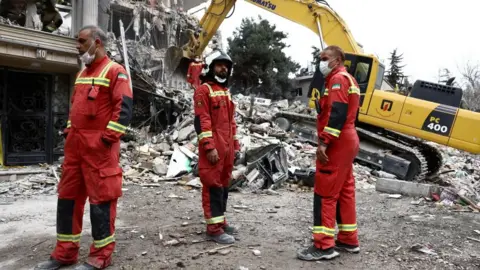
A lot of damage has been caused across Iran
Iran has rejected US President Donald Trump's reported 15-point plan to end the war, according to state-run Press TV.
It cited an unknown "senior political-security official" laying out five Iranian conditions for the conflict to end, including paying reparations for damage.
The White House has not confirmed the contents of the plan - published by Israel's Channel 12 network - only admitting "elements of truth" in it. It is said to include a commitment from Iran not to build nuclear weapons and to reopen the strategically important Strait of Hormuz.
The war began on 28 February with US and Israeli air strikes, after which Iran widened hostilities by targeting American allies in the Gulf.
On Tuesday, Trump said Iran was "desperate" for talks and that Iranian negotiators had given the US a "very significant prize".
The "present" was related to oil and gas, and the Strait of Hormuz, the US president said, without providing further details.
But Iran's parliament speaker has dismissed any suggestion of talks altogether.
"No negotiations have been held with the US, and fakenews [sic] is used to manipulate the financial and oil markets and escape the quagmire in which the US and Israel are trapped," Mohammad Bagher Ghalibaf wrote on X.
However, when asked by reporters at a White House briefing on Wednesday, Trump's press secretary Karoline Leavitt said talks were "ongoing" and "productive"
What does Trump's plan contain?
According to Israel's Channel 12, Iran must fulfil a number of demands for the war to end.
They mostly centre on the main rationale US officials have given for starting the war: to stop the country building nuclear weapons - an allegation that has not been supported and which Iran has always rejected - and to eliminate the threat of its missile programme.
The proposals request that Iran must "commit never to pursue nuclear weapons", pledge to dismantle nuclear facilities and hand over the enriched amounts of uranium it possesses to the International Atomic Energy Agency (IAEA), the UN nuclear watchdog, which is to monitor the issue going forward.
According to the proposals, Iran would agree to limit its missile programme in range and quantity.
Additionally, Iran would stop funding regional proxies - Hezbollah in Lebanon, Hamas in Gaza and the Houthis in Yemen.
Iran would also be required to reopen the Strait of Hormuz so it could function as a "free maritime corridor". Closure of the strait - through which a fifth of the world's oil and gas supplies pass - has sent prices spiking and led to fears of recession in the world economy.
All international sanctions would be lifted on Iran, the reported plan says.
Full sanctions were reimposed last November after Iran suspended inspections of its nuclear facilities in the wake of Israeli and US bombing of several of its nuclear sites and military bases.
Asked to confirm these details, Trump's press secretary said: "The White House never confirmed that full plan. There are elements of truth to it, but some of the stories I read were not entirely factual".
What are Iran's counter-proposals?
According to Press TV, Iran has listed five conditions to end the war.
They include a complete halt to "aggression and assassinations by the enemy".
Israeli Prime Minister Benjamin Netanyahu and his officials have often said they intend to "cut the head of the octopus". Several top Iranian officials have been killed since the first day of the war when a massive Israeli air strike on Tehran killed Supreme Leader Ayatollah Ali Khamenei.
Other Iranian conditions include "concrete mechanisms to ensure that the war is not reimposed on the Islamic Republic", though it is unclear what guarantees could be provided and which countries would take part - or monitor their observation.
On the economic front, Iran is also demanding the payment of war damages and reparations, as well as the right to remain solely in charge of the Strait of Hormuz.
Crucially, Tehran wants Israel to end attacks on Iranian allies in the region.
Israel has intensified its campaign against Hezbollah, announcing on Tuesday that its military would remain in a widened buffer zone inside Lebanon until attacks on northern Israel ceased.
The unnamed official is cited by Press TV as saying these conditions are in addition to demands previously presented by Tehran during negotiations in Geneva, which took place in February, shortly before the war began.
Is the end of the war in sight?
Any eventual talks are likely to be led by Trump's peace envoys, Steve Witkoff and Jared Kushner - the president's son-in-law.
The reported US peace proposals look similar to the model followed by the envoys to end more than two years of fighting between Israel and Hamas in the Gaza Strip.
If that procedure is to be replicated, a ceasefire would have to be declared to enable negotiations on any draft.
Israel's Channel 12 said the country's leaders might not be too happy to pause their attacks on Iran at this stage - Netanyahu had similar reservations about a ceasefire during the Gaza negotiations.
Israel's Economy Minister, Nir Barkat, told the BBC it was unlikely Iran would agree to Trump's terms.
With Iran not confirming the talks, it remains unclear who is negotiating on Tehran's behalf.
Trump has said "we're dealing with the right people".
They are not believed to include Iran's new Supreme Leader, Mojtada Khamenei, who has not been seen since being wounded in the same attack that killed his father.
The current Iranian leadership is wary of engagement in any talks with the US - the current war began in the middle of negotiations to reach a new nuclear deal.
Besides, US troops are now being sent to the region, with some suggestions they may be used to open the Strait of Hormuz or seize some territory in Iran.