
 5 months ago
78
5 months ago
78
3 hours ago
Faisal IslamEconomics editor

 Getty Images
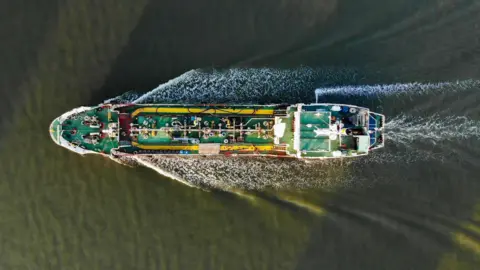
Oil and gas tankers around the world have been diverted from their usual routes due to blockages in the Strait of Hormuz since early March (file photo)
For most of the past six weeks, we have brought you maps of a gummed-up Strait of Hormuz.
Approximately 800 ships are believed to have been stuck in the Gulf, many transporting oil and gas, and have been unable and unwilling to exit onto the open seas.
During that time, there has been a direct line from the world's biggest traffic jam to rising petrol and diesel prices, higher airfares and swelling mortgage rates around the globe.
Many countries are also dependent on these waters for significant supplies of other petrochemical products, made at the refineries in the region. These include jet fuel, diesel, fertiliser ingredients and industrial products such as helium, essential for microchip manufacture.
The good news is that the overnight ceasefire pauses any further escalation of the conflict, and provides a pathway for deescalation and peace.
This is why the markets have responded positively with 15% falls in the market price of oil and gas and a rally in stock markets.
However, there are many reasons for caution about the economic impact at this delicate moment.
There are different accounts about the basis for negotiations from Iran, the US, and Israel.
The test of this is whether face-to-face negotiations actually occur.
Then there is the physical situation in the Strait.
Will traffic flow freely as suggested by US President Donald Trump?
Or will it flow "via coordination with Iran's Armed Forces and with due considerations to technical limitations", as suggested by Iran's Foreign Minister?
This is vital, not just for oil and gas, but also jet fuel, sulphur, urea and diesel.
The longer the ceasefire, the more likely that any spike in inflation ebbs away in the coming months.
It also raises a fundamental question about any peace. Iran has now created a new reality in the Gulf.
It has established that it can control the key maritime chokepoint, even without a navy and an airforce. It had even begun to collect tolls.
Will this remain? Will the Gulf nations accept this?
The suggestion from Iran that it will now jointly coordinate control of the Strait with Oman is extraordinary.
Has the war turned the Strait of Hormuz into the world's most lucrative toll booth, with many ships paying million dollar transit fees?
Clearly none of this was on the cards before the war.
Global gas production will likely to be damaged for some years, following direct damage to infrastructure, mostly in Qatar.
It will take weeks to restart production and years for that production to be back to pre-war capacity.
There will need to be a sustained flow of liquified natural gas (LNG) tankers from the Gulf, from now until the summer to contain rises in bills, as Europe tries to refill its stocks of natural gas.
While a modest rise in UK domestic energy bills is almost certain in July, October's feared significant further rise could now be off.
If sustained, a lower spike in inflation would also help keep interest rates from rising.
The markets saw a significant decline in the effective interest rates paid by European governments, including in Britain.
The five-year gilt rate was down the equivalent of a quarter per cent rate cut.
This ceasefire will help pause the notable rise in fixed mortgage rates. If sustained, mortgage rates will start to come down again, here and around here world.
The economics of this war have always been a central factor, not a by-product.
The Iranians have established a form of global economic leverage in ths Strait, and demonstrated its use.
Much uncertainty remains about the underlying diplomacy. More remains about the impact on prices, interest rates and delicate growth.
Yesterday, events could have led to $200 a barrel for oil and all the other knock on effects as soon as this week. Now, it is possible to see a pathway back down to $60 to $70 a barrel, contained inflation, lower petrol prices and calmer interest rates.
So the absence of a further escalation is a definite relief for the global economy as finance ministers fly into Washington DC for key IMF meetings.
The depth of the scarring from this conflict, on gas supply, and on control of one of the world's key economic arteries, remains an open question.

















































