2 months ago
29
2 months ago
29

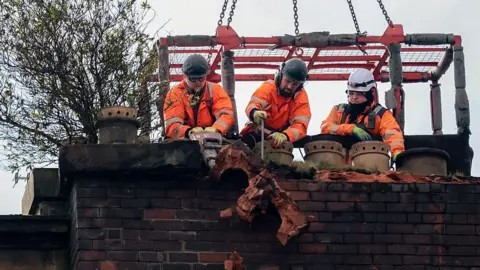 Getty Images
Workers began dismantling the chimney on Friday morning
Demolition work has begun at a fire-ravaged building in Glasgow city centre.
The historic Union Corner, at the junction of Union Street and Gordon Street, was destroyed in the inferno on Sunday night after flames took hold in a vape shop.
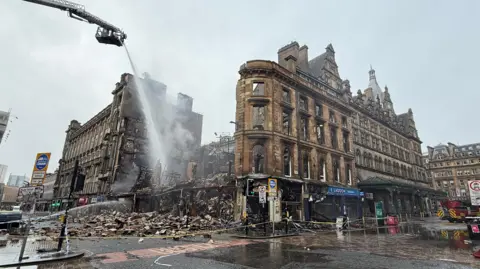
Glasgow City Council said that the remains of the B-listed Victorian building were "fatally compromised" and "highly dangerous".
Among the first remnants of the building to be dismantled is a 'floating' chimney stack still attached to the adjoining block, several storeys above ground.
Council leader Susan Aitken told the Herald that a compulsory purchase order (CPO) might be a useful option for Union Corner.
But the council said there were no plans to build a hotel on the site, despite some newspaper reports.
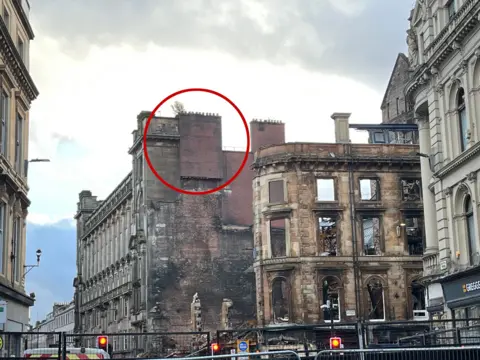
The chimney appears to float several storeys above ground
 Network Rail
The fire which devastated the historic Union Corner has now been brought under control
A "safe zone" has been set up around the building, extending to Central Station which will remain closed for the rest of the week.
The council took control of the site from the Scottish Fire and Rescue Service (SFRS) on Thursday and carried out its own assessment of the damaged structure.
Raymond Barlow, from the council's building standards team, said it was not possible for the council to say exactly which aspects of the building could be saved, nor how long the demolition will take.
He said: "You are talking a good number of weeks before we see any change to aspects around here.
"We need to start work at one end of the site, take off the highest bits of danger and hopefully that will let us start to access parts of the station and get the station back up before coming to the façade."
The council said crews would work around the clock, but timescales were weather-dependent as cranes cannot be used in high winds.
What happened on Sunday night?
The fire broke out in a vape shop at about 15:45 on Sunday afternoon - crews from the SFRS were swiftly on the scene.
Within hours, the flames had spread to other parts of the block and smoke engulfed the street.
One man tried to tackle the fire at the shop with a small fire extinguisher but had to abandon the attempt after a series of explosions.
By 21:00, it was clear that the building - including its distinctive dome - had collapsed.
Timeline: The fire began in a vape shop next to the station side entrance on Union Street on Sunday afternoon
Within hours the blaze had engulfed the entire building on Union Corner
At the height of the emergency operation, nearly 300 firefighters, 18 fire engines and specialist resources, including a high-volume pump drawing water from the River Clyde, were on the scene.
A nearby hotel was evacuated and Central Station has been closed - though low-level services resumed earlier in the week.
Crews have since been working to cool off hotspots.
With most of the building reduced to rubble, only the facade on Gordon Street was left standing.
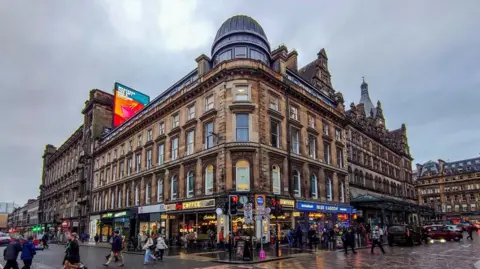
The Union Corner building was constructed in 1851 and pre-dates Glasgow Central Station itself, which opened in 1879.
First Minister John Swinney has said that the Scottish government held discussions with Glasgow City Council over supporting local businesses.
He said the local authority was gathering information from affected businesses, and details of financial support would be announced soon.
Among the businesses that until recently occupied the ground floor were the Blue Lagoon fish and chip shop and Sexy Coffee.
Swinney also said ministers were also looking at ways for tighter regulation of vape shops.
Carina McCreery ran a nail bar in the building and told BBC Radio Scotland Breakfast that the community had "rallied round" the affected businesses.
She told the programme: "People have been sending flowers and cards, kind messages - even my postman gave me a fiver yesterday towards my GoFundMe that my friend set up for me.
"It was really, really sweet. Brands have reached out offering to send new pieces of kit replacing the stuff that we've lost. It's been a bit of everything."
She added: "I only opened in November and I put quite a few thousand pounds towards kitting it out. It's been a really big hit, in terms of what's been lost."
McCreery said she wanted the government support to include expediting tattoo and piercing licences for people that need them.
Scott McAnally, who owned a tattoo parlour in the building, said he had lost about £40,000 worth of equipment in the blaze.
He was asked if he would set up shop above a vape shop again after the fire.
McAnally replied: "I think the unfortunate thing about the high street in Glasgow, and probably most cities, is that I don't think you have a choice if you want to open your shop above a vape shop.
"You just shut your eyes and throw a stone and you'll hit one."
What will happen to the Union Corner site?
 Getty Images
The building known as Union Corner was occupied by multiple businesses before the fire
The fire is out but Union Corner remains a huge challenge for the council, writes BBC Scotland News correspondent David Henderson.
The privately-owned site needs to be made safe - that's why the council has taken it under its control.
Only then can the roads around the site be reopened, along with the main Gordon Street entrance of Central Station.
That would make it far easier to get the 70,000 rail passengers in and out of the station each day.
But Union Corner is in a built-up city centre, surrounded by valuable buildings.
So demolition work can't just mean taking a swing with a wrecking ball.
Instead, contractors have started as they mean to go on - by hand.
Soon they'll have to turn their attention to the creaky sandstone facade on Gordon Street - but it's three stories high.
And I'm told the curve on the structure makes it especially hard to handle. If it twisted as it fell, it might damage Central Station.
Only once it's safe, and the site is cleared of hundreds of tonnes of rubble, another tough decision has to be made.
Should the council use a compulsory purchase order to buy the site from its numerous owners?
It's thought that doing so could make re-development easier, quicker and cheaper.
No-one wants a small-scale owner blocking this prime site's renovation for months or years.
But is the council the right body to manage a big commercial property development? And what should be built there?
Council leader Susan Aitken's told the Herald newspaper a five star hotel is an appealing option for the site.
But that's only one of many options being considered.