 3 months ago
34
3 months ago
34
It’s time once more for that twice-yearly shock to the system that is the clocks moving backwards or forwards an hour. You’ll wake to discover it’s an hour earlier than you’d expected, and you’ve got an hour to kill before brunch. At least you get 60 minutes of snooze time.
At 3am on the first Sunday in April, daylight saving ends in the Australian states that have it, the clocks jumping backwards an hour; at 2am on the first Sunday in October, daylight saving begins, and the clocks jump forwards.
Time can be complicated. We agree to call the period that it takes for the Earth to orbit the sun a “year”, and also the time it takes the globe to spin once on its axis a “day”. The precise length of a second has been another matter, as has been gaining worldwide agreement on precisely what time it should be where.

A workable, if imperfect, solution are the time zones that divide the globe into segments. Time shifts forwards (or backwards) as you cross a boundary from one zone to the next, usually by an hour, though not always. The solution is complicated by another division around the globe: nations.
China, for example, has just one time zone stretching over 5000 kilometres east to west, meaning the sun rises at 6am in (east-coast) Shanghai but at 7.30am in (western) Chengdu. It once had several zones to accommodate its vast girth, but the communist government scrapped that notion in 1949, leader Mao Zedong declaring a single time zone would aid national unity. India adopted one time zone after its independence from the British in 1947 and consequently, sunrise and sunset are earlier in, say, Kolkata than in Mumbai.
“Time zones are so interesting,” says Dr Emily Akkermans, from the Royal Observatory Greenwich, in London, where she is the official curator of time. “I love studying the maps and tracing the time zone boundaries. It’s great to look at these from different periods because this shows how they are not fixed and can be changed to reflect political, cultural or geographical priorities.”
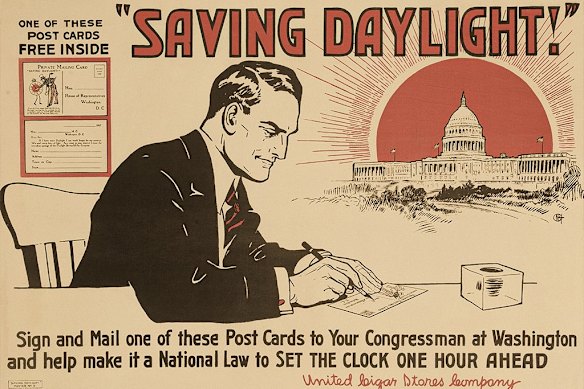
Then there is daylight saving time, which turns Australia’s three standard time zones into five. Some people (mostly in Queensland and Western Australia) firmly reject the very notion; by contrast, there’s a push in Britain to wind clocks forwards during daylight saving, not just one hour but two – so-called Churchill Time, named for the former British PM’s initiative to make the most of productive daylight hours. In the United States, several states are pushing for permanent daylight saving, even though a national trial of it in 1973 – to save power during a global oil crisis – was ditched.
Where did daylight saving come from? Who invented time zones? Why is the International Date Line so squiggly?
Where did daylight saving come from?
At 6 o’clock one February morning in 1784, American statesman and inventor Benjamin Franklin was woken by noise at the Hotel de Valentinois in Paris. Not typically an early riser, he was surprised that his room was filled with light. This gave him an idea. The previous night, he had been at a soirée where a new type of bright-burning oil lamp had been on show. How economical was it? Come to think of it, how economical were the candles that night-owl Parisians routinely used for light? He calculated that between any given March and September, they burned a total of 64 million pounds of wax and tallow for 128,100,000 hours: “An immense sum! that the city of Paris might save every year, by the economy of using sunshine instead of candles,” he wrote in a satirical letter to The Journal of Paris, suggesting that Parisians rise with the sun – and that a tax be put on window shutters.

Many years later, across the world in New Zealand, post-office shift worker and entomologist (insect expert) George Vernon Hudson had a serious idea about capturing the benefits of daylight. He proposed “seasonal time”: a two-hour clock shift from October to March. Milkmen might suffer, he told the Wellington Philosophical Society in 1898 (because winding clocks forwards would mean darker mornings) but they were a minority; anyone who regarded “an abundance of outdoor recreation” as key to “human health and happiness” would surely back the scheme.
But Hudson was ahead of his time. While New Zealand had been one of the first nations to standardise its time by reference to Greenwich, in 1868, it didn’t get on board with daylight saving until the 1920s. The first place to formally “save daylight” is generally agreed to have been the town of Port Arthur in Ontario, Canada, today called Thunder Bay, in 1908, led by an amateur athletics fan and former teacher, businessman John Hewiston.
‘If some of the hours of wasted sunlight could be withdrawn from the beginning and added to the end of the day, how many advantages would be gained by all.’
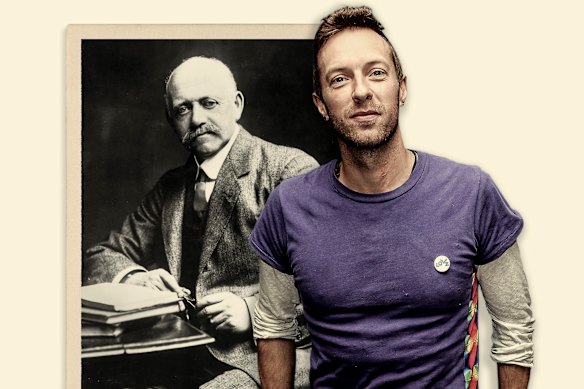
William WillettBritain was first moved towards action by a builder who liked horseriding: William Willett, who happens to be the great-great-grandfather of Coldplay singer Chris Martin (whose hit songs include Clocks). Willett’s self-published pamphlet The Waste of Daylight put daylight saving on influential radars.
Willett had been on a morning ride in Kent when he’d noticed that the blinds of most houses were still drawn. “Now, if some of the hours of wasted sunlight could be withdrawn from the beginning and added to the end of the day, how many advantages would be gained by all,” he wrote in 1907. He lobbied for “British Summer Time”: for the clocks to be moved forwards by 80 minutes in four weekly increments from April, then backwards in September, which he calculated would “save” 210 hours of daylight a year.
In the end, though, it was neither health nor leisure but conflict that kicked daylight saving into being. “It is one of the paradoxes of history,” Winston Churchill later opined in a tribute to Willett, “that we should owe the boon [of daylight saving] to a war which plunged Europe into darkness for four years.” In 1916, wartime Britain turned its clocks forwards an hour at the start of summer, to conserve fuel. (In World War II, it went even further, with Churchill mandating the clocks stay two hours ahead during daylight saving hours, so-called Double Summertime.)
When Australia followed suit, in 1917, it took just a month before the complaints began, writes Graeme Davison: mostly from dairy farmers, who claimed their early-rising cows were less productive; and cinema and restaurant owners, who claimed patrons were lingering outdoors instead of spending their wages with them; and residents who said “skylarking” youths were keeping them awake in the evening; as well as mothers of sleepless children; and shift workers.
Daylight saving was dropped after the war, returned in 1942 during the next world war, then was ditched. Tasmania became the first state to reintroduce it, during drought in 1967, in a bid to reduce pressure on the state’s hydroelectric electricity supply.
‘You get the introduction of flexi-time in offices, the extension of night shopping hours, new interest in techniques of time management.’
Professor Graeme DavisonBy the 1970s, it was on radars again across the nation, Davison tells us. “There’s a lobby group, the Daylight Saving Association, pushing for it. In a broader sense, you get the introduction of flexi-time in offices, the extension of night shopping hours, new interest in techniques of time management – all of that tends to contribute to the idea that organising time in a rational way is a good idea.”
Not everyone was on board. WA, which had dropped out of daylight saving in both world wars, has rejected adopting it in four referendums, most recently in 2009. In Queensland’s 1992 referendum, the “yes” case argued that local businesses would benefit from being in chronological alignment with their neighbours in NSW; the “no” case complained that daylight saving would condemn children to finishing school during the hottest part of the day and that “for many elderly people” it would be an “inconvenience requiring changes to daily living routines”. The “no” campaign won with 54.5 per cent of the vote.
In Britain, meanwhile, Conservative MP Rebecca Harris brought a bill to parliament in 2012 calling for a cost-benefit analysis of potentially moving the clocks forwards one hour year-round, a proposal that was widely supported but failed to proceed due to political shenanigans. In 2025, British Labour MP Alex Mayer revived the issue, calling for an even more extreme measure: moving the clocks forwards two hours, meaning even when they went backwards one hour in winter they would still be an hour ahead of UTC, so-called “Churchill hours”.
Even Donald Trump has an interest in daylight saving, apparently supporting efforts to put the clocks forwards one hour year-round. “Very popular and, most importantly, no more changing of the clocks, a big inconvenience and, for our government, A VERY COSTLY EVENT!!!,” he wrote on social media in April 2025. Versions of what’s known as Sunshine Protection acts have been debated by Congress several times, and 19 states have sought federal approval for permanent daylight saving, but so far nothing has been approved.
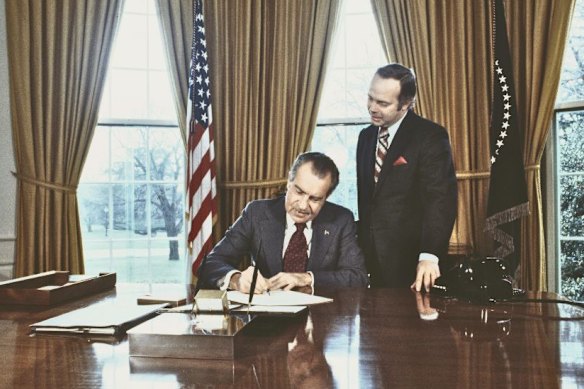
Back in 1973, as the United States reeled from fuel shortages caused by an oil embargo by oil-producing nations in OPEC, then president Richard Nixon signed into law a two-year trial of permanent daylight saving to conserve fuel. But it was quickly abandoned as its effects became clearer, including that children were not as safe bike-riding or walking to school in the dark; and it did not prove to be a magic bullet for solving social maladies such as night-time crime.
Meanwhile, time is about to enter a new frontier with the creation of Co-ordinated Lunar Time for the moon. At present, lunar projects run according to the time at the co-ordinating agency’s headquarters (e.g. Houston time for NASA, China Standard Time for China’s missions). In 2024, Congress requested that NASA make the new zone happen by the end of 2026, the idea being that it can be scaled out to Mars and beyond. This will require a lot of cleverness, observes the United Nations Office for Outer Space Affairs. “Place two perfectly synchronised clocks – one on Earth and one on the Moon – and, after just one Earth day, the lunar clock would be ahead by about 56 microseconds. That might not sound like much, but for spacecraft navigation, this tiny discrepancy could be critical.”
Who invented time zones then?
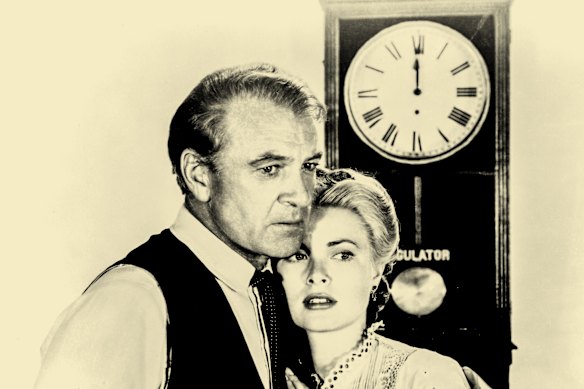
In the 1952 western High Noon, a telegram arrives at 10.40 in the morning in the frontier town of Hadleyville. A villain fresh out of jail is due in town on the noon train (or, to be precise, at “high noon”, the term used since medieval times for when the sun is at its highest point in the sky). Will our hero, town marshall Will Kane, stand his ground or flee with his new wife, played by Grace Kelly? It’s a tough call. As the countdown begins, we see clocks tick, pendulums swing and Kane anxiously consult his fob watch. The action, as film buffs will know, unfolds in near real-time.
Before there were clocks, local time could be reliably determined by noting the sun’s position. Yet, by the 1870s, when High Noon was set, time across the United States was a mess – the anxiety felt by Hadleyville’s clock-watchers may well have reflected this temporal chaos. Rival railway companies used at least 80 “standard times”, usually based on the local time at their headquarters. It was all a train passenger could do to keep their pocket watches adjusted as they sped across the country. In the midwest city of St Louis, where railways converged from all directions, “station clocks once showed no fewer than 14 different times”, writes Davison in his 1993 book The Unforgiving Minute: How Australia Learned to Tell the Time.
Britain had clocked the problem in the 1840s, the Great Western Railway imposing a standard “Railway Time” along its route, from London in the east to Bristol out west, though some villages stood firm and installed public clocks with two minute hands: one pointing to Railway Time, one local.
Seeking some kind of sensible uniformity for the United States, in 1883 a man called Charles Dowd lobbied railway officials to create a workable solution: four time zones called Eastern, Central, Mountain and Pacific.
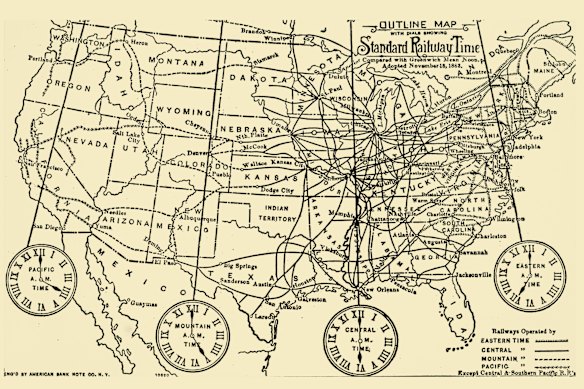
Meanwhile, the celebrated Canadian railway engineer Sandford Fleming had grander ambitions: to impose an overarching order on the whole of the Earth’s natural time differences.
Modern nations seeking to standardise time would have to set aside their own versions and agree on just one. But whose?
Fleming knew that the Earth spun west to east at 1 degree every four minutes (the planet has been spinning since it formed out of swirling gas and dust 4.6 billion years). He proposed breaking up the globe into 24 zones, each 15 degrees, or an hour, apart, tagged with letters of the alphabet.
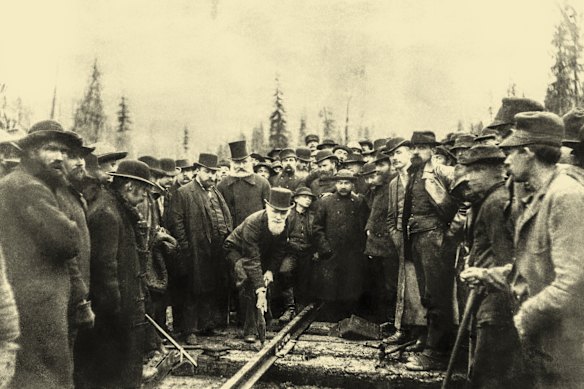
Of course, his “Cosmic Time” was built on centuries of geography. Early Greek polymaths, for instance, had drawn a grid on the world with horizontal lines of latitude and vertical lines of longitude, or meridians (Latin for “midday”), that bent from pole to pole. Longitude was critical to navigation, which was mostly done by sea (airplanes having not yet been invented).
“Since the Earth rotates by 15 degrees every hour,” explains Professor Richard de Grijs from the School of Mathematical and Physical Sciences at Macquarie University, “if you knew the time at your reference meridian (Greenwich, say) and also your local time (from the Sun or at night based on the stars), the time difference times 15 degrees would give you your current longitude, east or west of the reference, expressed in hours.”
‘Even the Great Pyramid of Giza was once mooted as a reference [meridian].’
Professor Richard de GrijsOver the centuries many places had designated their own reference meridians: Indian cartographers and astronomers agreed “zero” ran through the city of Ujjain; Japanese map-makers favoured a line through Kyoto called Kairekisyo (but only between 1779 and 1871); before Italy was unified, its major city-states such as Venice and Florence had their own “zeroes”. “Even the Great Pyramid of Giza was once mooted as a reference in 1884,” writes de Grijs in his 2017 book Time and Time Again: Determination of Longitude at Sea in the 17th Century. Modern nations seeking to standardise time would have to set aside their own versions and agree on just one. But whose?
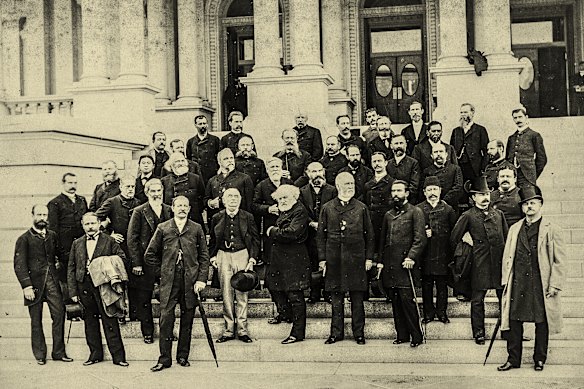
Fleming joined forces with the US’s first chief meteorologist, Cleveland Abbe, to lobby Washington for a vote on the matter. Twenty-six nations, mostly from Europe and South and Central America, attended the International Prime Meridian Conference in 1884. The group made several resolutions that governments could then enact, or not.
By this time, Emily Akkermans tells us, “nearly two-thirds of the world’s shipping used maps and charts based on the Greenwich Meridian. It was therefore a practical choice that the delegates voted for, although not all agreed. France and Brazil abstained and the Dominican Republic (then San Domingo) voted against.” The conference proposed that from the Greenwich Meridian, “longitude shall be counted in two directions up to 180 degrees, east longitude being plus and west longitude minus.” France, wanting a “neutral” meridian, refused to adopt Greenwich time until 1911, calling it Paris Mean Time “retarded by 9 minutes and 21 seconds”.
‘You need synchronisation at microsecond level for things to work correctly.’
Dr Michael WoutersThe Paris meridian is now marked by 153 bronze discs in pavements dedicated to the astronomer Francois Arago. In London, visitors to the Royal Observatory in Greenwich can stand on the line that once marked zero degrees. (They can also see the telescope used in the 1850s to define that line, which, incidentally, had spiderwebs as the crosshairs through which astronomers observed the transit of particular stars. “It was important to time the exact moment a star disappeared behind a crosshair,” Akkermans says. “They tested silk, metal threads and human hair but the spiderwebs were stronger, thinner and more uniform.“)
Today, defining the meridian is a high-tech pursuit – satellites not spiderwebs. In the mid-’80s, the world’s co-ordinate systems were updated such that the prime meridian passes 102.5 metres to the east of the old meridian at Greenwich. Greenwich Mean Time has been replaced by UTC, or Co-ordinated Universal Time (at least, officially). UTC is determined by atomic clocks, super-accurate devices that measure the oscillations of “cesium-133 atoms” to define the length of a second, previously calculated as 1/86,400 of a solar day.
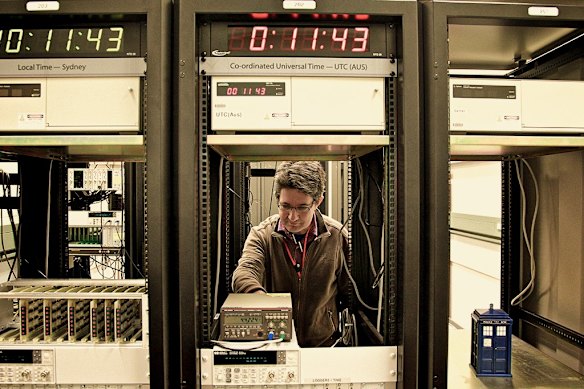
In Australia, the job of regulating time falls to Dr Michael Wouters and his team at the National Measurement Institute in Sydney. “The International Bureau of Weights and Measures, which is responsible for calculating Co-ordinated Universal Time, collects all of these measurements from labs like ours around the world, makes an average of them, and then tells you what your difference is with respect to that – and that average is UTC,” he tells us. UTC is broadcast by select atomic clocks through GPS, the internet and radio signals. Depending on daylight saving hours, eastern Australian time is UTC + 10 or + 11.
Even a tiny inaccuracy in how clocks are synchronised – a millionth of a second over three years – can affect industries that rely on near-perfect time keeping, such as the power grid and mobile communications, says Wouters. “You need synchronisation at microsecond level for things to work correctly.”
Time zones, a human invention, are less scientific. Few neatly align with Fleming’s 24 meridians as he might have hoped; deciding where they fall is “really just a national decision about what time zone to have within their borders”, says Wouters. In the US, for example, townsfolk can apply to the Department of Transportation to have their zone changed. In March 2026, the state of Georgia asked to shift from Eastern Time to Atlantic Standard Time, which is an hour ahead, to put the state into permanent daylight saving time.
Sometimes the US creates a new zone, too, as it did in 2000 with the Chamorro Time Zone, for Guam and the Northern Mariana Islands. North Korea has switched back and forth from “Pyongyang Time” in 2015 to realigning with South Korea in 2018; Venezuela set its clocks back 30 minutes under then-president Hugo Chavez in 2007, but reversed the move in 2016.
Why was time all over the place in early Australia?
In 1897, Charles Deland, a miner at Menzies, near Kalgoorlie, arrived at church to find the sermon nearly over, writes Graeme Davison in The Unforgiving Minute. Deland later explained to his fiancée: “The post office time is usually 40 minutes behind town time & mine time is just between the two. I went to church by town time and found they had started by the post office time. The irregularity is because of the mine being taken from the sun & post office time from the Perth time.”
The story was similar in towns across the continent, including Broken Hill, where the railways ran on Adelaide time, the post office on Sydney time and the mines on “local”, or solar, time. To thicken the plot, any public clocks in the early colonies’ cities were set by their makers and prone to breaking down. “There are but five public clocks in Sydney, three of which have not shown any symptoms of movement for the past five or six days,” grumbled The Sydney Morning Herald in 1844.
‘Even as late as the 1880s, Australia is still more like an archipelago of islands than it is like a completely united country.’
Professor Graeme DavisonBy the 1870s, the big cities were sending telegraph signals from government astronomical observatories to their public clocks and to an instrument called a time-ball, a huge ball that dropped down a pole at an appointed hour (usually 1pm) and which could be seen by ships at sea (in Williamstown in Melbourne, say, or on The Rocks in Sydney). No one was in a hurry to standardise time.
“Even as late as the 1880s, Australia is still more like an archipelago of islands than it is like a completely united country,” says Davison, an emeritus professor of history at Monash University. “It’s only in 1878 that you finally get direct railway communication between Melbourne and Sydney and, shortly after, Adelaide. Even within, say, Victoria or NSW, different communities will keep their own time.” (It was a “chaos”, noted The Telegraph in Brisbane, that “caused much friction”.)
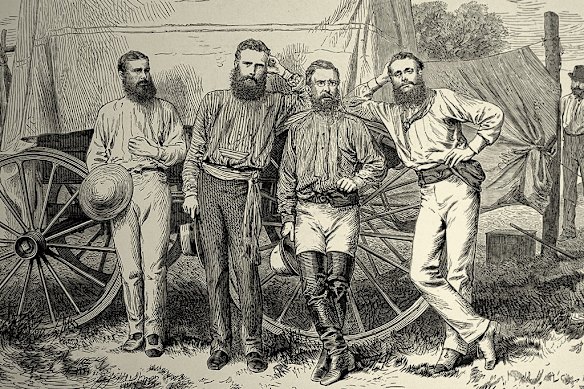
An Australian who had been in touch with Canada’s Sandford Fleming was Charles Todd, South Australia’s postmaster-general and superintendent of telegraphs. An astronomer and engineer, he had overseen the Overland Telegraph Line that linked Adelaide to Darwin then Indonesia, via one of the first subsea cables, and on to London. At a conference in 1891, he proposed that Australia be united under one time zone based on the 135th meridian, which, conveniently, ran through his home state.
The colonies made these zones into law on one discombobulating evening in 1895.
“Todd had an interest in trying to make South Australian time the time for the whole continent,” Davison says. “Now, that was going to be very difficult because the difference [in solar and standard times] between, say, Brisbane and Adelaide, let alone [Brisbane and] Western Australia, was really a bit too much. The Queenslanders were the first to object to Todd’s proposal and the division of opinion on that led towards the final decision to have three one-hourly time zones rather than just one or two.”
In 1892, a meeting of surveyors in Austraila took a US-style approach to zones, proposing three: Western time at 120 degrees longitude, Central at 135 and Eastern at 150 (eight, nine and 10 hours, respectively, east of Greenwich). The colonies made these into law on one discombobulating evening in 1895. At midnight on February 1, NSW clocks stopped for five minutes and Adelaide clocks for 14 minutes and 20 seconds. At 20 minutes to 12, Melbourne clocks whizzed forwards to midnight. It was “a busy night for Australian clockmakers and a bewildering one for many citizens,” writes Davison in his essay Punctuality and Progress: The foundations of Australian standard time.
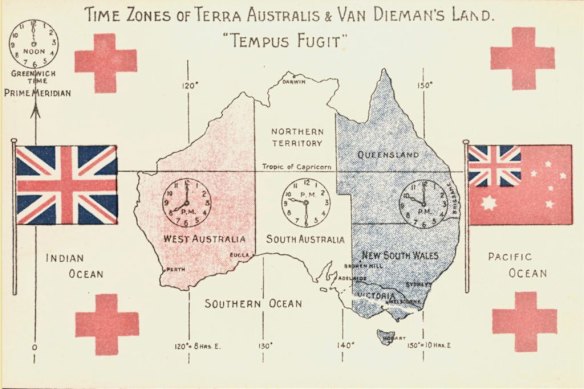
Not everyone was happy. Some South Australians felt they had been cast into a time warp: having to wait an hour longer than their eastern counterparts for a telegram from Britain, for instance, as their post office was still closed and, even worse, finishing footy matches in the dark.
‘The South Australians were not going to be content to observe Sydney time.’
As The Advertiser noted in 1899, “An agitation has been raised by commercial men and fomented, it is said, by cricket and football circles that we should move up half an hour nearer to Melbourne time, and to also obtain half an hour’s extra daylight.” In 1899, Australian Central Standard Time came into effect in South Australia (and the Northern Territory, then part of SA), which was 9½ hours ahead of Greenwich. Broken Hill, although in NSW, also opted in because of its rail links with Adelaide.
“What’s surprising is that Adelaide didn’t come aboard and observe Eastern Standard Time,” notes Davison, “because a half-an-hour difference hardly matters. I’m not sure how you would explain the fact that they’ve continued it – but its origin is partly explained by the fact that it was with Charles Todd that the argument began, and the South Australians were not going to be content to observe Sydney time.”
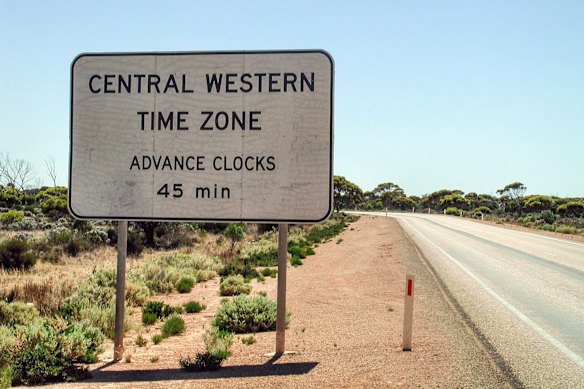
Drive along the Eyre Highway on the Nullarbor Plain and you’ll reach another pocket of the nation that has not signed up entirely to our mainstream time zones. Central Western Standard Time is an unofficial, albeit clearly signed, zone that applies at roadhouses for some 340 kilometres of WA up to Border Village roadhouse near the SA border. Clocks are set to UTC+ 08.45, 45 minutes ahead of Perth and 45 behind Adelaide, a difference thought to be a relic of an old telegraph station caught between time zones at Eucla.
‘If they don’t listen to you, they’ll turn up and we’re just about ready to close.’
Christine Warren“It was funny at the beginning because I have never been in another place with three clocks,” says the duty manager at Eucla Motel, Gianfranco Nicolini, originally from Chile. “Sometimes when guests arrive at the cafe, they ask, ‘Well, I don’t know if I have to have lunch, breakfast or …’ It’s something iconic from this place.”
Down the highway at Cocklebiddy Roadhouse, site manager Christine Warren warns travellers who phone ahead to plan for “Cocklebiddy time”. “If they don’t listen to you, they’ll turn up and we’re just about ready to close.” Some customers can get annoyed, she adds. “If they carry on like a pork chop, I just say, ‘Look, if you’ve got a problem with it, take it to your member of parliament and let them sort it out.’”
This Explainer was published on October 5, when daylight saving started, and has been updated to reflect the end of daylight saving on April 5.
Get fascinating insights and explanations on the world’s most perplexing topics. Sign up for our weekly Explainer newsletter.