 3 months ago
56
3 months ago
56
Kate WhannelPolitical reporter

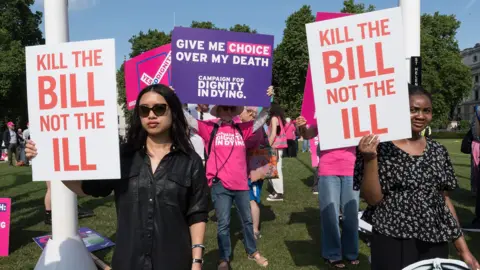 Getty Images
Demonstrators on both sides have campaigned in Westminster as the bill has progressed through Parliament
Both supporters and opponents of the Assisted Dying Bill are now acknowledging that the legislation will not become law in the current session of Parliament.
The House of Lords are continuing to debate the proposals but it is clear there is not enough time to complete all the stages before May when a new session begins.
Backers of the bill have blamed opponents in the Lords for slowing down progress by tabling more than 1,200 amendments, believed to be a record high for a backbenchers' bill.
Critics argue that the bill lacked safeguards and the debates in the Lords had "exposed further problems".
The legislation was not a government bill but introduced by Labour backbencher Kim Leadbeater.
MPs voted in favour of the bill last June but it has struggled to progress in the House of Lords where timetables for debates are less strict and every amendment can be debated.
The bill, which would allow terminally ill people expected to die within six months to seek medical help to end their life, needs approval from both houses before it can become law.
Earlier this month, supporters of the bill said it was "effectively impossible" for the bill to pass before the end of the session.
In a joint letter to members of Parliament, opponents including paralympian Baroness Grey-Thompson, wrote: "It is now clear that the Terminally ill (End of Life) Bill will fall".
They said the proposal "does not sufficiently guard against coercion or protect the most vulnerable people in our society".
The peers also argued that a backbencher's bill was the "wrong vehicle for a change of this scale and sensitivity" and expressed concern that supporters could try to "force" the bill through Parliament.
Labour peer Lord Falconer who has led support for the bill in the Lords, previously suggested the government could deploy the Parliament Act - a rarely-used power - to push the bill through Parliament in the next session.
Earlier this month, more than 100 Labour MPs wrote to the prime minister warning that failing to pass the legislation would undermine trust in politics.
They urged Sir Keir Starmer to make more time for the bill to be debated but the government has said it is "neutral on the matter of assisted dying and the passage of the bill".
A government source has said using the Parliament Act would be deeply controversial and suggested setting up a Royal Commission - or independent public inquiry - to examine the proposals in Leadbeater's bill.
A proposal to legalise assisted dying in England and Wales could return in the next parliamentary session, if a backbench MP opts to introduce new legislation.
In order to have the chance to bring forward a proposed law, backbench MPs can enter a ballot. The first 20 names to be drawn will get priority time for their bill.
The government could also introduce its own bill, however it has so far not given any indication that it intends to do so.