
 4 months ago
70
4 months ago
70
58 minutes ago
Theo LeggettTransport Correspondent

 Getty Images
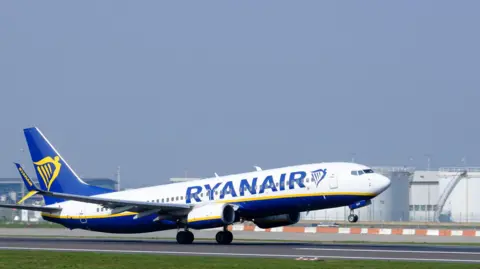
Ryanair passengers due to fly from Milan Bergamo to Manchester last week were left behind due to problems at passport control, the airline has confirmed.
The introduction of a European digital border control system, known as the Entry-Exit System (EES), has been blamed for long delays at European airports.
"Should these passengers have presented at the boarding gate desk before it closed, they would have boarded this flight," Ryanair said.
EES requires non-EU citizens, including Britons, to register biometric information, including face scans and fingerprints, which can then be checked each time they cross a European Schengen Area border.
It has been phased in since October and was meant to become fully operational on 10 April.
However, its introduction has been more successful in some parts of Europe than others.
Ryanair said: "Due to passport control delays at Milan Bergamo Airport on 16 April, a number of passengers missed this flight from Milan to Manchester."
According to one passenger, about 30 people were left stranded. Ryanair did not say how many travellers were affected.
Milan Bergamo Airport has been contacted for comment.
EES is run by the relevant border control authority in each country rather than by the airport or airline.
Adam Hassanjee, 18, from Bolton was one of the passengers left stranded in Italy.
"We were waiting for an hour and a half and weren't moving," he told the BBC.
"Then we see the plane leave and got told we have to go and book our own flight back."
He said roughly 80 passengers were in his passport control queue, made up of people from four flights.
"People were pushing past us that were on later flights than us. Some were let through. It was complete chaos. No organisation and staff had no care," he said.
As there were no available flights on the same day, he had to book a flight from Bergamo to Malta, then from there to Leeds.
A spokesperson for the European Commission told the BBC the EES system was "working very well". In the overwhelming majority of EU member states, it said, there had been "no issues".
But it conceded there were "a few member states where technical issues have been detected – as can be expected in the first days of full operation of any major new system".
The Commission said the purpose of the system was to make borders more secure and to protect EU citizens.
Since EES was introduced in October, it said, more than 56 million border crossings had been registered, and 28,500 people had been denied entry, of whom 700 had been identified as posing a security threat.
Additional reporting by James Kelly and Faarea Masud.

















































