
 1 month ago
42
1 month ago
42
Five years ago, James J. Robinson broke into St Kevin’s College in Melbourne to burn the blazer he had worn as a student there. It was a protest about what he considered the toxic and bullying culture at the elite private boys school. In an accompanying Instagram post he complained of “a system designed to let young boys think they can do anything … and get away with it”.
Robinson, now 30, was working as a photographer in the US at the time, getting to glimpse, through fashion and magazine shoots, the gilded world of such celebrities as Rihanna, Lily-Rose Depp and Sydney Sweeney.
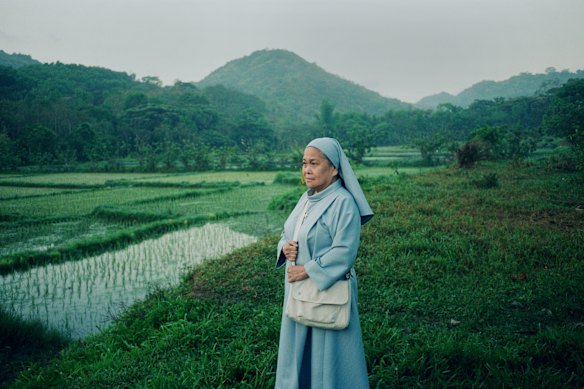
But his debut feature film First Light is neither the provocation his school protest might suggest nor a reflection of privileged lives in the US. Instead, it’s a gentle, thoughtful drama about an elderly nun, Sister Yolanda (Ruby Ruiz), living in an ageing convent in the Philippines – a very Catholic country – whose faith in the church is tested when a young man dies after a construction accident.
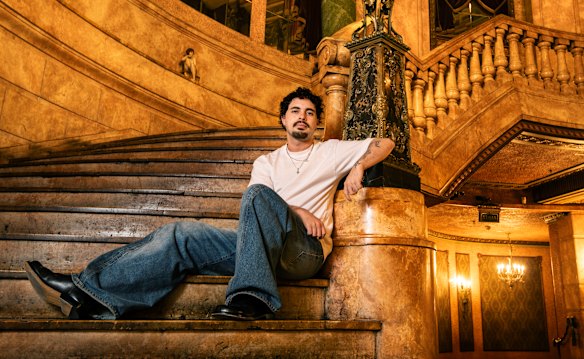
It’s a surprise to hear from Robinson that First Light is “deeply autobiographical”. He is not an elderly nun and he doesn’t live in the Philippines. In fact, growing up in Ashwood in Melbourne’s south-eastern suburbs, he had never even been to the country of his mother’s birth until he was 19.
But Robinson says that “every single character represents a different version of myself or different parts of my brain that are constantly in conflict” with each other.
“The character of Sister Yolanda is this grace I feel like I had, especially when I was a lot younger and my commitment to the church was very unsullied.”
Other characters in First Light include a wealthy woman, Linda Dela Cruz (Maricel Soriano), who, Robinson says, represents his capitalist side, and a young nun, Sister Arlene (Kare Adea), who wonders if the convent is right for her.
“The whole story itself is my own experience with Catholicism and learning how to find a version of it that works for me,” Robinson says. “Different characters become metaphors for different parts of that.”
Robinson, who grew up devoutly Catholic in a Filipino-Australian family, shot the film in an old convent in Rizal, in the mountains east of Manila, and had to have his script translated into the local Tagalog language.
His mother, Sheila Domingo Robinson, migrated to Australia as a teenager when president Ferdinand Marcos declared martial law in the 1970s. She now works in an office, while his Anglo-Australian father Jack is an accountant. Before studying film at Swinburne, Robinson topped his bible studies class in year 12.
“It’s impossible to extract me completely from Catholicism,” he says. “I found new forms of belief in God that isn’t so tied to Catholicism but it really shapes the way that I see the world, as much as I disagree with the institutional side of it. I’d say that I’m maybe still a Catholic but my version of it is completely my own.” The “very queer version of the cross” that Robinson wears around his neck – Mexican and bejewelled – symbolises his take.
Robinson developed the film while working as a photographer in the US.
“It was amazing to have access to this world of celebrity and success and finally start earning good money,” he says. “When I was in Melbourne I was working at Uniqlo and I did Santa photography at Myer.
“To be finally purely practising my creative craft in New York was obviously amazing [but] it put me in this bubble of quite big egos and a lot of people who were trying to use you to get what they want … a good thing to learn at a young age is to navigate when people are trying to do that. But it was a confusing place … the highest of the highs and the lowest of the lows.”
He has been writing screenplays since high school, intending to direct one day.
“First Light was one of many features that I’d written but it felt like the first time that I was saying something that was mature enough to actually attempt to make,” he says. “Approaching 30, it felt like it was born from a place that felt authentic.”
While the crumbling convent where Sister Yolanda lives is a metaphor for the institutional church, Robinson did not want the film to come across as anti-Catholic.
“If anything, it’s upholding the core values [of Catholicism] that I think are beautiful,” he says. “It’s when the institution becomes involved – the human side of it – that’s where corruption begins to enter.”
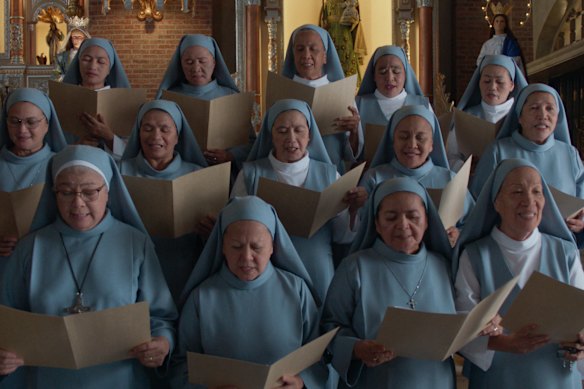
Shooting First Light allowed him to reconnect with what he calls the motherland.
“It wasn’t like, ‘I have to shoot my first film there’,” he says. “But it felt interesting to make this film in the Philippines and see the parallels between the way that Catholicism can exist and become intertwined with politics and class [and find] there’s a resonance with how that happens in Australia.”
While many foreigners associate the Philippines with beaches and islands, Robinson says his “indigenous Filipino blood” comes from the mountains. “I really wanted to showcase this whole other side of the Philippines,” he says. “It’s misty and there’s pine trees.”
His mother didn’t teach him her native language because she “had a hard time with her English here, just assimilating into the country”, he says. “She didn’t want us to have those same problems.”
Robinson wrote the script in English, had it translated to Tagalog, then, as the actors rehearsed, he focused on their non-verbal communication – their body language and how they raised their voice – rather than the dialogue. He relied on his assistant directors to tell him if lines had been changed.
First Light screened at Melbourne International Film Festival last year, with Robinson winning the best Australian director award, then at Sydney Film Festival earlier this month. He thinks he shot the film with enough tact that it won’t be controversial when it’s released in the Philippines.
“There are senators in the Philippines who have seen it, and a lot of nuns have seen it as well, and they’ve all really loved the film,” Robinson says. “I don’t think it’s a hot topic to talk about corruption in the Philippines.”
Robinson doesn’t feel any responsibility to be the voice of the diaspora.
“There’s almost this expectation of what an Asian director’s film might look like, or what a queer director’s film might look like,” he says. “To me, both of those identities are so much more complex than just direct experiences of those things.
“A Filipino film isn’t always going to be about racism, or a queer film doesn’t always have to be about homophobia. It’s impossible for me to extract my identity from what I’m going to do. All I can do is be authentic to myself and to my voice.”
First Light opens in cinemas on July 9.

















































