3 months ago
23
3 months ago
23
When Neil Robertson heard a friend’s uncle was selling his two-bedroom terrace house in Melbourne’s Fitzroy for $7500, he knew he had to buy it.
Measuring about 6.5 metres across and 25 metres deep, it came fully furnished, with two power points – “one for the toaster and one for the fridge” – no hot water service, and an outhouse containing a rusted stove.
It was no dream, but in 1972, Robertson was 24, single, and his uncle, a man who could “turn his hands to anything”, reckoned the house was a terrific buy, “sound as”.
“I didn’t bother going to the bank because I didn’t have the funds for the bank to offer me a loan,” the 77-year-old recalls. “So I sold my car, and I got about $1400 for that, and I put down a $1500 deposit on the house.”
With help from a solicitor, Robertson worked out the payment terms over five years, which amounted to about $100 a month. As he paid it off, he slowly renovated it.
“I had to jack the house up, put stumps under it, and build it up again, room by room,” Robertson recalls. “I also had to install a hot water service. We later demolished the back section of the house, poured a slab, and put a new addition on.”
By age 30 he had paid it off – and hasn’t had a mortgage since.
Robertson, like many of his generation, did what was expected: he worked hard, bought a home, fixed it up and sold it (or not), purchased another. Maybe bought an investment property down the track, a small nest egg for the kids. The decisions of Baby Boomers and those older were rational, measured, even humble.
But read through the eyes of younger generations today, these choices – opportunities – are what many believe have contributed to their own difficulties in achieving the Great Australian Dream.
“After about nine years we sold the house for $64,000, and bought a second one about 500 metres down the road for $50,000,” Robertson says. The ceiling was rough, the plaster was cracked, and the bathhouse at the back was tipping over.
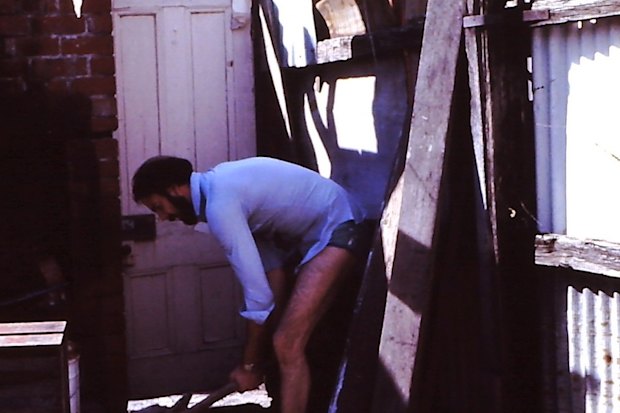
Neil Robertson fixing the outhouse at his second home in Newry Street, Fitzroy North.
The couple lived in the house on Newry Street, Fitzroy North until 2012, when they sold it for just over $1.5 million. They purchased their current house in West Brunswick for $1,210,000, this time fully renovated.
While their original dream included settling on a quarter-acre block out in Eltham, life led them down another, far more lucrative path. The Robertsons know they are lucky: being mortgage free for so long has enabled them to live a peaceful, financially secure life.
They also know Australia’s youngest generations have a very different future.
“I have huge sympathy for young people today,” Robertson says. “It must be so hard. Younger people today need two, maybe three incomes. The prices have just gotten crazy. Back then, you got a job and you’d expect you might have a shot.
“I couldn’t comprehend taking out a mortgage for a million dollars.”
Home ownership has been central to Australian identity, the main event in the broader myth of the Great Australian Dream – an enduring belief that home ownership can lead to a better life. Monash University urban historian Emeritus Professor Graeme Davison says this desire to own a home dates back to the mid-1800s.
“Australia was far more democratic in every sense than Britain. One of the fruits of that was the idea of trying to give working people their own homes,” he says. In Britain, only property owners could vote, cementing the notion that property ownership was essential to citizenship.
Property meant having a stake in the country, and therefore the right to determine its future. “So in Australia, there was still this tie between property ownership, even on a modest scale, and political rights,” Davison says. “It tied people to a mortgage, and made them solid citizens attached to the soil.”
By the end of the 19th century, Melbourne and Sydney had, by global standards, some of the highest home ownership rates. Davison reckons that in Melbourne, about 40 per cent of people owned their home; in Sydney, it was roughly 30 per cent.
“Compare that to the places they’d come from – in England, home ownership was no more than 5 per cent in most cities, never more than 10 per cent. Australia’s rates were comparable only to a very few American cities,” he says.
Most of these homes weren’t flash. A relatively poor, working-class family could only afford a small timber house – “a shack, really” – in an outer suburb like Footscray at the time, teeming with industrial pollution and built on low-lying land and unmade streets.
But they owned it, and this transformed people who would have otherwise remained without many civic rights into “modest, upstanding citizens”.
“The thinking was that if you own property … you’re not going to be attracted to radical ideas that would nationalise property, or do away with landlords,” says Peter Mares, writer fellow at the Centre for Policy Development and author of No Place Like Home: Repairing Australia’s Housing Crisis.
Robert Menzies, the longest-serving Australian prime minister, who held office from 1939 to 1941 and from 1949 to 1966, helped cement property ownership in the Australian psyche.
“Our home-owning society really began in a big way in the postwar period, and was driven by a whole lot of government policies that encouraged people into home ownership,” Mares says.
“This was the Cold War time, a confrontation between global capitalism and global communism, and the Menzies government had a view that people who own their own piece of land, their own small house and garden … would turn into good, upstanding citizens who were moderate and had a stake in the status quo.”
The appetite to build houses that were affordable, livable and simple to construct spawned the Small Homes Service, which saw The Age team up with the Institute of Architects in 1946 and hire architect Robin Boyd (and others) to design drawings of affordable houses available for purchase.
At its peak, home ownership reached about 70 per cent between the 1950s and 1970s, a rate often viewed as a historical benchmark despite renting being more common in Australia, especially cities, than it seemed.
“Until World War Two, about 50 per cent of people were renters,” Mares says. But the decades-long focus on home ownership created a two-tiered system where “renting as an alternative is far inferior to home ownership in Australia”.
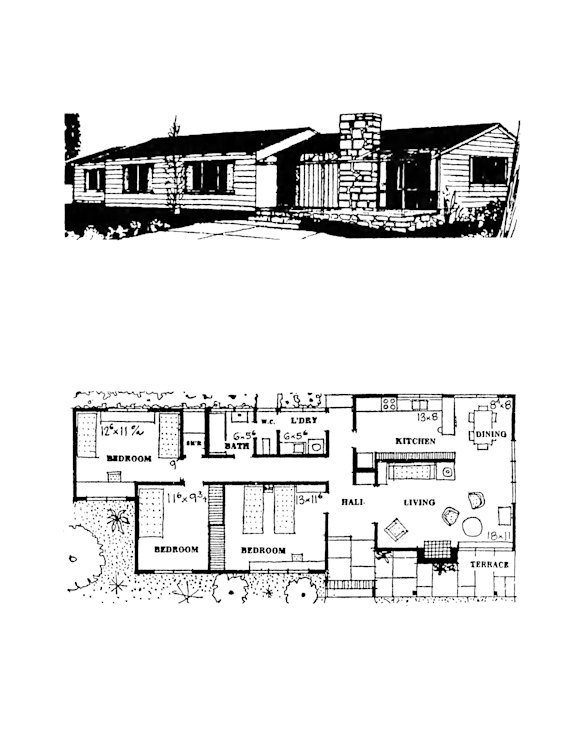
The T377 plan for a house, drawn up by architect Neil Clerehan for The Age’s Small Homes Service.Credit: The Age
Allison Vallance, 61, a former horticulturist, bought her first house in 1985 with her then-partner and his brother for $96,000. It was a run-down three-bedder with mould and dicey electrical work.
“It was so repulsive,” she says of the property in the leafy Sydney suburb of Eastwood. “We had to mow the front yard so we could even get furniture into the house because it was so overgrown.”
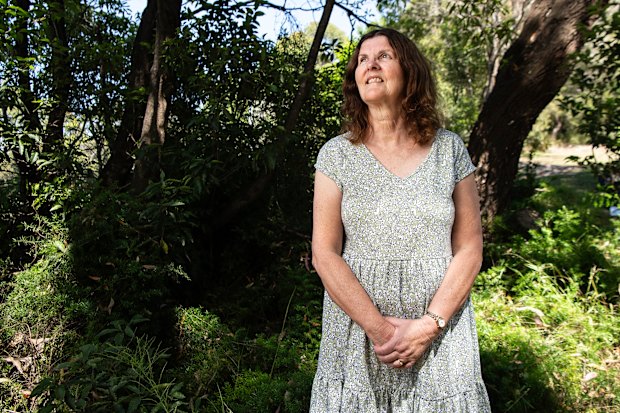
Allison Vallance, 61, started saving for a house when she was 16 years old. Credit: STEVEN SIEWERT
The trio could see the brick home’s potential. The bones were good, and it was on a decent-sized block. The plan was to renovate and sell. “It was a stepping stone … no one could ever afford to buy where they wanted to live,” recalls Vallance.
Her parents extolled the virtues of owning a home, urging her to buy. It was better than paying rent and was achievable, with a bit of frugality.
So at 16, when she got her first full-time job in a bank, Vallance started saving 20 per cent of her $90 a week salary. After about six years, while still living in the family home, she had a deposit saved.
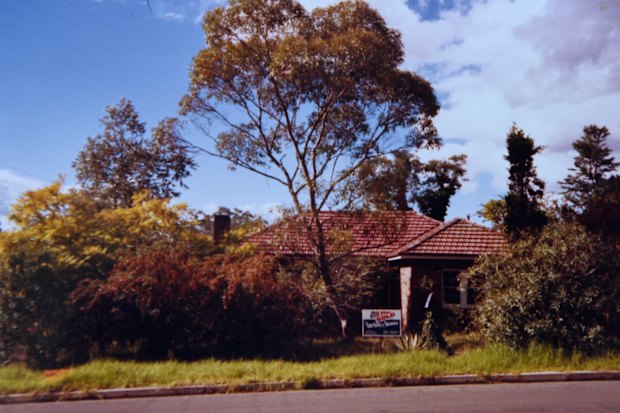
The Eastwood property with its overgrown yard.
During that time, “we didn’t do much at all,” she says, noting it was a big deal to go to the pub.
While sacrifices were made to buy her first property –“We couldn’t afford to go on holidays, couldn’t afford a new car … us and all our friends would take turns to have people over for a barbecue” – Vallance reckons it was easier to get into the market in the mid-80s when properties were cheaper.
Her two adult sons have different expectations.
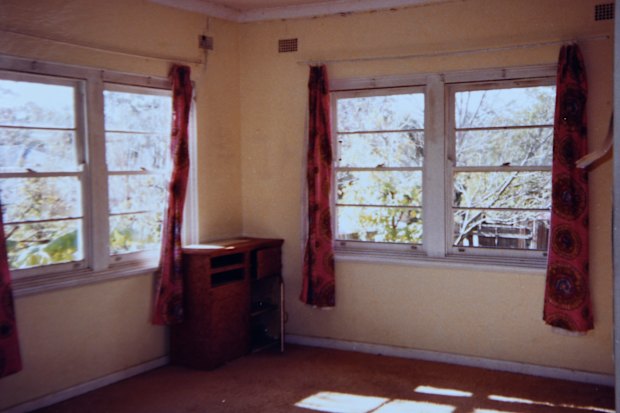
The Eastwood property was run-down when Vallance and others bought it.
“Our oldest son … he actually bought a house near where he works,” she said, of the property near Newcastle. “My other son has saved a deposit … but he’s also said he’ll never be able to afford to buy in Sydney.”
Loading
Between the end of the Second World War and the late 1970s, house prices remained “remarkably stable” at about three-and-a-half times average weekly earnings, despite Australia’s population growing faster than it has in the last 10 to 15 years, says independent economist Saul Eslake.
All governments believed their primary housing responsibility was boosting supply.
“In the 1950s, nearly one in five dwellings were built by governments,” Eslake says. “And while many were poorly located – this is where your Broadmeadows comes from, for example – with poorly serviced amenities, they at least provided secure housing for home owners and renters at an affordable price.”
In 1963, Menzies introduced the first home owners’ grant scheme. “Ever since then, government policy under Labor and Liberal governments, federal and state, has shifted from boosting supply towards inflating demand,” Eslake says.
Eslake also highlights the change to capital gains tax in 1999, which made it more favourable to property investors. Negative gearing then converted from a strategy “about deferring tax, into a strategy which was about both deferring and permanently reducing tax”.
The proportion of home loans to investors rose, largely to buy established properties, which Eslake says has driven up prices.
Loading
Local governments have made it more expensive to redevelop existing brownfield sites at higher densities, leaving far-flung, under-developed greenfields as sites for new housing estates.
“The quarter-acre block is a pervasive mythology and an urban legend that has been around since before the 1940s,” says Michael Fotheringham, managing director of the Australian Housing and Urban Research Institute. “The development industry leans into it because building detached houses on greenfields is the cheapest model.”
Urban spread, fuelled by a preference for detached housing, means Australia’s suburbs are among the lowest-density in the world. “We still build about six detached houses for every apartment,” Fotheringham says.
We also build big. While official records by the Australian Bureau of Statistics did not start measuring house sizes until the 1980s, historical texts suggest the average Australian home was about 111 square metres-120 square metres between 1946 and 1950; 92sqm-111sqm in the late ’50s; 130sqm-157sqm in the 1960s and 1970s; 110sqm in the 1980s, and 120sqm in the ’90s.
Then, in 2003-04, the size more than doubled to 235.1sqm, reaching 240sqm in 2010 before slightly shrinking in the 2020s to 230sqm.
Big houses weren’t always the dream. For Maureen and Frank Cantwell, 89 and 93, getting a foot on the property ladder meant buying a little mill house in Traralgon for £2900 in 1958.
“It was a lovely two-bedroom weatherboard on a block shaped like an ice-cream cone,” Maureen recalls. “The toilet was out the back, down the yard, and it didn’t have a flush, but when we were living there the sewerage came on, and we had it connected.”
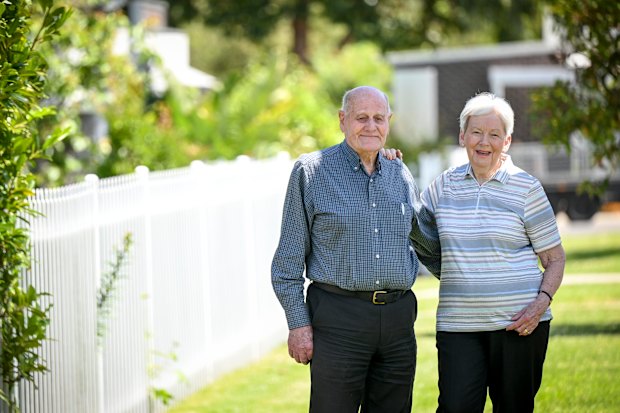
Maureen and Frank Cantwell bought their first house in early 1950s for £2900, and their second in Boronia for $29,000 in 1966. They were mortgage-free by the time Frank was 40 years old. Credit: Eddie Jim
Maureen was 19 and Frank was 23. They lived there for a few years. Frank got a job in Melbourne, and they moved to Maureen’s aunty’s house in Belgrave.
In 1966, they had enough savings to purchase their second home: a two-bedroom house on a three-quarter acre block in Boronia. It cost $29,000, and they had it paid off by the time Frank was 40. While Maureen worked part-time, they led a comfortable life with their two sons – including overseas trips and home renovations such as a tennis court, swimming pool and extra lounge – mainly on Frank’s salary.
About 18 years ago, the couple sold their land to a developer, who subdivided it and built five smaller units, one earmarked for Frank and Maureen. They lived there until 2024 before moving to a retirement village in Ferntree Gully, where they live an independent, fulfilling life.
They know they are lucky.
“It didn’t feel really hard [paying off a mortgage by 40],” Maureen says. “I had a reasonably good job and Frank had a good job, and in those days you didn’t worry that you were going to lose it – you stopped at the one job.”
“I grieve much for the young ones today,” adds Frank. “I just can’t see them getting ahead.”