 3 months ago
43
3 months ago
43
When you take a moment and look into one of John Perceval’s paintings, there’s a chance that the artist himself is the one staring back at you. A young, cherubic face with a pudding bowl haircut appears again and again – a face, which it turns out, is the artist’s own.
A similar visage is also apparent in some of his most beloved works, the ceramic angels.
Opening at Heide Museum of Modern Art this week is John Perceval: All That We Are, an extraordinary coming together of 25 of the angels, arguably some of the West Australian-born artist’s most significant creations, as well as several previously unseen masterpieces.
Remarkably, this is the first major survey of Perceval’s work in more than 30 years; the last was Of Dark and Light at the National Gallery of Victoria in 1992.
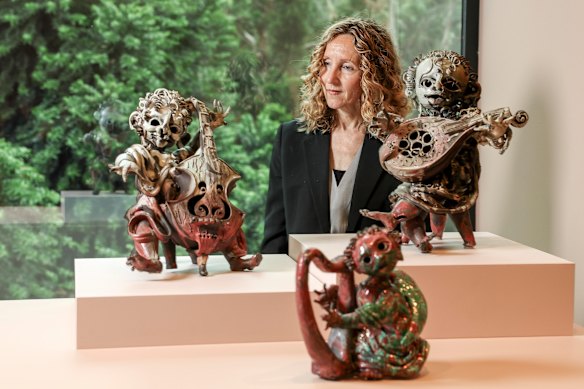
Drawn from significant public and private collections, the show includes several rarely seen works and covers the artist’s first three decades.
The saying goes ‘where angels fear to tread’ but at this exclusive walk through, it’s me concerned about my every step in the room housing these precious and fragile otherworldly offerings.
Putting together the show required months of intensive tracking. “A lot of these works have been in private collections for many, many years; people love living with them, they treasure them,” says Kendrah Morgan, Heide’s head curator. Once people own a Perceval, they tend to hold on to it, she explains.
Morgan has been keen to put this show together for many years. “[Perceval] is one of the artists I admire the most in the Heide collection because of the psychological depth of the work, and because for me… the work is profoundly humanist and it’s about all the facets of the human condition.”
One work – Angel Trumpeting (c.1960) – was found at a school after following a trail of leads. Keen to find some angels that weren’t known to the public, Morgan contacted Joe Pascoe an authority on Australian ceramics and a former director of Shepparton Art Museum. Pascoe pointed her to Preshil, in Kew, who then facilitated a viewing. “Perceval’s children attended Preshil when the family were living in Canterbury from 1954 to 1963, and he gave the school the angel for its art collection, presumably as a gesture of thanks and goodwill.”
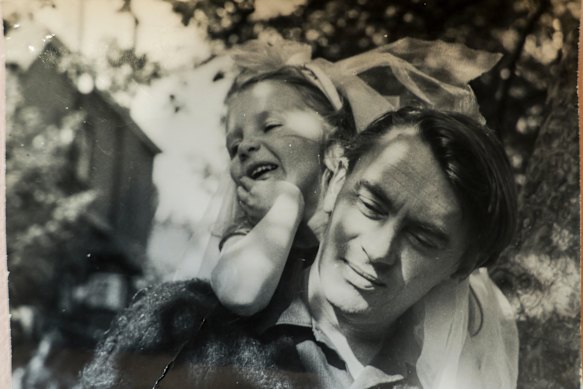
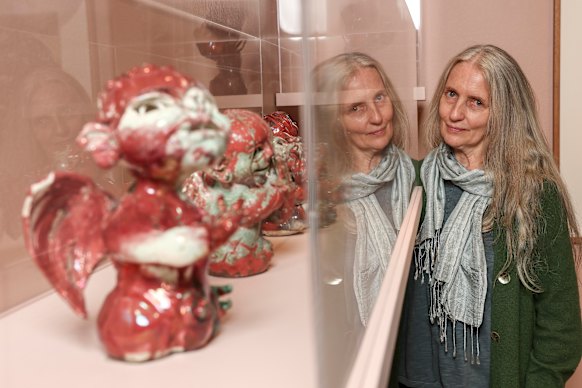
Wales-based Alice Perceval, youngest child of Perceval and Mary Boyd, is visiting Heide to see the show as it is installed: she is at once overjoyed and slightly overwhelmed.
“I am struck by what an extraordinary artist my father was,” she says, adding that while she’s always known that, seeing the works so beautifully restored, all together and in real life, is very moving.
An artist in her own right, Alice fondly recalls drawing and painting alongside her dad. He was very playful, not precious at all, and he loved children, she says.
“We used to draw this playful thing he called the Triantiwontigongolope [based on the CJ Dennis poem]. We would take it in turns to draw the wings. It was a sort of an insect with an angel-like face.”
Despite Perceval having a “lonely and sad” youth, according to Alice – his parents having divorced when he was very young – he was very playful as an adult. “I think that’s why he and Mirka Mora were such good friends because they really saw the inner child in each other. There was lots of mischief when those two were together.”
Two early self-portraits at the entrance to the show, created when Perceval was 14 and 15, are remarkably self-assured. Other pieces through to his early 20s reveal that while at times anxious and troubled, he was incredibly talented. “There’s something about my father that was just quite extraordinary, there was something that came from somewhere else, he was just like that from the beginning,” Alice says.
She imagines that when he was 18, meeting Arthur Boyd and then through him his sister, Mary, who would become Alice’s mother, “there was that nurturing, creative environment, like a feeling of homecoming in a way”.
As for Perceval inserting himself into his works, Alice says: “He’s superimposing himself as a child, and still there, like the witness and the commentator”.
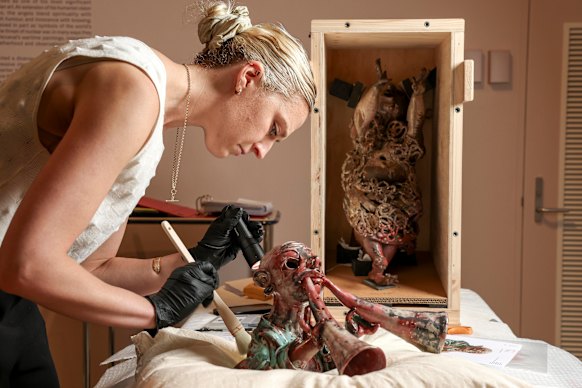
An impressive 25 of Perceval’s much-loved ceramic angels have been brought together for the exhibition, marking the first time they’ve been shown together at this scale.
Morgan sees them as “symbols of the world’s survival … even though they’re angels, and, of course, meant to be divine creatures, they’re very secular and they show every type of personality. You’ve got innocence and knowing, mischief and an idealistic, beautifully behaved one,” she says.
Created in the late 1950s, in part a response to the threat of nuclear war, the angels are regarded as one of Perceval’s most important contributions to Australian art.
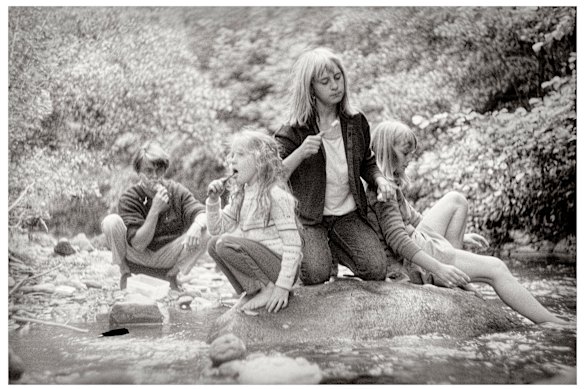
One is called Angel Winkie – Alice’s older sister, Celia’s nickname - and the mischievous face on another reminds her of a cheeky cousin.
As well as reflecting the full array of human behaviour, the angels are beautifully crafted, often with incredibly realistic childlike gestures, says Morgan pointing to one. “You know how babies do put their toes in their mouths ... and this one … [Figure of an Angel 1958] I think she’s sucking her thumb.”
Two rooms are dedicated to Perceval’s landscapes and seascapes. The latter features several from his renowned Williamstown series, capturing the docks, shipyards and waters of the seaside town.
The stunning landscapes show incredible technique. One features a leaf the artist stuck onto the picture, while Alice recalls another on which her Dad stuck a dead crab. She’s not sure what happened to it, but muses it may have gotten too smelly.
Prolific and inventive, Perceval also placed historical figures and events in a local context. In Christ Dining at Young and Jackson’s (1947–1948), he seats Christ and his disciples at the iconic pub opposite Flinders Street Station, complete with the once-infamous Chloe in the background, and a character who looks like Charlie Chaplin.
It’s typical of the maverick, self-taught artist whose work plays with big ideas.
While not religious in a formal sense, Perceval was committed to being a good person, says Alice. His work draws attention to those allegorical stories in the Bible that have a broader meaning for humanity.
For Morgan, it underlines part of Perceval’s enduring appeal: “He really pinpointed what it means to be human.”
John Perceval: All That We Are is at Heide Museum of Modern Art from March 21–July 12.