3 months ago
31
3 months ago
31
When Brian Wilson and Michael Love memorably issued an invitation to join The Beach Boys on a “surfin’ safari” around the world, Malibu made the itinerary; Munich, unsurprisingly, most certainly did not.
But in the years since the song was written back in the 1960s, Munich’s unlikely members of the board have become every bit as passionate as those of Malibu, even though the Bavarian capital is hundreds of kilometres from the nearest sea.
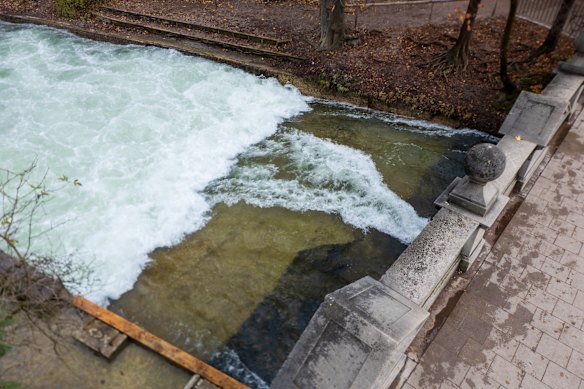
This unexpected turn of events has all been due to Eisbachwelle, or the “Eisbach wave”, a powerful torrent of water flowing along a section of the Eisbach canal at the edge of Munich’s Englischer Garten (English Garden) that proved the perfect aquatic venue for funf hangen (that’d be German for hanging five).
Unfortunately, the surf here has been down, not up, of late. For some still uncertain reason, the Eisbach Wave, which had become one of Munich’s major, if not most offbeat, tourist attractions, suddenly vanished late last yearafter a major clean-up of the river.
It’s meant that the essential wetsuits of Munich’s goofiest goofy-footers will remain dry until the city’s authorities determine how to restore it. So far, they have failed miserably, with the surfing community virtually losing interest.
Sign up for the Traveller Deals newsletter
Get exclusive travel deals delivered straight to your inbox. Sign up now.
Meanwhile, those once turbulent waters could well serve as a metaphor for Munich’s own tumultuous 20th-century history, something revealed in the tales of two of its vast public parks, including the remarkable English Garden, claimed to be the world’s biggest inner-city expanse of parkland.
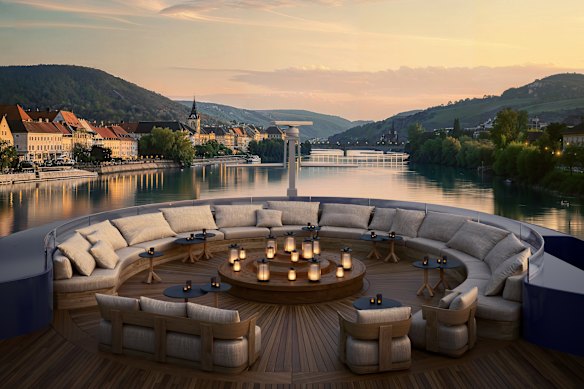
I’m in Germany for a cruise along the Rhine and Main Rivers aboard APT’s new and luxurious Ostara river ship, and have allowed time in Munich to explore both the English Garden and Olympiapark Munchen (Olympic Park Munich) with my day divided into two halves.
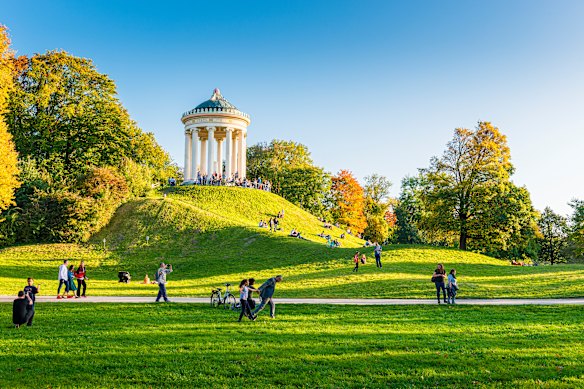
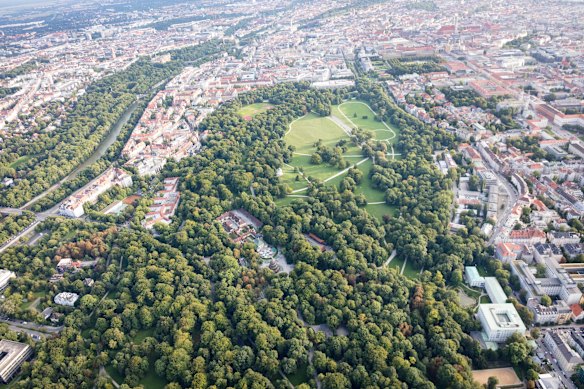
The English Garden, equivalent to about 640 soccer pitches, and the 85-square-kilometre Olympic Park, built for the ill-fated 1972 Summer Olympics, may belong to the same city, but they’re worlds apart in style and vintage, with the former conceived 200 years ago.
But, as I discover, despite both parks being oases of calm, they have also both seen tragedy and drama. The Englischer Garten, so named because it was designed in the style of an English landscape park, was created in 1792 by Benjamin Thompson, an American-born British military officer, as a people’s park for the then 40,000 citizens of Munich.
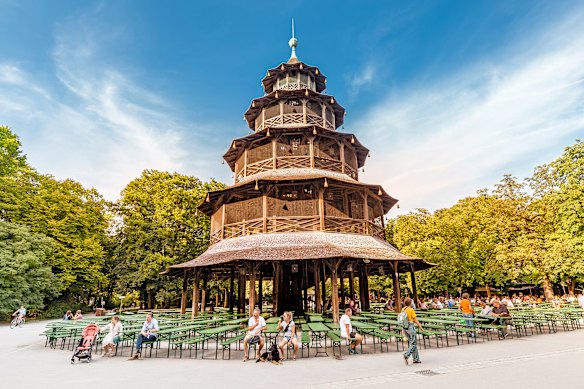
Surprisingly, the Nazis never changed the park’s name, even though it was bombed by the Allies during World War II, damaging one of its most distinctive, if eccentric, features, the Chinese Tower, a 25-metre timber pagoda folly. It was later rebuilt with a convivial tree-draped biergarten encircling it.
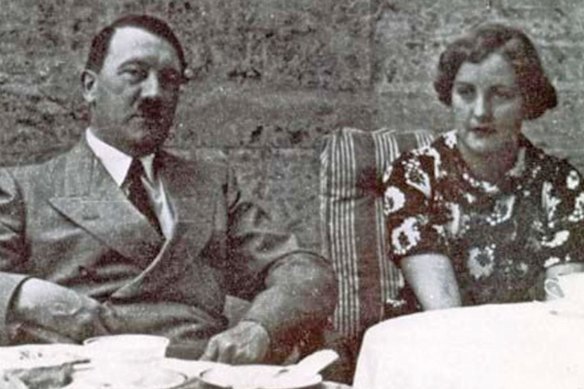
Even before the bombing of Munich by the Allies began, the English Garden was the scene of some drama. In 1939, the fascist Unity Mitford – a Munich resident and a member of Britain’s aristocratic and ultimately notorious Mitford sisters – shot herself in the head with a pearl-handed pistol within the confines of the park.
She’d moved to Germany from England after aligning herself politically with the Nazis. It was not long before she’d become a close friend of Adolf Hitler, if not (as widely rumoured) his mistress.
It was the news of Britain’s declaration of war on Germany – two nations she professed to love – that triggered her decision to kill herself.
Remarkably, she survived the gunshot, with the bullet lodging in her brain, leaving her with the equivalent mental age of a 10-year-old. She returned to England, with help from Hitler, and eventually died from her self-inflicted injuries in 1948.
It wasn’t until nearly three decades later that such violence revisited parks in Munich, and this time on a global scale. During the city’s hosting of the 1972 Summer Olympics, Munich was the scene, in echoes of a more recent outrage closer to home, of the murder of 11 members of the Israeli Olympic team taken captive by the Palestinian Black September terrorist group.
It forced the Games for the first, and since then last, time in Olympic history to be paused mid-way. It wasn’t until 2017 that a full and suitably sombre memorial for the Israeli victims of the attack, which also included the death of a West German police officer, was erected.
The memorial, Erinnerungsort Olympia-Attentat, or Place of Memory, is located in an easily overlooked, shaded area of Olympic Park, directly across from the athletes’ village where most of the agonising hostage crisis occurred. The village has survived intact to this day, serving as a residential estate for 6000 ordinary Munchner.
Inside this discreet memorial, a triangular column displays the biographies of the athletes, as well as the policeman who was also killed, with an imposing and wholly affecting multimedia display on rotation screening television footage aired during the crisis.
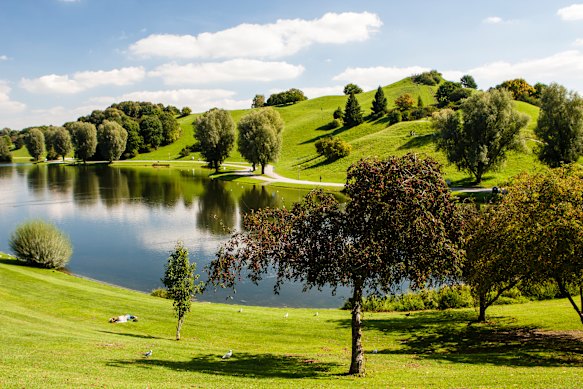
As you otherwise contentedly wander the green gorgeousness of both Olympic Park and the English Garden, these days – it should be stressed – typified by serenity not brutality, it’s difficult to conceive the dire events that occurred within both.
It wasn’t the last tragedy to bedevil the city of 1.6 million’s parks. The postwar peacefulness of the English Garden was again shattered in 2021 when four people were injured by the detonation of a World War II bomb that was discovered during construction work.
Despite such events, the English Garden is a largely underrated municipal marvel that transitions from a more formal park to a more wooded affair the further north you wander beyond the Chinese Tower. The grassed, open spaces of the gardens give over to idyllic forests, meadows and streams.
And this being Germany, it’s not uncommon to see park-goers in the warmer months sunbathing in the nude, even in the wide open.
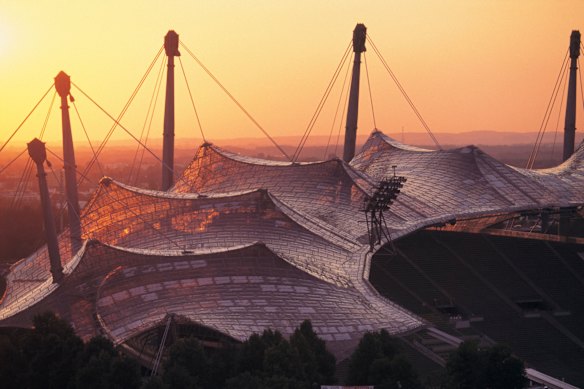
Meanwhile, at Olympic Park, less than a 10-minute taxi ride or half an hour or so by subway from the English Garden, Munchner treat the former Games site as much as a public playground as they do the English Garden.
While the park no longer hosts the city’s most important sporting events, the main Olympic stadium, with its translucent, big top-like Plexiglass roof, suspended by gigantic cables that extend all the way into its public approaches, remains an architectural marvel and one that is way ahead of its time when it was conceived in the mid-1960s.
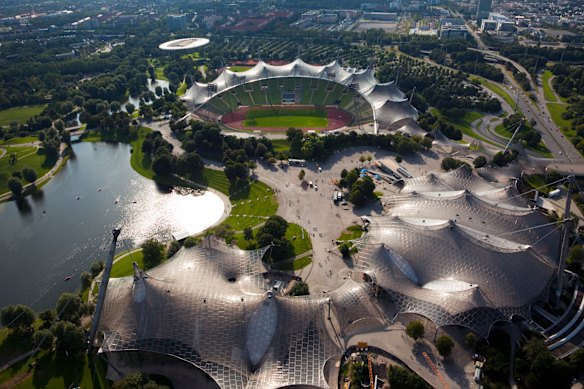
Indeed few, if any, major stadiums built since it was opened have been as ambitious or, for that matter, as lyrical. Strolling below these massive, undulating glass roofs of the main stadium – overlooked by park lands dominated by lofty grassed mounds meant to resemble alpine foothills – it is reminiscent of how those waves back at the English Garden once looked.
While Munich and the world will never forget the dramatic events that befell the city and its two great public parks at two ends of the 20th century, for Munich life goes on, as it must. Now all that remains is for the Bavarian capital’s beleaguered surfing community to again be able to leap, Malibu-style, atop a new and reinstated wave back at the Eisbach.
THE DETAILS
CRUISE
APT’s seven nights, eight-days “Highlights of the Rhine and Main” cruise, aboard Solara or Ostara, the cruise line’s two new river ships, between Amsterdam and Munich, from $4395 a person, not including flights. Phone 1300 336 932; see aptouring.com
STAY
Extend your cruise itinerary by staying a few nights in Munich. APT can organise hotels in the Bavarian capital as well as transfers from Nuremberg, where the cruise ends, with Munich about two-and-a-quarter hours away by road, or only an hour away by train, to the south.
FLY
Emirates flies direct to Dubai from Sydney and Melbourne with regular connections to and from Amsterdam and Munich. See emirates.com
VISIT
Entry to the main public areas of the English Garden and Olympic Park is free. See muenchen.de
The writer travelled as a guest of APT.