 3 months ago
44
3 months ago
44
Loading
The sight of Nick Daicos patrolling the members’ wing to start the second half on Saturday night was strange at the time, and by game’s end a genuine head scratcher.
In what proved to be the pivotal quarter of the night, Daicos was positioned away from where the game was being decided. He touched the ball just six times. Adelaide slammed on six goals. Game over.
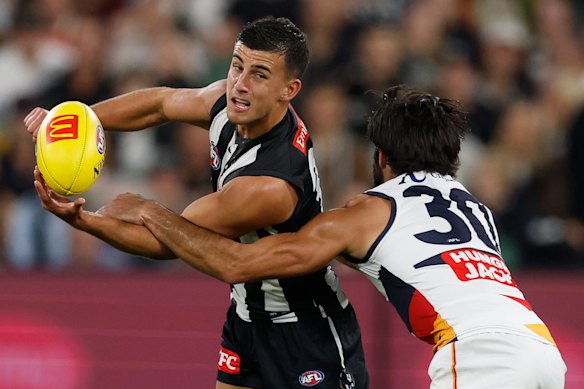
Wayne Milera pays close attention to Nick Daicos.Credit: AFL Photos
The new ruck rules have changed the game. Instead of the soft drop from wrestling rucks, there is now a greater hitting zone for the rucks who can run and jump at the ball.
This shift should, theoretically, favour nimble midfielders with fast feet like Daicos, who can zigzag in and out of the scrimmage into open space. Except Daicos was out of the hot zone, holding his width as is expected of the modern-day winger.
By the time he was in for his first centre bounce of the second half, the Crows had booted three goals in less than seven minutes and a margin that had been three points in the Pies’ favour just before half-time had stretched to nearly four goals.
Daicos’s 20 centre bounce attendances was the highest for Collingwood, barring ruckman Darcy Cameron, but it was those where he was absent that were most telling.
The Crows’ takeaways were pure, resulting in deep entries inside 50. Collingwood’s undermanned and undersized defence was powerless to divert the heavy traffic headed their way.

Craig McRae defended his use of superstar midfielder Nick Daicos against the Crows.Credit: Getty Images
Pies coach Craig McRae said Daicos’ removal from the centre square was part of the dealmaking that occurs at the initial throw-up, presumably when starting onballers flip and switch and an unguarded man is spat out of the wash. It did not work.
“That third quarter really shifted momentum, didn’t it?” McRae said. “And I’ve been watching the first couple of rounds, and momentum shifts pretty quickly in this game now.”
The Pies were smacked at centre clearance, beaten 16-9, and though it translated to only two goals from stoppage, the toll of the territory conceded was realised from the 11 goals they yielded on turnover.
“To be honest, our centre-bounce stuff, we put a lot of time into it,” McRae said. “We’ve got more work to do.”
The Crows did not apply a tag to Daicos. With 33 possessions and a game-high 790 metres gained, he was among the Pies’ best, just behind the rejuvenated Dan Houston, but was not a game breaker. Being on the wing, instead of the edge of the centre circle for the pivotal moments of the match, does not help.
Matthew Nicks let out a laugh when asked how he felt getting into the coaches’ box after half-time to see the positional switch for Daicos, who had been the most influential player on the ground in the first half.
The first few games of this season have shown how much damage can be done in a short time from the centre throw-up.
Loading
“The big change in the game at the moment is a little more speed, and in your onballers a little bit more agility and the ability to jump on a loose ground ball,” Nicks said. “The ball, because of this ruck rule, is getting more outside, rather than just, a bash and crash [style].
“We come out of there, and we can go forward and play, and it’s hard for the opposition then to get numbers behind the footy. It’s a key to the game. I think some of the teams that are winning convincingly at the moment have got a real weapon through that centre bounce area, or a number of them.”
Riley Thilthorpe did not have the field day expected of him against a backline missing Darcy Moore and Jeremy Howe but was the most dangerous forward on the ground, booting three goals.
Loading
Billy Frampton had the job at times on Thilthorpe, but there were periods where he was manned by Isaac Quaynor, a running defender giving up 21 centimetres to the Adelaide behemoth.
McRae is only “hopeful” Moore will be ready to face GWS on Friday week after experiencing hamstring “awareness” at training. Given his history of soft-tissue injuries, it may prove prudent to give him more time to recover.
For all their battles on the ball, the Pies generated more entries inside 50, but their forward line lacked bite.
Jamie Elliott did not touch the ball in the first half, and had just two possessions to three-quarter-time, but was a key to their late charge with two goals. Tim Membrey was equally ineffective in the first three quarters before the briefest of cameos in the final term. Dan McStay did not do much, either.
Membrey and McStay – the Pies’ two key forwards – have kicked just two goals in the first two rounds.
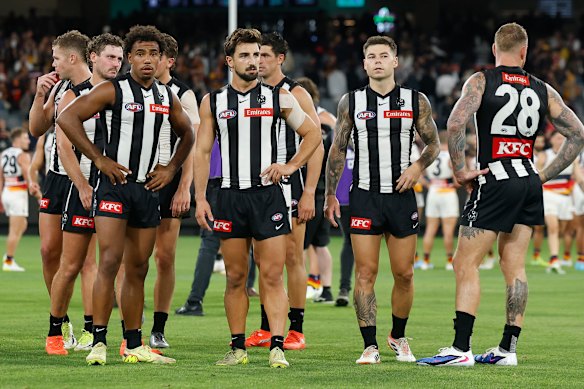
The Magpies look dejected after a rare MCG loss.Credit: AFL Photos
Unless they have midfield dominance, this will not be a forward line that will leave opposition defences quaking in their boots. They have produced two 11-goal returns in the first two rounds, while the perceived premiership fancies are kicking centuries.
“We’re not getting much out of our keys [key forwards], that’s real, I’m not going to shy away from that,” McRae said.
“We got work to do on that. I think there’s a connection breakdown at times. The second and the fourth quarter, we kicked nine goals of our 11 goals – then you say no [connection breakdown]. What about the last quarter? How’s that connection? I’d say pretty good.”
Keep up to date with the best AFL coverage in the country. Sign up for the Real Footy newsletter.
Most Viewed in Sport
Loading