 3 months ago
49
3 months ago
49
Set restarts increased 35% and divided the game. The NRL says they missed even more
The NRL has warned clubs to “expect a high focus” on ruck infringements after reviews that indicated several penalties were missed last weekend, despite a 35 per cent increase in set restarts across round one.
In the NRL’s weekly missive to coaches, head office warned that several areas of play will come under the microscope in round two, including ruck speed, contact on playmakers after passing and kicking and how and when captains approach referees.
The most notable finding is around the contentious policing of set restarts, which averaged eight per game across the NRL’s first round.
As one of four off-season rule changes, the awarding of set restarts has been widened to now apply from the attacking side’s 20-metre line for ruck breaches and defenders being offside.
The 64 “six-agains” across eight games made for a 35 per cent increase on last year’s average of 5.9 set restarts per game, and topped the 2021 average of 7.5 each game.
After that season of blowout scores and pointscoring records falling, the NRL wound back the application of set restarts, before widening their use again for this season.
Several periods of lopsided set restart counts throughout round one – most notably in Melbourne’s thrashing of Parramatta and the start of Canberra’s golden point win over Manly – drew criticism from wide quarters, but the NRL has informed coaches even more restarts should have been awarded.
“The referees have reviewed several slow rucks in R1 [round one] that, upon reflection, should have been a penalty or Set Restart depending on field position,” David Fairleigh, the NRL’s club relationship manager of elite officiating, wrote to coaches.
“You can expect a high focus in this area.”
Another section of the email subheaded “not clearing the ruck” read: “The referees reviewed defenders who did not clear the PTB [play-the-ball] area at the completion of the tackle, which wasn’t actioned and should have resulted in a Set Restart.”
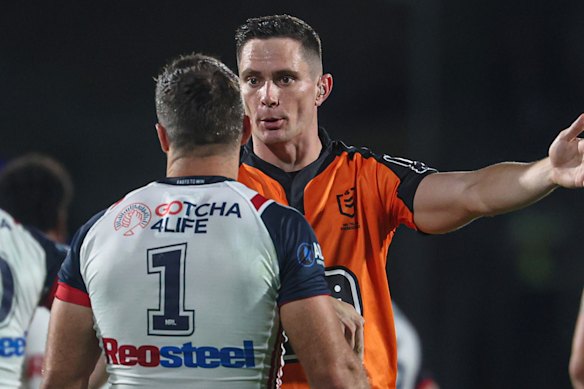
Roosters captain James Tedesco made regular enquiries with referee Wyatt Raymond on Friday night.Credit: NRL Imagery
The message from Fairleigh is not an indication of a crackdown given the NRL began sending weekly refereeing rundowns to coaches last season to improve communication with clubs, and most NRL mentors appreciate the feedback.
On set restarts though, greats of the game Andrew Johns, Laurie Daley and Brad Fittler were among those to question the influx of six-agains across round one. Round one’s average 20-point margin was the highest to an opening weekend since 2002 as multiple teams piled points on with runs of momentum and possession.
Queensland Origin coach Billy Slater argued on The Sunday Footy Show that it is up to clubs to adapt to the “standards of the game”, albeit while noting the inevitable teething issues when new rules are introduced.
“Some teams, they practice a certain way the whole off-season, then they get to round one and those interpretations are different to what they’d been practicing,” Slater said.
“They’ve got to move to the standard of the game… If you’re holding [ball carriers] down longer than that, it’s easy to give a six again against you… I watched all those infringements and they’re all warranted”.
Along with a renewed focus on ruck infringements, the NRL also flagged concern over how captains interacted with on-field referees.
Roosters skipper James Tedesco noticeably questioned several calls from referee Wyatt Raymond when his side was on the wrong end of an 11-4 penalty count in their heavy loss to the Warriors.
Loading
“In R1, some players approached the referee at the wrong time and repeatedly questioned the referee’s decisions,” Fairleigh wrote.
“There is an appropriate time for the Captain to speak with the referee. Please ensure that when the Captain speaks with the referee, it is to clarify the decision, not to dispute it.”
Contact on players after passing the ball was also highlighted in the memo, with the same “this will be a focus area” warning, after “there were several incidents in R1 where a half was contacted [late] after he had passed the ball and should have been penalised, but weren’t.”
Most Viewed in Sport
Loading