 3 months ago
21
3 months ago
21
Opinion
October 27, 2025 — 11.45am
October 27, 2025 — 11.45am
On Friday, Donald Trump said he would not go to Congress to seek approval for his “war” on drug cartels. “I think we’re just going to kill people that are bringing drugs into our country. OK? We’re going to kill them, you know, they’re going to be like, dead.” That same day, New York Attorney-General Letitia James pleaded not guilty in a case brought against her by Trump’s administration because Trump regards her as an enemy.
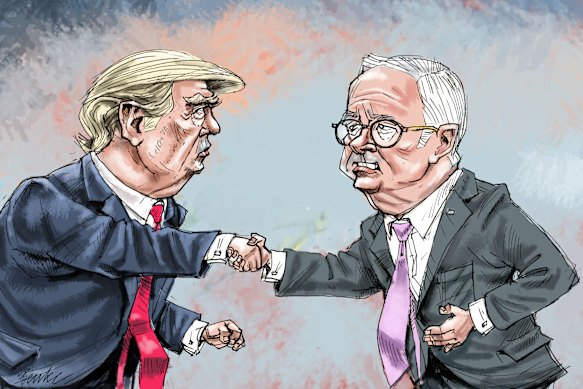
Illustration by Joe BenkeCredit:
A day earlier, former Trump adviser Steve Bannon told The Economist, “Trump is going to be president in ’28, and people ought to just get accommodated with that … At the appropriate time, we’ll lay out what the plan is, but there is a plan.”
The day before that, The New York Times outlined events from a recent teleconference of election officials. The new official in charge of election integrity at the Homeland Security Department “echo[ed] rhetoric that has infused the right-wing election activist movement that emerged since President Trump falsely claimed that his 2020 defeat was the result of widespread fraud”.
That was the end of the week. At its beginning, Anthony Albanese held what he described as an “incredibly successful meeting” with Donald Trump.
Is this jarring? Should it be? A few months ago, I wrote about the strange gap that had opened up in our national discussion of America. We seemed perfectly capable of discussing its slide into authoritarianism. Capable, too, of discussing AUKUS in fairly detailed terms. Oddly, though, the two discussions never seemed to meet.
Last week, that chasm seemed to grow even larger.
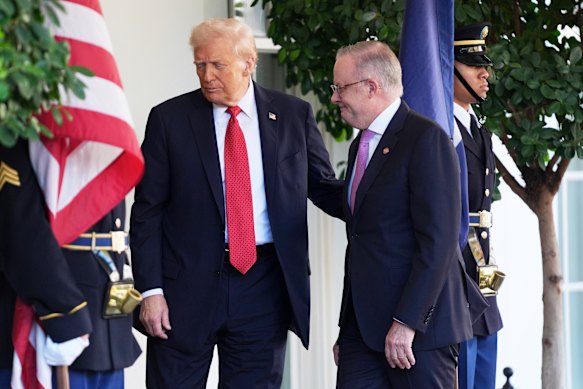
President Donald Trump (left) greets Australian Prime Minister Anthony Albanese at the White House on October 20. Credit: AP
There is always an argument that morality has little to do with the realpolitik of foreign affairs. Two years ago, at the National Press Club, Paul Keating was asked about China’s treatment of the Uighur minority. Keating said, “What if the Chinese said, ‘Look, what about the deaths in custody of Aboriginal people in your prison system?’ You know, wouldn’t that be a valid point for them? In other words, great power diplomacy cannot be about reaching down into the social entrails of these states any more than they can with us.” He went on to talk – reasonably enough – about India’s treatment of Muslims, and how little that seemed to figure in talk about our nation’s relationship with India.
What is new is that we are not used to considering American human rights abuses – or democratic failures – in the way we are those of other countries. This is partly wilful blindness. During the years of our alliance, America supported the ascension of the murderous Augusto Pinochet in Chile. It made a fraudulent case to justify invading Iraq. It pretended torture was acceptable.
I am reminded of the day after Trump’s first election. The world had not suddenly shifted overnight. It was only that most of us were, now, finally forced to realise how different it was from how we were accustomed to thinking about it. Australia has for many years argued that it shares values with the United States; that this is in part the basis for our alliance. Trump’s blatant approach is forcing us to ask whether that is still the case. But we could ask whether it has ever really been the case. Or, alternatively, whether our values are not exactly what we usually think they are.
Or to put this another way: we are now having to properly reckon with Keating’s point, and recognise that foreign affairs is transactional above all else.
Anthony Albanese clearly understands this.
Last week’s meeting has largely been interpreted through the disturbingly shallow test of whether Trump was nice to Albanese. The government, smartly enough, would have expected this. A similar thing happened to Kevin Rudd – in a different way – in 2008, when media attention was given to the question of just how much eye contact George W. Bush had made with Rudd, then prime minister. On this measure, Australia had a bumper week.
Of course, it is not the only metric – there was AUKUS and the critical minerals deal. Only time will tell how useful they are. But because of the success of the event, and because it is so recent, all attention right now is on the strength of the alliance.
We should not overlook Albanese’s other moves in recent months, though. As Shaun Carney has noted in these pages, Albanese has in other ways been distancing himself from America: through a stronger relationship with China, recognition of Palestinian statehood, and a refusal to meet America’s defence spending demands. And remember that Albanese’s incredibly warm welcome in China, three months ago, was at the time described as hugely significant.
Loading
The truth of the White House meeting is that everybody present won: three famous men managing to have their cake and eat it too. There was Albanese, having recently won an election effectively campaigning against Trump, now praised by Trump; and simultaneously pursuing parallel strategies with China and America. There was Kevin Rudd, who managed to strongly criticise Trump – in comments that land him on the right side of history – and then achieve everything his ambassador role demanded.
And, finally, there was Donald Trump, a man leading his country away from democracy while winning the embrace of democratic leaders such as Albanese.
Last week, Bruce Wolpe – who has been a congressional staffer and with whom I worked in Julia Gillard’s office – asked of Australia’s approach: “Is it enough just to manage Trump’s excesses day by day? ... What if the struggle for democracy and the soul of America fails in 2025, 2026 or 2027?” To which another question can be added: at what point, precisely, do we decide that the struggle for democracy in America has failed? How many dominoes must fall? We should hope wise heads in government are considering this right now. Otherwise, at some point, we might suddenly realise we have left it all too late.
Sean Kelly is author of The Game: A Portrait of Scott Morrison, a regular columnist and a former adviser to Julia Gillard and Kevin Rudd.
Most Viewed in Politics
Loading