 3 months ago
52
3 months ago
52
Kim Gordon is a woman of few words. But when those words hit – even in the form of a trivial packing list (“Hoodie, toothpaste, brush, foundation”) – they can cause a cultural rupture.
Two years ago, the then 70-year-old released Bye Bye, the lead single off her second solo album, The Collective, on which she listed the contents of her travel suitcase over a grinding trap beat. In a career filled with avant-garde excursions, it was Gordon’s most outlandish. While indie heads smiled knowingly, the rest of the internet lost its collective mind.
The song went viral across social media, including in some unexpected corners. On hip-hop Reddit, commenters marvelled that “a 70-year-old white lady is dropping some noise-rock rap that feels fresh, interesting, and isn’t completely wack”. On YouTube, music bros posted reaction videos where they went berserk over the track’s churning severity.
The song was embraced by a hip-hop crowd raised on the ear-sludging sounds of Playboi Carti’s Whole Lotta Red, and by a brain-rot generation who instantly connected with Gordon’s aloof, absurd spirit.
Now 72, Gordon – Sonic Youth’s bassist for 30 years from 1981 to 2011, until a sudden split from ex-husband Thurston Moore dissolved the project, a tumultuous experience she examined in her acclaimed memoir Girl in a Band – has a following of young people who weren’t even aware of her past as the coolest person in indie-rock. Did she anticipate any of this?
“Not really,” Gordon says, typically understated. “I mean, we knew it was kind of a banger, you know?”
I imagine that before The Collective, Gordon had a certain understanding of who her audience was – most likely, Gen X-ers in Sonic Youth T-shirts. How much has that changed?
“There’s a lot more young people, and lots of girls,” says Gordon. “But mostly, I don’t really like to look at the audience, or see them. It’s distracting. It’s kind of cool if you can just feel them in the dark. Being aware of the audience, that’s kind of the worst.”
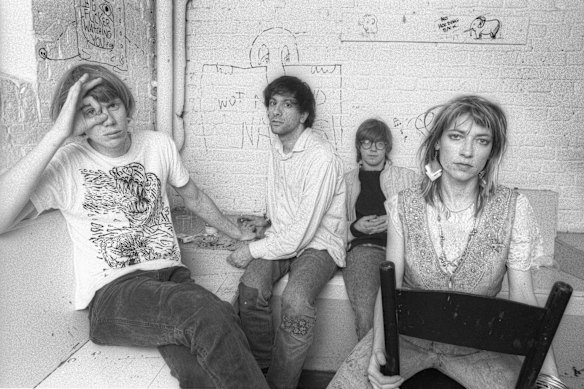
Speaking from her home in Los Angeles – her background’s blurred, but she’s wearing a simple cream button-up, her hair tied back high – Gordon’s just completed five lengthy interviews before mine, and now she’s rushing to make it to a birthday dinner for her three-year-old goddaughter. If not eager, she’s at least willing to discuss her new album Play Me, a spectacular continuation of the avant-rap dalliance she began on The Collective.
Tracks boom with stuttering dissonance and blown-out bass; dusty samples and guitar shards poke minor melodies through the debris. Gordon’s vocals are a spirited instrument: on the title track, she hazily slurs the names of Spotify playlists (“Neon Cowgirl … Villain Mode … Jazz in Background”) to deride our culture of algorithmically defined convenience. On the thrumming Nail Biter, she’s blurting ludicrous adlibs (“Squash! Squash!“) like she’s Young Thug.
“I don’t know anything about hip-hop,” says Gordon. “I mean, I know what I like and I always liked minimal rap. But my collaborator [producer Justin Raisen] likes to f--- with that world. Justin does a lot of work with rappers, and that’s his inspiration when working with me. In fact, the beat for Bye Bye, he made for Playboi Carti, but then he said, ‘No, this is too out there for him, let’s give it to Kim.’”
For someone with noise in their musical DNA (just go revisit Expressway to Yr Skull), it makes sense that Gordon would be inspired by today’s underground hip-hop, where dissonance is thriving via artists like Xaviersobased, OsamaSon and 2Slimey. The same thing happened to John Cale, architect of the Velvet Underground’s droning white noise, who’s now a hip-hop aficionado at 84.
“That’s interesting because Justin’s worked on some of his songs, too. He’s the one who brought John Cale in to work on that Charli XCX song [from Wuthering Heights],” says Gordon. “But usually in [hip-hop], the noise isn’t guitar-originated, so that’s the main difference between me and all that. Usually, when [rappers] want to do rock stuff, it’s always kind of corny.”
Gordon’s not new to the world of hip-hop. Chuck D featured on Kool Thing, Gordon’s infamous riposte to LL Cool J, after the pair became acquaintances in 1988 when Sonic Youth was making Daydream Nation at Manhattan’s Greene St Recording studios at the exact time that Public Enemy was making It Takes a Nation of Millions to Hold Us Back right next door.
Growing up in the ’90s, I remember those worlds being quite separate, even heated arguments on the bus when, as a 10-year-old, I tried to convince my classmates that Geto Boys were better than Nirvana. It was an era where you had to pick a side: were you hip-hop or rock?
“I have to say, the indie-rock world was pretty blind back then; they weren’t that aware of hip-hop,” says Gordon. “But we really only knew Public Enemy because we were working at the same studio. We didn’t, like, have dinner,” she laughs. “I knew Mike D [of the Beastie Boys] since they were like 15 when they were a hardcore band, but they were kind of an exception.”
Despite her pivot to ear-blaring beats, Gordon has never stopped playing guitar. Her textured, atonal squall is all over Play Me, including on the krautrock highlight Girl With a Look and the dreamy Not Today. She finds it interesting that – with the current breakout success of rock acts like Geese, Turnstile and Mk.gee, who even inspired Justin Bieber’s Swag – the instrument is making a comeback.
“Rock got pretty boring. Like, really boring. Like, dead,” she says. “But people do seem to be receptive to guitar music again.”
Why, after all these years, is dissonant guitar still her preferred mode of sonic expression? “Well, I play with an open tuning, and I just never properly learned how to play any instrument, and it’s just kind of good for improvising,” says Gordon. “Electricity is very influenced by movement, so it’s a visceral thing, and I think that’s always interesting to play with on stage, just moving around or in your relationship to your amp.“
For Play Me, Gordon re-recorded Bye Bye as a political anthem. It was another idea her producer Raisen borrowed from the hip-hop world, where remixes are common. While searching for a concept that’d match the original track’s viral list format, Gordon saw a news report noting the words Donald Trump had started banning from government platforms.
“It’s one of those things where it’s like, ‘Really, did that happen?’ But, you know, it really did,” says Gordon. The song finds her absurdly reciting “banned” terms like “climate change”, “Hispanic”, “transgender” and “measles”. “I just thought it was funny,” says Gordon. “I didn’t really set out to make it a political song, but that’s the way it ended up.”
The rest of the album’s funny, too. Much like her iconic cover of Robert Palmer’s Addicted to Love, Gordon has a knack for skewering macho posturing with withering cool. “Are you my white-collar service worker?” she coos breathily on Dirty Tech, a song that wags a pinky finger at the AI-conquering ambitions of Silicon Valley’s tech bros.
Her deadpan bite is also there on Bye Bye 25! in the way she pairs terms like “peanut allergy” and “abortion” to highlight the ludicrous totality of Trump’s attacks on “wokeness”. What kind of comedy does Gordon like?
“Oh, I’m so bad with names,” she says. “Back in the day, I used to like Louis CK a lot, his TV show. Most of the comics I like are sort of modern-day fools. Like in Elizabethan days, the fool was half-mad and half-wise; I like comedy that’s like that. Dave Chappelle, Maria Bamford. There’s a lot of funny people out there. But I don’t have enough comedy in my life.”
Gordon says the thing that most influenced this album was “the news”. She glances at The Guardian and The New York Times regularly each day, and she’s an avid watcher of the political show Breaking Points on YouTube, which pairs a left-wing host with a right-wing host, and anchor Ryan Grim’s other outlet, Drop Site. “But I’m mainly influenced by what’s happening in the world and popular culture. Like, how are men feeling, are they full of themselves yet?” Gordon laughs.
You may be aware that the news is not good. Much like her songs’ horrorcore beats, Gordon’s lyrical absurdity veers cataclysmic. On Subcon, she riffs on the prefix “sub” to highlight the lacking world we’ve inherited; on Post Empire, she riffs on the prefix “post” to denote that civilisation’s nearing its death rattle. Does she think of this album as end-times music?
“Yes,” says Gordon. “But in a joyous way, you know?”
Kim Gordon’s Play Me is out now.