
Responding to report Trump briefed on new attack plans, Iran commander says forces ready to impose "painful retaliation"
A senior Iranian military commander responded Friday to reports that President Trump has been briefed on plans for a potential new wave of strikes on Iran by warning that any new attack would be met with a "sustained, wide-ranging, and painful retaliation."
"We will respond to any enemy operation — whether it is a short, sudden strike or otherwise — with sustained, wide-ranging, and painful retaliation," Brigadier General Seyed Majid Moosavi, commander of the powerful Islamic Revolutionary Guard Corps' aerospace force, said in a statement posted on social media.
Axios reporter Barak Ravid reported that Mr. Trump was briefed for 45 minutes on Thursday by top military commanders on "new operational plans for potential strikes against Iran," citing two senior American officials.
He said previously that the options would include a wave of "short and powerful" strikes on Iran, including against infrastructure sites.
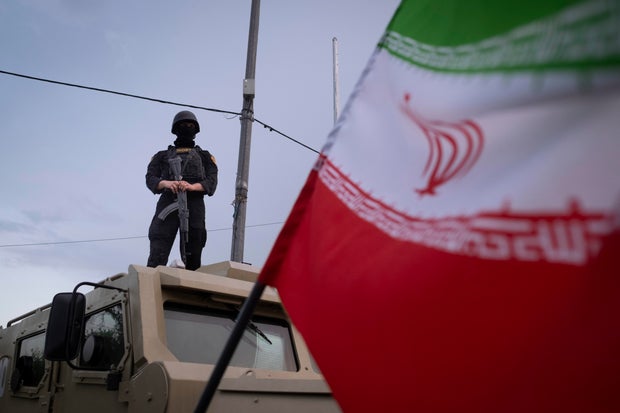 An armed Iranian police officer stands guard on an armored vehicle, monitoring the area during a state-run religious rally in downtown Tehran, Iran, April 29, 2026.
Morteza Nikoubazl/NurPhoto/Getty
An armed Iranian police officer stands guard on an armored vehicle, monitoring the area during a state-run religious rally in downtown Tehran, Iran, April 29, 2026.
Morteza Nikoubazl/NurPhoto/Getty
Neither the Pentagon nor the White House have confirmed the Axios reports. President Trump, speaking Thursday with Newsmax, again insisted the U.S. had "already won" the war with Iran, but he said: "I want to win by a bigger margin."
"We have to have guarantees they will never have a nuclear weapon," Mr. Trump said.
U.K. navy says "Hormuz stand-off," causing "strangulation of international trade" and threatening 20,000 seafarers
"Shipping traffic in the crucial Strait of Hormuz has dropped by more than 90% since the conflict in the Middle East began," the U.K. Royal Navy said in a statement on Friday, warning that the gridlock in the shipping lane was causing not only a "strangulation of international trade," but also a looming humanitarian crisis for the roughly 20,000 seafarers stuck on ships in the waterway.
"More than two dozen ships have been damaged or suffered casualties attempting to run the gauntlet into/out of the [Persian] Gulf," the Navy said, citing experts with the Navy-led U.K. Maritime Trade Operations (UKMTO) center, which monitors traffic in the region.
"With the world's gaze focused on the Strait of Hormuz, there is a warning of resurgent piracy off the coast of Somalia," the center warned.
"After intense periods in the late 00s/early 10s when Somali-based piracy was at its peak, and again at the end of 2023 when Houthi rebels in Yemen targeted Red Sea shipping, traffic in the Middle East's sea lanes had resumed some form of normality."
The U.S.-Israeli war with Iran has ended that period of normality, and in addition to the attacks on and ongoing threat to ships in the Persian Gulf and Strait of Hormuz, Iran has threatened at least three times to have its Houthi allies again attack ships to limit access to the Red Sea via the Bab el-Mandeb strait.
U.S. urges Lebanon to cement a peace deal with Israel, says "time for hesitation is over"
The U.S. Embassy in Beirut has called on Lebanon's government to further its engagement with Israel - and tacitly, to sideline the Iranian-backed group Hezbollah which, while designated a terrorist organization by the U.S. and Israel, has been a massive force in Lebanese politics for decades.
"Lebanon stands at a crossroads. Its people have a historic opportunity to reclaim their country and shape their future as a truly sovereign, independent nation," the embassy said in a social media post on Thursday, warning the "time for hesitation is over."
The post did not refer directly to Hezbollah, but said Lebanon should have "never been at war" with neighboring Israel. Hezbollah dragged Lebanon into the regional conflict by launching attacks on northern Israeli communities in retaliation for the U.S.-Israeli strikes on Iran that began on Feb. 28.
Israel responded with overwhelming force, opening a new offensive against Hezbollah with a blistering campaign of airstrikes across the country, and later an ongoing ground invasion in the south of Lebanon that authorities say has killed almost 2,590 people and displaced more than a million. Israeli leaders have said forces will continue to occupy a buffer zone across southern Lebanon, from which residents have been forced to evacuate, indefinitely, until the Hezbollah threat is removed.
Hezbollah and Israel have accused each other of near daily violations of a ceasefire the Trump administration brokered between the Israeli and Lebanese governments, which has been extended until mid-May.
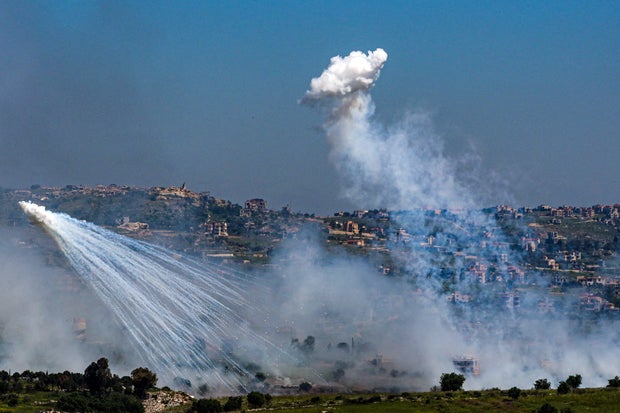 An explosion of what appears to be white phosphorus fired by the Israeli military is seen on the Lebanese side of the Israel-Lebanon border, as seen from the Israel, April 30, 2026.
AYAL MARGOLIN/REUTERS
An explosion of what appears to be white phosphorus fired by the Israeli military is seen on the Lebanese side of the Israel-Lebanon border, as seen from the Israel, April 30, 2026.
AYAL MARGOLIN/REUTERS
The U.S. embassy said Thursday that "a direct meeting between [Lebanon's] President Aoun and Prime Minister Netanyahu, facilitated by President Trump, would give Lebanon the chance to secure concrete guarantees on full sovereignty, territorial integrity, secure borders, humanitarian and reconstruction support, and the complete restoration of Lebanese state authority over every inch of its territory — guaranteed by the United States."
"This is Lebanon's moment to decide its own destiny, one which belongs to all its people. The United States is ready to stand with Lebanon as it seizes this opportunity with confidence and wisdom," it said. "The time for hesitation is over."
Lebanon's Prime Minister Dr. Nawaf Salam met Friday with U.S. Ambassador Michel Issa at his office in Beirut, for "discussions focused on consolidating the ceasefire and on talks related to negotiations with Israel," Salam's office said in a brief statement.
Gas prices continue to soar as Strait of Hormuz gridlock keeps oil prices high
The war keeps costing American motorists more at the pump, with the average price of gas hitting $4.39 a gallon early Friday, according to AAA. That's up a steep nine cents from Thursday and 34 cents from just a week ago.
Crude oil shipments have been severely curtailed by the vital Strait of Hormuz remaining all but closed due to Iran's threats to shipping, which it has refused to lift while the U.S. blockade of its ports and vessels remains in place.
Global oil prices are a significant factor behind the prices Americans pay at the pump, and the tanker gridlock in the strait combined with a lack of any imminent sign of a diplomatic resolution to the war helped push the price of international benchmark Brent crude briefly over $126 a barrel on Thursday.
Brent was trading early Friday at just over $111 a barrel. Before the war began in late February, it was trading around $70 per barrel.
As Iran war nears key 60-day deadline, Congress and Trump face choices on next steps
President Trump faces a key deadline in the war with Iran on Friday under a decades-old law that limits the use of force without authorization from Congress.
The War Powers Resolution of 1973 lays out a timeline for when lawmakers must be notified of hostilities and when a president is required to withdraw American forces from a conflict in the absence of congressional authorization.
Under the law, the president is required to give formal notification to Congress within 48 hours of introducing American forces into hostilities, which officially begins a 60-day clock for the president to terminate the use of force unless Congress has declared war or authorized the use of military force.
Defense Secretary Pete Hegseth, testifying before the Senate Armed Services Committee Thursday, expressed doubt that the 60-day window was closing this week. "We are in a ceasefire right now, which in our understanding means the 60-day clock pauses or stops in a ceasefire," he said.
Trump says if U.S. left Iran right now it would "take them 20 years to rebuild"
In an interview with Newsmax's Greta Van Susteren, President Trump again proclaimed "We've already won" the war in Iran but said he wants to "win by a bigger margin."
Mr. Trump said Iran's navy and air force have been destroyed, along with the country's leadership, claims the administration has been making since very early in the war.
But multiple U.S. officials with knowledge of intelligence on the matter told CBS News last week that Iran maintains more military capabilities than the White House or Pentagon has publicly admitted.
About half of Iran's stockpile of ballistic missiles and its associated launch systems were still intact as of the start of the ceasefire in early April, three of the officials told CBS News.
"We've destroyed everything. If we leave right now, it would take them 20 years to rebuild if they ever could rebuild," Mr. Trump said Thursday, but added it's "not good enough."
"We have to have guarantees they will never have a nuclear weapon," Mr. Trump said.
UAE bans citizens from traveling to Iran, Lebanon and Iraq
The United Arab Emirates' Foreign Ministry announced Thursday it was banning citizens from traveling to Iran, Lebanon and Iraq "in light of the current developments in the region."
The ministry also urged "all citizens present in these countries to depart quickly and return to the United Arab Emirates at the earliest opportunity."

















































