 3 months ago
30
3 months ago
30
As I step into Melbourne’s famed Bakehouse Studios, where 64 teenagers are participating in the groundbreaking Rock Academy program, I can’t shake the feeling that something isn’t right. There’s no sign of discontent among the group: some are jamming in rehearsal rooms, others refining songs they’ve co-written with peers, while a few take a well-earned break in the lush, plant-filled courtyard.
Then it hits me: not a single young person is using their phone. I’m even more astonished to learn there is no official phone ban – these kids are simply choosing real human connection over screen-mediated interactions.
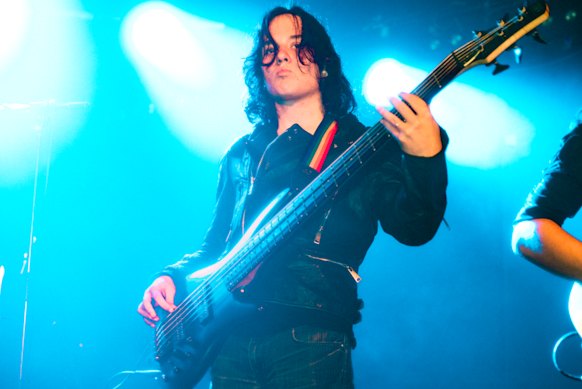
“I think it’s because people are so invested in the creative side of things,” says Isaac Wicklein, who has been a regular Rock Academy attendee over the past six years. “But I’ve learned a whole bunch of life skills as well, like how to connect with people, make friends and maintain conversations, because I’ve kind of struggled with those things.”
As Wicklein talks, several other teens nod along. Some confess to being so nervous before their first Rock Academy – presuming they’d be sneered at by a bunch of uber-cool musicians – that they almost quit before they started. Others say it’s given them the confidence to find part-time jobs, or to attend parties instead of confining themselves to their bedrooms on weekends. Those who were branded as “weird” at school almost cry when explaining the sense of finding their tribe; as one girl puts it: “This place feels like home.” They speak of finding their voice, figuratively and literally. Nearly all describe the experience as life-changing.
“We’re not these kids’ parents. We treat them like adults and expect them to act accordingly – and generally, they do.”
Rock Academy co-founder Alan LongPerhaps Rock Academy, founded by musicians Alan Long and Phil Ceberano in 2015, is best described by explaining what it’s not. For a start, it’s nothing like School of Rock, the zany 2003 comedy film starring Jack Black. Nor is it a traditional music program, where students learn scales on a piano or where to place their fingers on a guitar. There are no “battle of the bands”-style contests in which uniform-clad pupils compete for trophies in stuffy school auditoriums. And participants can return as many times as they like, as long as they’re of high school age – many of those I spoke to have attended more than 20 times over the years, with some who are now adults returning as mentors.
“We assume they’ve already got a music teacher showing them how to play their instrument,” Long says. “When the kids are writing their original songs, we might show them how to build in dynamics: making it faster or slower, or louder or quieter, so they can learn to build attention and then hold or release it.”
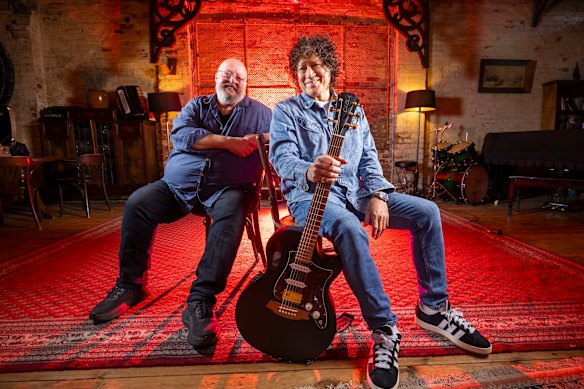
Like Long, Ceberano has been in the music game for decades. Over the years he’s worked as a guitarist, producer, songwriter and composer – and has learned, through personal experience, the many ways in which things can go wrong.
“I love showing the kids how showbiz works, and giving them the understanding that the show must go on,” he says. “Maybe you get up on stage and the PA doesn’t work, or the guitar lead gets unplugged, or you forget the words to your song. We want them to appreciate that these things are perfectly normal; the important thing is that you learn to just pivot and roll with it.”
I see what he means as I observe a rehearsal in the Bakehouse’s eclectically-decorated Scrap Museum room, where the likes of Paul Kelly, Archie Roach and Tones and I have performed. As one group of teens, wearing Nirvana and Metallica T-shirts, launches into a song, a guitarist accidentally yanks his lead out by stepping on it. Minami Deguchi – who participated in seven Rock Academy programs as a teen before being appointed stage manager as an adult – shows the boy how to thread his lead through his guitar strap, preventing future mishaps. He also demonstrates how to enter and exit the stage; how each musician should pick up their instrument; and how to avoid ear-splitting feedback.
Ceberano then explains how to adjust the height of a microphone; a task that seems deceptively simple to novices. “Make sure you don’t move it towards your face too fast or you’ll break a tooth,” he says. “I’ve done that before.”
When those awaiting their turn start talking, a simple “Oi!” from Long silences the chatter.
“We have three rules here,” Long says. “Rule number one is, ‘Don’t be a dickhead’. Rule two is, ‘Treat this venue like it’s your grandma’s place, because you’d never trash her house’. And the third rule is, ‘If you have any issues with the first two rules, refer to rule one’.”
During each Rock Academy program, participants are split into bands and tasked with picking and rehearsing a cover song. There are no adults telling them what to do; it’s up to each group to figure it out themselves.
“It can be intense,” says Owen Perks, who has done Rock Academy 18 times. “But the fact is you just have to learn how to do it because we know we have to play a gig at the end of the week. It teaches you things like compromise and conflict resolution, and those are skills that have helped me in my life.”
There are songwriting workshops, often helmed by Ceberano, which inspire attendees to compose an original tune as a group – providing another opportunity to practice balancing assertiveness with teamwork. (They are regularly shuffled into different teams, allowing them to work with each of their peers at some point.) These are followed by instrument workshops, then a final stage rehearsal.
While the mentors play a crucial role, they’re instructed not to give explicit directions; instead, they might say: “I’ve been in this situation before; have you considered approaching it this way?”
“We’re not these kids’ parents,” Long says. “We treat them like adults and expect them to act accordingly – and generally, they do.”
All of this culminates in a Saturday afternoon gig at an iconic venue such as The Prince of Wales Bandroom or The Esplanade Hotel. The alcohol-free events are ticketed and attract friends, family members and local music fans. Sometimes, the audience exceeds 400 people.
When I ask the teens how they feel after playing these gigs, they begin talking over the top of each other. “It’s the most amazing feeling in the world,” says one. “I know everyone says this, but it really does put you on a high,” says another. “I was so emotional that I burst into tears, but in a totally good way,” adds a third.

Mila Henning, a talented vocalist, admits to being crippled by nerves on her first day at Rock Academy.
“I was surrounded by so many interesting people and I felt like I wasn’t interesting enough – but everyone was so welcoming and friendly,” she says. “It didn’t matter how old you were or how much experience you had; everyone treated each other as equals.
“In this generation, it’s hard to make friends. But since I came to Rock Academy, I’m always growing and changing as a person, and it’s made me more mature and independent. When you learn about other people, it actually helps you learn about yourself.”