
 5 months ago
89
5 months ago
89
25 minutes ago
Greg BrosnanBBC Climate and Science team

 NASA
NASA
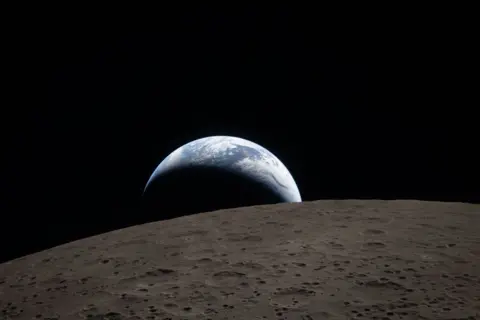
'Earthrise'
Nasa has released the first photographs taken by the Artemis II astronauts during their fly-by of the Moon.
The first image, above, shows an 'Earthset' as the astronauts glimpsed our home planet peeking out beyond a cratered lunar landscape.
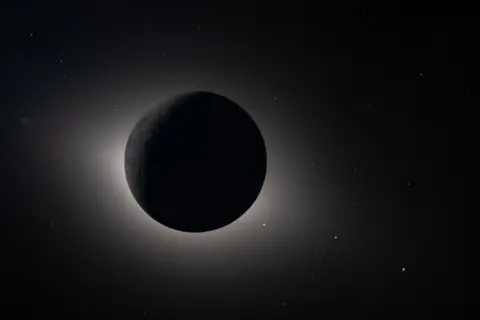
The second photograph, below, shows the spectacular solar eclipse to which the astronauts were treated as the Moon blocked out the Sun.
Nasa did not say which of the astronauts, who are on their return journey to Earth after the fly-by, took the photographs.
 NASA
NASA
The solar eclipse which the astronauts witnessed, with the Moon blocking out the Sun
The Earthset photo carried echoes of the famous Earthrise photograph taken by Bill Anders aboard Apollo 8 in 1968 in the moon fly-by that preceded the historic first human landing the following year.
The astronauts took the photos during a six-hour flyby, including a period of radio silence when their capsule was behind the Moon.
Nasa said in its description that the Earthrise photograph was captured through the Orion spacecraft window at 18:41Eastern Daylight Time (2341BST) on Monday.
"The dark portion of Earth is experiencing nighttime. On Earth's day side, swirling clouds are visible over the Australia and Oceania region," Nasa said.
"In the foreground, Ohm crater has terraced edges and a flat floor interrupted by central peaks. Central peaks form in complex craters when the lunar surface, liquefied on impact, splashes upwards during the crater's formation.'
 NASA
NASA
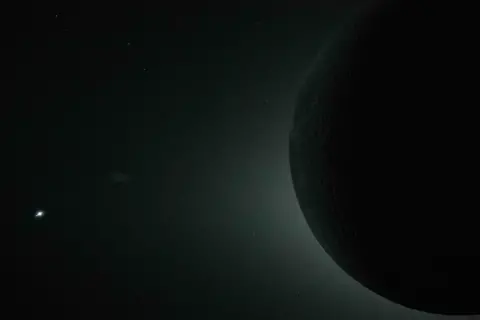
The glow of the Sun's corona was visible around the Moon's edge during the eclipse, along with Venus in the bottom left corner of this picture
For the astronauts, seeing a lunar eclipse as the Moon blocked out the Sun was a highlight, even on this extraordinary trip.
In the photo above, the Sun's corona can be seen around the Moon's edge. Solar eclipses are fleetingly brief when seen from Earth, but because of Orion's proximity to the Moon, the astronauts enjoyed nearly 54 minutes of totality, Nasa said.
The bright spot to the left of the frame is Venus.
Victor Glover described the eclipse as "sci-fi" and "unreal", also describing the view of the corona of the Sun.
"This continues to be unreal," he said. "The Sun has gone behind the Moon and the corona is still visible, and it's bright and creates a halo almost around the entire moon.
"The Earth is so bright out there and the Moon is just hanging in front of us."
 NASA
NASA
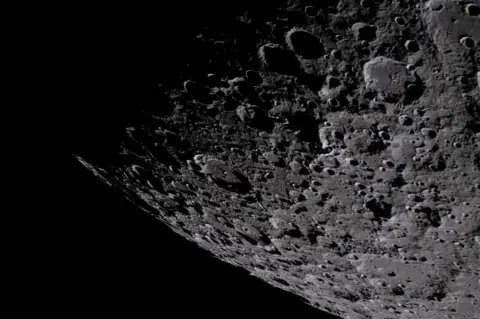
Nasa called this picture of the lunar surface 'Ready for a close up'
While satellite photographs have been taken of the Moon's far side in the nearly five decades since the last human landing in 1972, Nasa said that the astronauts seeing it with their own eyes during the flyby was invaluable.
The crew recorded audio descriptions of what they were seeing, and Nasa's scientists will be poring over these notes for new information.
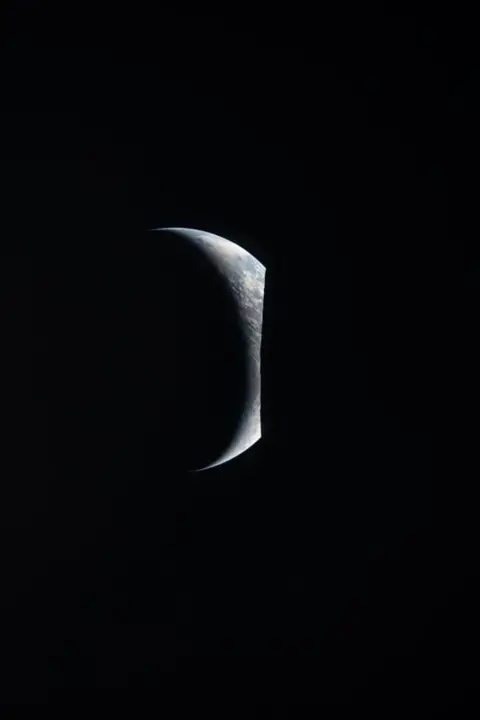
The following photograph shows Earthrise as our planet came back into the astronauts' view after their time behind the Moon.
 NASA
NASA
Earthrise as photographed by the Orion crew

















































