When Eric Dillon started feeling pain in his shoulder, he chalked it up to a strained rotator cuff.
A visit to an orthopedic doctor seemed to confirm it. Physical therapy and stretching helped. For the most part, the pain faded. Over the next two years, he'd feel the occasional discomfort, but changing his sleep position or reducing his activity level would fix it.
The aches became a part of daily life, but then he felt a burst of "tremendous pain" while doing yard work at his Houston home in May 2024. Dillon went back to the orthopedist. An MRI showed something concerning. Dillon was referred to an oncologist, having "no idea" what that would entail.
"I walked in, and she was like, 'You know why you're here?' I was like, 'I've got a referral from another doctor to see you,'" Dillon remembered. "She was like, 'I'm an orthopedic oncologist ... I do cancer.' I was like, 'Wait, what?'"
Tests confirmed that Dillon had multiple myeloma, a form of blood cancer. Within minutes, Dillon's wife had made him an appointment at MD Anderson Cancer Center in Houston, Texas. The couple met with doctors there days later. New tests confirmed the diagnosis and led to a treatment plan. Dillon was surprised to learn that his pain had been an early warning sign.
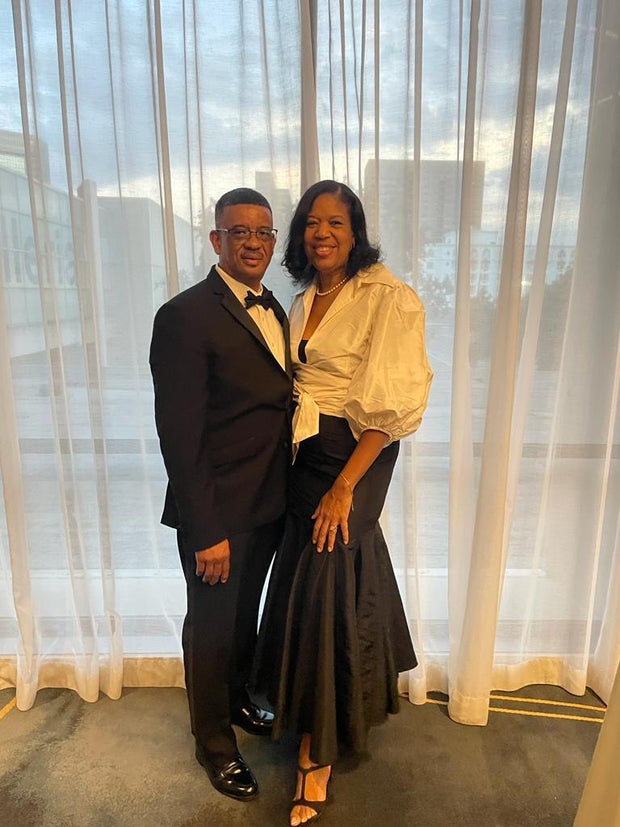 Eric Dillon and his wife.
Eric Dillon
Eric Dillon and his wife.
Eric Dillon
What is multiple myeloma?
Multiple myeloma is a cancer that affects plasma cells, said Dr. Hearn Cho, an oncologist and the chief medical officer of the Multiple Myeloma Research Foundation, who did not treat Dillon. The cancerous cells can impair normal blood formation, causing anemia, kidney damage and increased calcium levels. The disease can also damage the hard part of the bone. That was what was causing Dillon's shoulder pain. Cho said it's not unusual for multiple myeloma to be misdiagnosed as an injury.
"The bones of the spinal column are often involved in myeloma, and so that causes back pain. But back pain is probably the number one or number two most common complaint in general medicine. So going to your internist and saying 'My back hurts,' the first thing in their mind is not multiple myeloma. It's musculoskeletal back pain, it's arthritis, muscle strain. They'll say take some anti-inflammatories, ice your shoulder, do physical therapy, because common things are common," Cho said. "It can be very difficult to make the diagnosis, and can take a long time."
Dillon was shocked by his diagnosis — but he was familiar with the disease. His cousin had been treated for it in the early 2000s, and an old friend from college had recently been diagnosed with it. Soon, he learned that Black Americans are disproportionately affected by the condition.
"Even though Black people are about 4% of the U.S. population, they're about 20% of multiple myeloma patients," Cho said. Black patients also tend to develop the disease at an earlier age, Cho said.
Treating multiple myeloma
Dillon was eager to begin treatment. Having a plan reassured him, he explained. And shortly after starting treatment, his doctors offered him the chance to join a clinical trial. He signed up with "no hesitation."
"Being in a clinical trial, to me, was a plus. It made me feel a lot better. It gave me a little more control and more understanding of what was going on," Dillon said. He also wanted to do what he could to make clinical trials more equitable: Cho said that Black patients are historically underrepresented in clinical trials. That pattern holds in multiple myeloma research, despite the disproportionate level of the disease in Black communities.
Dillon underwent eight cycles of the treatment over nearly a year. He rearranged his work schedule to ensure he could juggle the trial and his career as an engineering consultant. He also kept a daily journal detailing the process. At one point, he had minor side effects that led his care team to adjust his dosage of the trial drugs. Dillon said he was proud to have helped refine the trial.
"From that point forward, everything seems to have gone well. There were no major side effects, no major impacts, anything else from it," Dillon said.
After completing the clinical trial, some cancer remained in Dillon's shoulder bone. It was eliminated after several additional rounds of radiation. With that treatment, the pain in his shoulder finally went away.
"It was just tremendous to be pain-free and moving forward," Dillon said. "Now, everything is beautiful."
"The future is bright"
Today, Dillon is in remission. He regularly has appointments with his oncologist to ensure the cancer has not returned, and takes one daily medication to maintain his status. In the future, he may undergo a stem cell replacement, but he is not interested in the procedure right now because it involves months of isolation. Instead, he's focused on celebrating his new grandchild and spending time with loved ones.
"It's just spending more time with the family, enjoying the family," Dillon said.
 Eric Dillon and his family.
Eric Dillon
Eric Dillon and his family.
Eric Dillon
Dillon also wants to continue raising awareness of multiple myeloma's unusual symptoms, and the tools that exist to help speed diagnoses. He has been working with the Multiple Myeloma Research Foundation, and is working on getting his friend who was diagnosed around the same time as him to participate as well. He said he also wants people to know what clinical trials or research options are available to them.
"This is not one of those cancers that there's no treatment for," Dillon said. "The future is bright. The opportunities are bright."
Edited by Nicole Brown Chau
In: